Aluminium value chain tracking: Multi-modal logistics approach of bagged alumina imports amid Hormuz crisis
GCC alumina climbed to 0.56Mt in May, driven by a multi-modal logistics approach of bagged alumina imports. The approach is costly but remains workable amid elevated aluminium prices. Even if shipping via the Strait of Hormuz resumes in June, alumina and bauxite imports are unlikely to rebound to pre-war levels immediately, as halted smelting and refining capacity cannot be brought back online soon.
High aluminium and low alumina prices sustain costly bagged alumina imports into the GCC
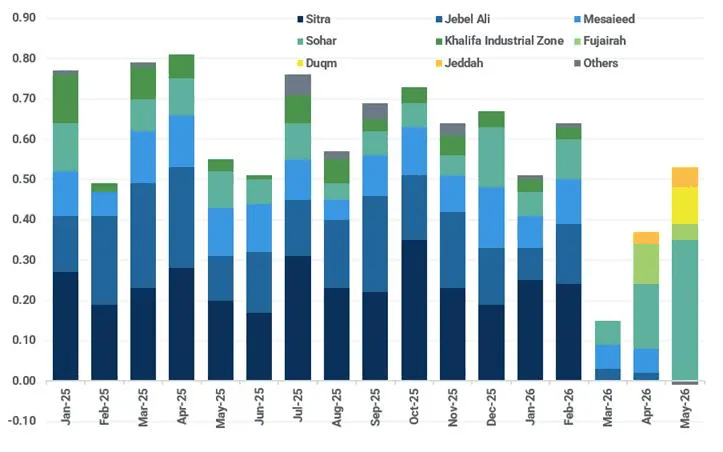
Seaborne alumina imports into GCC countries, excluding intra-regional flows, rose to 0.52Mt in May, recovering significantly from March and April levels, although still below the previous five-year average. With the Strait of Hormuz remaining effectively closed, Gulf aluminium producers are increasingly adapting to the status quo through costly but workable alternative alumina supply routes: importing bagged alumina through ports outside the Strait, primarily Sohar, Duqm and Fujairah, before distributing material via trucking and intra-GCC shipments.
GCC alumina imports by destination ports (Mt)
Source: Kpler
Based on our assessments, around 0.44Mt of alumina is estimated to have ultimately reached smelters in the Gulf in May, namely Bahrain’s Alba, Qatar’s Qatalum and the UAE’s Al Taweelah, after adjusting for Oman’s Sohar smelter's typical import requirements prior to the conflict. The adjustment uses 0.52 Mt to deduct 0.08 Mt, which is the 12-month average of imports by the Sohar aluminium smelter before the US/Israel-Iran war broke out.
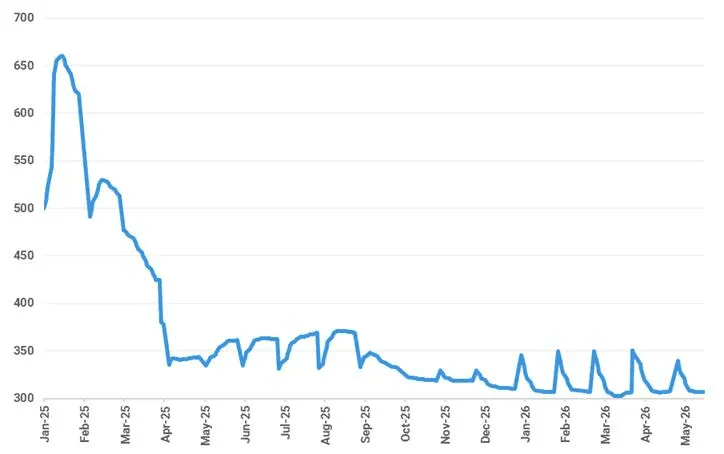
However, this alternative supply chain comes at a considerable cost. At least 0.22Mt of the imported alumina was suspected to have been bagged in China, though originally sourced from Australia and Indonesia, adding further logistical complexity. Preliminary estimates suggest that combined freight, handling, re-export, and trucking costs range from $100-160/t for these cargoes, representing a significant share of the FOB Australia alumina price, which has traded between $300-350/t since late 2025.
FOB Australia alumina price ($/t)
Source: MarketView, Kpler Insight
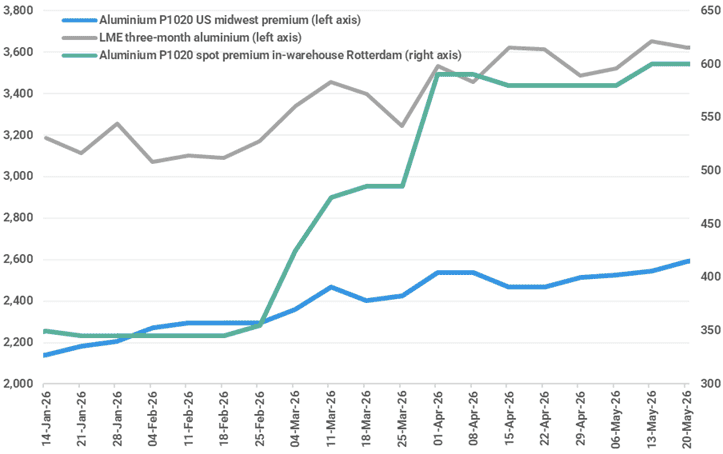
What makes these arrangements economically sustainable is the strength of aluminium prices. The three-month LME aluminium contract reached a fresh four-year high of $3,672.50/t on 26 May, while regional premiums in the US, Europe and Asia climbed to record levels. Elevated margins, driven by elevated prices, are effectively allowing Gulf smelters to absorb sharply higher input and transport costs.
LME aluminium, US Midwest premium and Rotterdam premium ($/t)
Source: MarketView, Argus, Kpler Insight
Alba’s latest results underline this dynamic. The company reported 312,563 tonnes of aluminium sales (-17% y/y) and $336 million of EBITDA (+90% y/y) for Q1 2026. With the average LME price so far in Q2 ($3,565/t) running 11.50% above the Q1 level ($3,198/t), profitability per tonne is expected to remain robust despite higher logistics costs, rising gas prices, lower operating efficiency and the dilution of fixed costs across reduced output.
Hormuz reopening unlikely to deliver immediate recovery for alumina and bauxite imports
Prospects for a reopening of the Strait of Hormuz are improving, with reports suggesting that Washington and Tehran could restore full maritime traffic within weeks if a broader ceasefire agreement is reached. However, even if shipping routes reopen in June, the full recovery of alumina and bauxite imports via Hormuz is unlikely to be immediate, as partially or fully suspended smelting and refining capacity across the Gulf will require time to restart.
According to the International Aluminium Institute (IAI), GCC countries produced 0.33Mt of primary aluminium in April. Given the region’s installed smelting capacity of 6.23Mtpa, equivalent to around 0.52Mt per month, this implies an operating utilisation rate of approximately 64%, sharply below the 97–98% levels recorded a year earlier. The decline has been driven primarily by disruptions at Alba, Qatalum and EGA’s Al Taweelah smelter, all of which have partially or fully curtailed output following the closure of Hormuz and subsequent Iranian attacks.
GCC smelters and their implied utilisation rate in April (Mt)

Source: Companies’ results, IAI, Kpler Insight

See why the most successful traders and shipping experts use Kpler