Bucking the trend: Why China is still building stocks amid global supply disruptions
While Middle East conflicts have forced a global inventory drawdown to offset supply disruptions—particularly in the Asia-Pacific, where onshore stockpiles have shed roughly 1.6 mbd since mid-March—China has emerged as a notable outlier, trending in the opposite direction.
Key Takeaways:
- China’s onshore crude inventory has increased by a minor 8 mb in April, even though its seaborne imports have fallen by 2 mbd.
- The apparent discrepancy likely comes from unobserved inventory movements, a higher-than-expected refinery demand reduction, and underestimated domestic production.
- The resilient inventory offers China buffers to cope with a prolonged Middle Eastern war and more influence in physical oil pricing.
- This reinforced energy position provides Beijing with significant strategic flexibility, reducing its exposure to global supply-chain shocks during the upcoming Xi-Trump meeting.
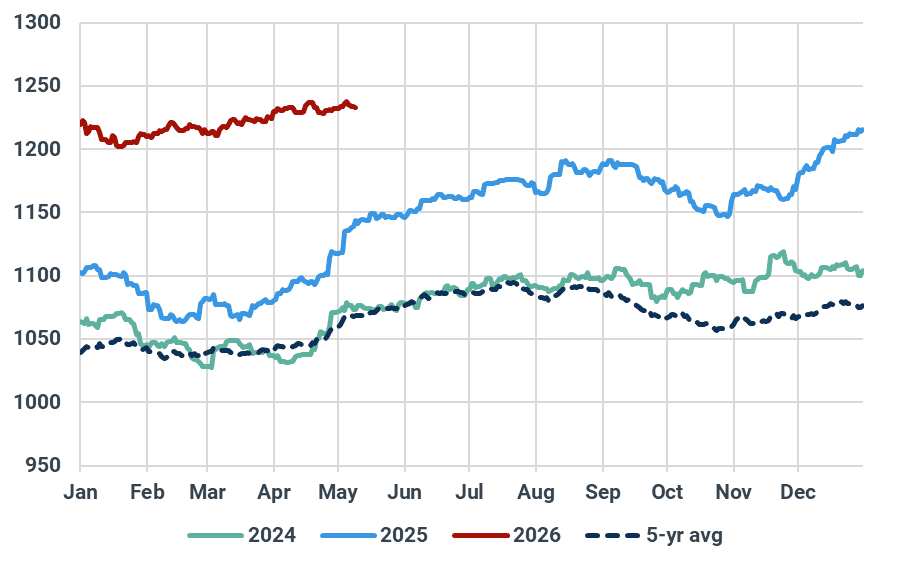
Kpler data shows that China’s onshore crude inventories stood at 1,232 mb at the end of April and have remained at this level since, compared to 1,217 mb in mid-March when seaborne imports first began to ease. During this period, China’s seaborne crude imports—including volumes via Myanmar’s Maday Island—declined from 11.7 mbd in February to 10.5 mbd in March, and further to 8.4 mbd in April.
While supply tightness led us to revise China’s refinery runs down to 14.7 mbd in March and 14.2 mbd in April (from 15.7 mbd in February), this reduction in throughput appears insufficient to offset the steeper decline in imports. While this partially explains why inventories haven't plummeted, it fails to account for the actual build observed during this period.
China's onshore crude inventories, mb
Source: Kpler
So, what might explain this apparent discrepancy?
Assumption 1: Pre-war inventory levels may have been underestimated
China’s onshore inventories—particularly State Petroleum Reserves (SPRs) and government-controlled commercial stocks—remain a closely guarded secret in Beijing. Official transparency has been sparse: the last public update on the locations and availability of China’s oil reserves was released in 2017. Later, in 2019, officials disclosed that total reserves were equivalent to roughly 80 days of demand (likely referring to net imports), though exact volumes were withheld.
At Kpler, we estimate China’s underground storages by integrating proprietary cargo tracking, refinery analytics, and observable onshore data. However, as these assessments rely on a confluence of modelled inputs, our figures may lag in capturing real-time fluctuations or accounting for newly commissioned sites—particularly as Beijing no longer discloses the locations or operational timelines of new storage facilities.
That said, our China crude balance showed an average oversupply of 780 kbd between September 2025 and February 2026, implying roughly 140 mb of “unaccounted” oil. This surplus suggests we may have underestimated either domestic refinery throughput or the pace of onshore stock building during that period.
This likely led to a higher inventory baseline prior to the Middle East conflict than our data reflected. Consequently, the currently observed trend would, in fact, point to a degree of stock drawdown in March and April as that unrecorded surplus is consumed.
Assumption 2: Potential reallocation from underground to overground inventories
As mentioned, our underground stock estimates may not mirror real-time movements as accurately as overground floating roof tanks. Therefore, if oil were withdrawn from underground facilities and moved overground for easier refinery access, we might capture the overground build without accounting for the underground draw. Consequently, our post-war inventory assessments could be higher than actual levels.
Currently, Kpler data assess China’s underground SPR at 100 mb, compared to 94.5 mb in early-March, with the increase coming from the newly launched Yunnan SPR.

See why the most successful traders and shipping experts use Kpler