EXPLAINER: How Mideast Gulf crude exports returned to pre-war levels
Excluding Iran, crude exports from the Middle East Gulf region are back at pre-war levels. But 40% now bypass Hormuz, and most crude crossing the strait changes tankers offshore. Kpler tracking and satellite imagery analysis show how the region rebuilt its export system.
Key takeaways
- Back at pre-war levels outside Iran. At least 16.5 mbd left the region in September, matching the pre-war average excluding Iran. Iran, under US blockade, accounts for the rest of the gap.
- Through different routes. 40% of the region's crude now leaves without crossing Hormuz, against 17% before the war, through Saudi and United Arab Emirates (UAE) pipelines.
- A shuttle fleet carries most of what crosses. In August, more than 70% of the crude crossing the strait changed tankers off Fujairah or Sohar. Most of the shuttles are very large crude carriers (VLCCs) making round trips every 16 days or so.
- The system reroutes fast. Within 10 days of the attack that halted Yanbu, all 6 Juaymah moorings were full, and Saudi crude crossing Hormuz nearly quadrupled on the month. A week later, Yanbu was loading again.
Crude leaving the Middle East Gulf region is back at pre-war levels outside Iran, 7 months after the war closed the Strait of Hormuz. At least 16.5 mbd left the region between 1 and 28 September, matching the pre-war average excluding Iran. That is 10.5 mbd above March's monthly average.
The volume recovered. The route did not. Before the war, 83% of the region's crude crossed Hormuz. In September, 40% left without crossing the strait. Of the crude that did cross in August, more than 70% changed tankers offshore in the Gulf of Oman.
That makes the recovery hard to see with conventional tracking. Tankers cross with their AIS transponders off, cargoes change ships in open water, and Saudi exports have swung between the Gulf and the Red Sea. Kpler combines vessel tracking, satellite imagery, draught changes, port data, market sources, and destination checks to reconstruct each movement.
Crude leaving the Middle East Gulf region excluding Iran, 7-day average (mbd)
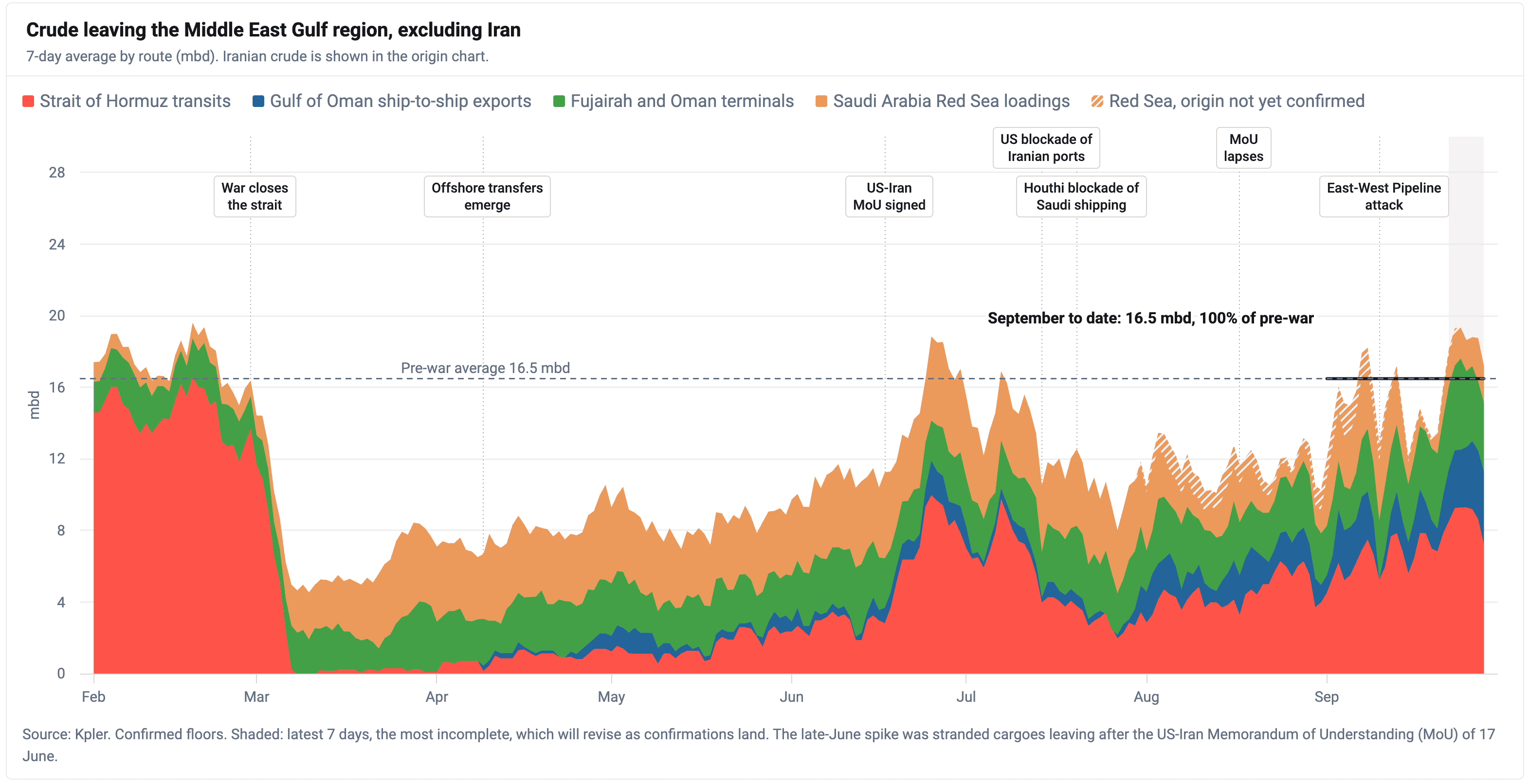
Source: Kpler. The late-June spike was stranded cargoes leaving after the US-Iran Memorandum of Understanding (MoU) of 17 June.
Gulf crude is back, through different routes
When the war closed the strait on 28 February, the 7-day average of non-Iranian crude leaving the region fell by 72% in 10 days, to 4.5 mbd. It has since climbed back through three exits instead of one. In September:
- 60% physically crossed Hormuz, 9.9 mbd, mostly using shuttle tankers
- 23% loaded outside the strait, on the Gulf of Oman coast (primarily Fujairah).
- 17% left through the Red Sea.
Where the region's crude leaves, and how Kpler counts each exit
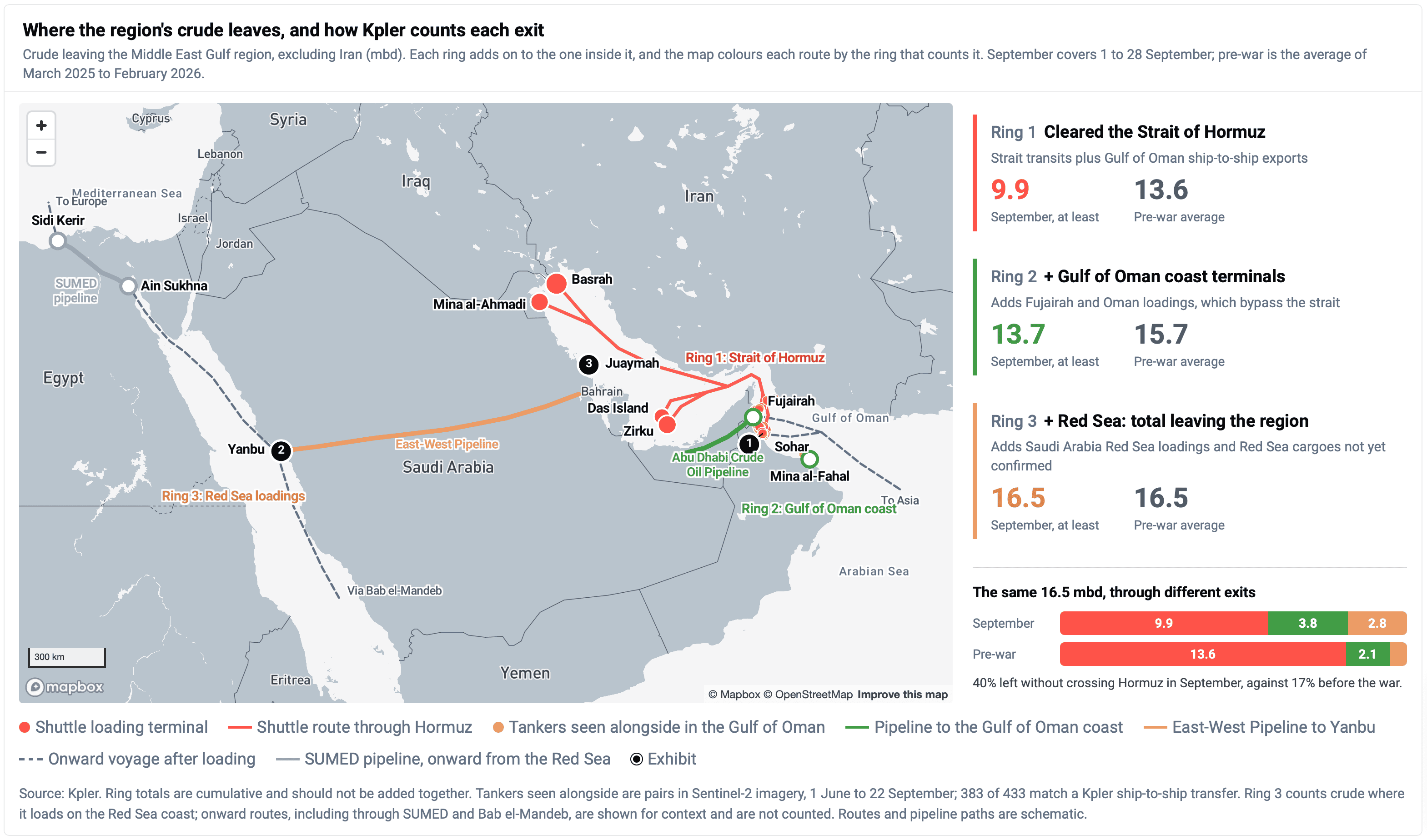
Confirmed crude crossing the strait is still more than a quarter below pre-war. The routes around it have more than doubled and make up almost exactly the difference.
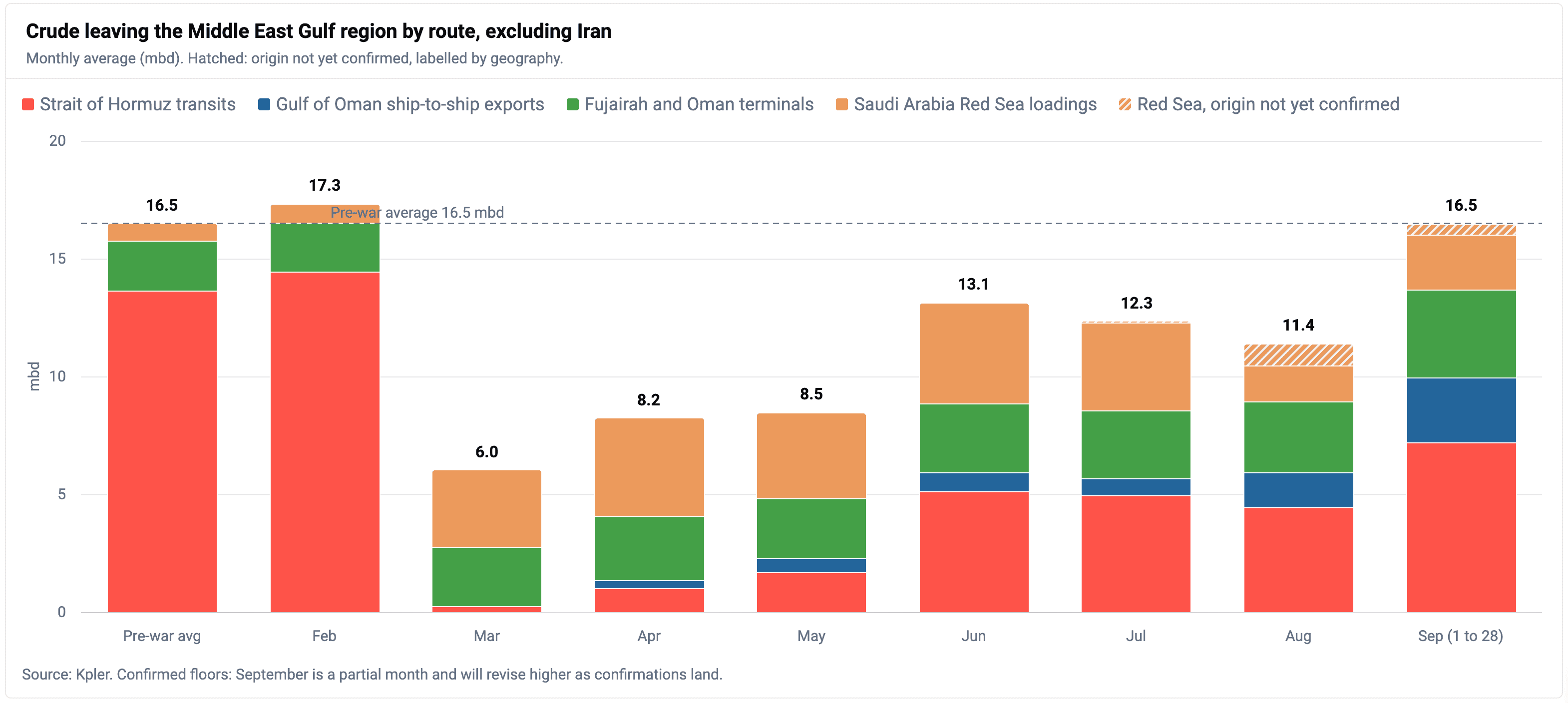
The workaround changed almost month by month. March belonged to the pipelines: 97% of non-Iranian crude leaving the region bypassed Hormuz. By May, a shuttle system had taken over the strait, with 86% of the crude crossing it changing tankers in the Gulf of Oman.
Crude leaving the Middle East Gulf region by route, excluding Iran (mbd)
Pipelines opened the first bypass
Saudi Arabia pushed crude west through the East-West Pipeline to Yanbu on the Red Sea. Saudi Red Sea loadings rose from 0.75 mbd before the war to 4.3 mbd in June, as the Yanbu bypass took over from the Gulf coast. The UAE sent crude through the Abu Dhabi Crude Oil Pipeline to Fujairah, where loadings rose from 1.1 mbd to 2.7 mbd.
Kuwait, Qatar, and most of Iraq have no route around the strait. Their recovery had to come back through Hormuz.

See why the most successful traders and shipping experts use Kpler