Iran faces forced shut-ins as storage ceiling collides with reservoir constraints
Iranian supply is entering a forced adjustment phase, driven by two simultaneous shocks: physical infrastructure disruption and a near-total halt to loadings.
Key takeaways
- Iran faces imminent forced shut-ins, with storage saturation likely within ~20–24 days, triggering rapid production cuts.
- Supply losses will be uneven across blends, likely to affect Iran Light more, and potentially irreversible, as reservoir constraints force selective shut-ins in mature carbonate fields.
- Medium-term recovery is capped by South Pars damage (~100–120 kbd), limiting condensate and associated liquids even if exports resume.
- Operational response will drive structurally higher costs, with rotating shut-ins and complex restarts increasing opex and weakening NIOC’s financial capacity.
Oil production has already declined by ~750 kbd versus pre-war levels due, primarily due to lower domestic demand during the war. However, the more structural constraint comes from Israeli strikes on five South Pars phases, which have reduced condensate output capacity by ~100–120 kbd for at least six months. Given that condensate production is tightly linked to gas processing at South Pars, this loss cannot be rapidly offset and effectively caps Iran’s liquids recovery in the medium term.
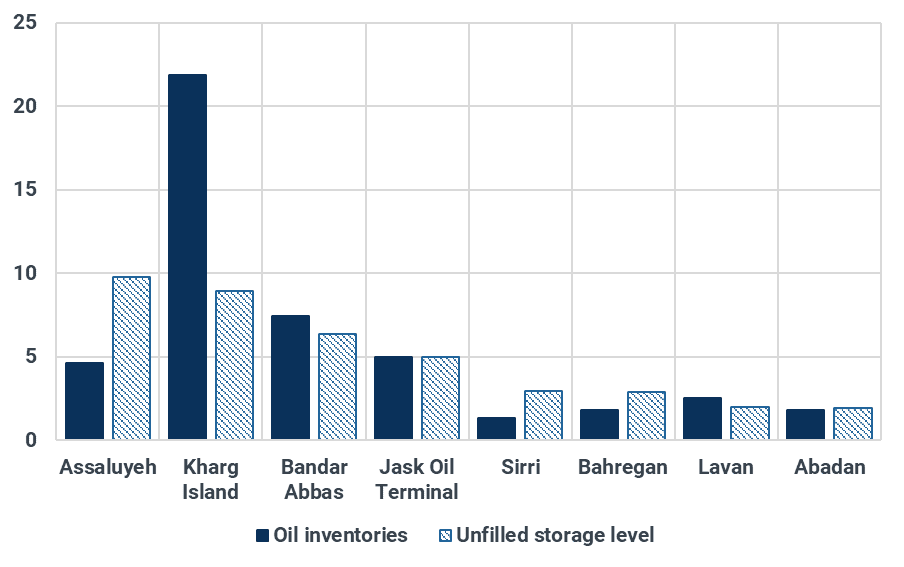
In the near term, the main binding constraint is the US naval blockade. Exports have effectively halted after a few loadings occurred last week. Only a couple of VLCCs are currently stranded in the Persian Gulf, allowing another 4 mbbls to be loaded. Nonetheless, Iran is being pushed into a storage-driven shut-in cycle. Based on displaced exports of ~1.8 mbd and ~39 mbbl of usable onshore storage, capacity could be exhausted within ~20–24 days. This estimate likely overstates usable capacity, as operational tank bottoms and flow constraints reduce effective working volumes. However, our estimate may also underestimate storage capacity at refineries in northern Iran, including the Tehran, Tabriz and Esfahan refineries.
NIOC oil inventories, mbbls
Source: Kpler
While the recent arrival of two VLCCs in the Persian Gulf may provide marginal floating storage (~4 mbbls), this does not materially change the timeline. NIOC is therefore likely to initiate pre-emptive production cuts within days, potentially delaying only to gauge the outcome of near-term negotiations.

See why the most successful traders and shipping experts use Kpler