Running out of barrels: cumulative oil losses reach 870 Mbbls this week, surpassing 1 billion barrels in late May
Cumulative crude and condensate supply losses in the Middle East have increased to 870 Mbbls as of 15 May, driven by storage-driven production shut-ins in Iran. In a ME supply restart scenario, 70–80% of production can return within weeks, but full normalisation will take up to five months.
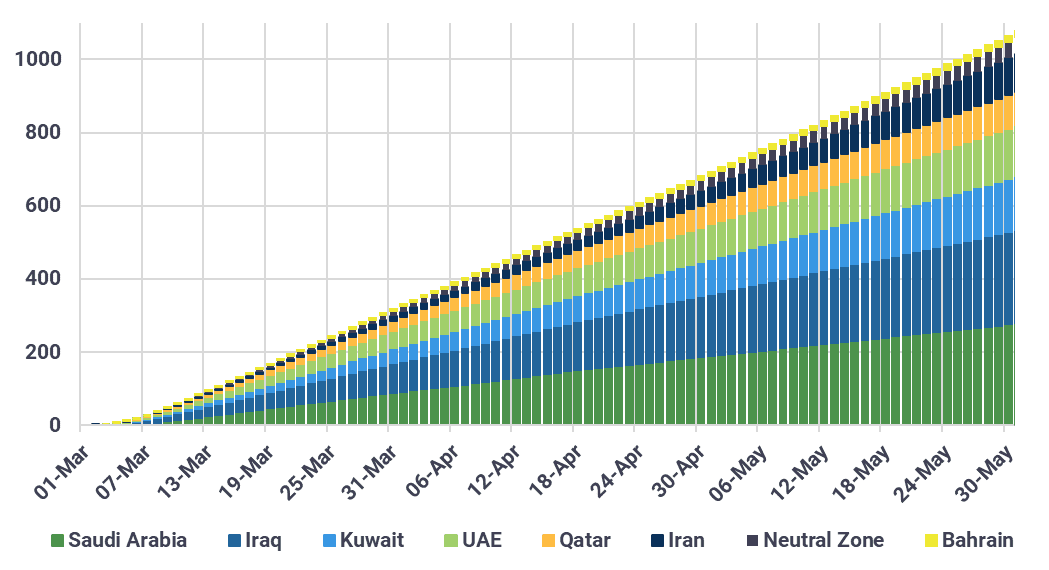
Cumulative Middle Eastern crude and condensate supply outages have continued to climb rapidly in recent weeks, currently hovering at 870 Mbbls as of 15 May, some 90 Mbbls higher w/w, and with outages expected to hit the 1,000 Mbbls mark later this month (see chart below).
Cumulative crude and condensate supply outages by country, Mbbls
Source: Kpler
Middle Eastern crude and condensate production outages have increased from 12.65 Mbd last week to above 12.9 Mbd this week, a result of the continued SOH stalemate and further downwards revisions for Iranian crude and condensate supply.
The US naval blockade has been effective at blocking Iranian oil exports, with our data recording no crude loadings since May 6 and observing no tanker berthing activity at Kharg Island. Meanwhile, Iranian onshore crude inventories are also being utilized and have continued to build through May, with stocks reaching close to 74 Mbbls as of 15 May, marking an increase of almost 10 Mbbls since late April. We reckon that there is limited storage capacity left on both onshore inventories and ballast tankers on water. Due to these dynamics, we estimate Iranian crude and condensate production at an average of 2 Mbd in May, well below pre-war levels of 4 Mbd, and volumes that will decline further if the blockade persists.
From the total 12.9 Mbd of Middle Eastern production offline, the largest shut-ins are still seen in Saudi Arabia at close to 3 Mbd and Iraq at 2.8 Mbd, followed by Iran with 2.17 Mbd, then Kuwait at 1.75 Mbd and UAE of around 1.5 Mbd (see chart below).

See why the most successful traders and shipping experts use Kpler