
Crude tanker rates hit new highs as Hormuz risk escalates
Crude tanker rates have broken to fresh highs as Iranian and US attacks across the Persian Gulf and Strait of Hormuz push shipping risk to its highest level since the war began. The pace of attacks has accelerated notably over the past 2 weeks, with roughly 24 successful strikes now claimed by both sides, 8 attributed to the US and the remainder to Iran.
Market & Trading Calls
- Freight hits new highs: MEG–China VLCC freight has reached $24/bbl, while Gulf of Oman loadings outside the Strait have risen to $12/bbl.
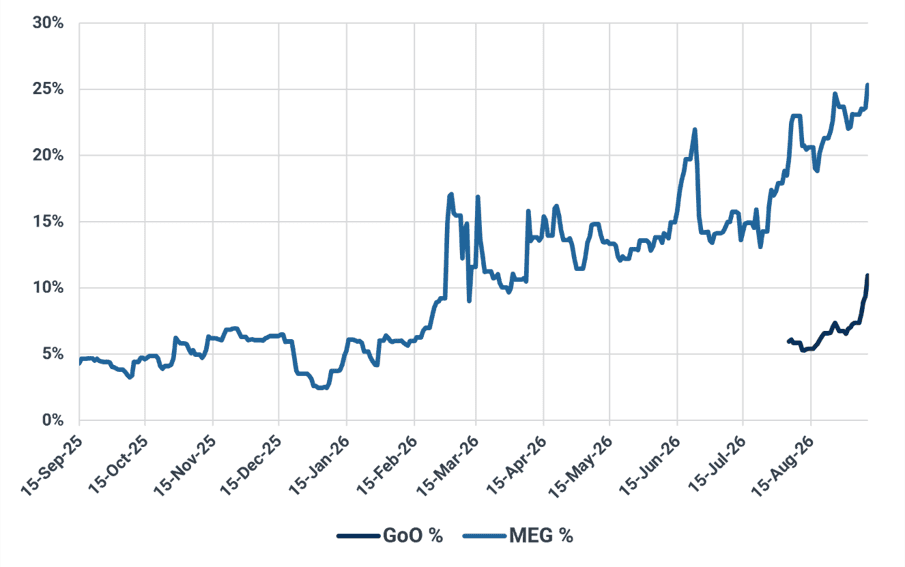
- Freight is overwhelming flat price: Freight now accounts for 25% of the fob crude price from the MEG and 11% from the Gulf of Oman.
- Flows continue despite escalating risk: Shuttle tanker operations facilitated by US Navy convoys continue to move barrels out of the Gulf, even as the threat to shipping reaches an all-time high.
- Rates are close to a ceiling: We expect freight to level off in the coming days. If attacks persist at the current pace, the next adjustment is more likely to come through lower loadings than another sustained leg higher in rates.
- Asian refining economics face further pressure: Product cracks will need to widen to absorb the higher delivered cost of crude and protect refinery margins.
Despite the escalation, physical flows have not collapsed. Shuttle tanker operations facilitated by US Navy convoys continue to move barrels out of the Gulf. Owners and charterers remain willing to load under naval escort, but that willingness increasingly comes at a price: the risk premium is being absorbed through freight rather than an outright halt in movements.
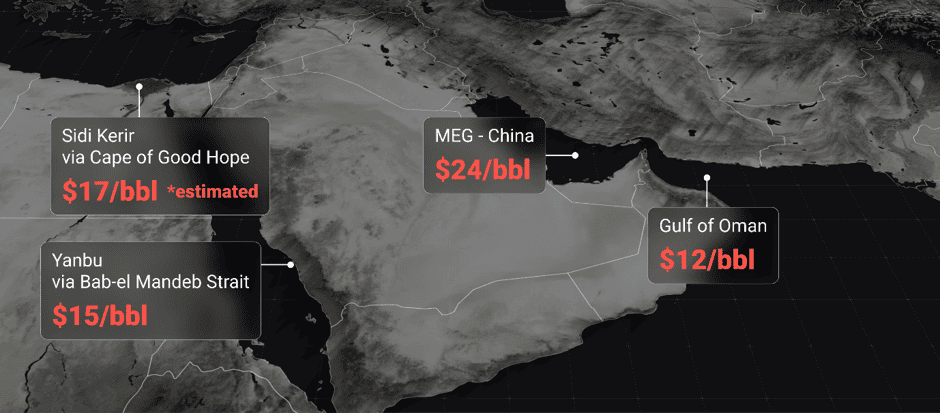
Middle East to China VLCC freight ($/bbl)
Source: Kpler, Baltic Exchange, Argus Media, Market Sources
MEG–China VLCC freight has reached $24/bbl, while rates for cargoes loading outside the Strait in the Gulf of Oman have risen to $12/bbl. The surge has sharply increased freight's share of the delivered crude price, increasing the all-in cost of crude for Asian buyers.
Freight now represents 25% of the crude price for MEG loadings, up from 17% at the start of the conflict and around 5% before the war. In the Gulf of Oman, where vessels avoid transiting the Strait itself but remain exposed to war risk, freight accounts for 11% of crude value. Both are the highest levels of the conflict to date.
Middle East to China VLCC freight as share of fob crude prices ($/bbl)
Source: Kpler, Baltic Exchange, Argus Media
This changes the nature of the crude price signal. For Asian refiners buying Middle Eastern barrels, delivered costs are increasingly being determined by freight rather than the underlying flat price.
Contagion spreads beyond the Middle East
The rise this week is not confined to the conflict zone. Tanker rates outside the Middle East have also broken to fresh highs for the year.
Part of that move reflects competition for tonnage. Elevated Gulf of Oman premiums increase the incentive for owners to position vessels toward Middle East employment, forcing Atlantic Basin charterers to bid higher to retain tonnage. The result is a broader tightening in the global crude tanker market, transmitting the Hormuz risk premium into routes with no direct exposure to the Strait.
Rates are approaching a ceiling
We expect rates to level off in the coming days rather than extend materially higher. The latest escalation has already pushed shipping risk to its highest level since the war began. Without another step change in the conflict, there is increasingly limited scope for freight alone to absorb additional risk.
More importantly, continued attacks at the current cadence would likely change the market's adjustment mechanism. Rather than generating another sustained freight rally, persistent disruption should increasingly constrain loadings.
That distinction matters. The next escalation in the conflict is therefore more likely to appear in reduced crude availability and lower tanker demand from the Gulf than in another proportional rise in freight. This creates a natural ceiling for rates even as geopolitical risk remains exceptionally high.
The downstream impact is also becoming more important. With freight lifting the delivered cost of crude from both the MEG and Gulf of Oman, Asian product cracks will need to widen further to preserve refinery margins. Refiners unable to pass through those higher landed costs face a deeper squeeze on economics, extending the impact of the tanker rally across the wider oil complex.

See why the most successful traders and shipping experts use Kpler
.jpg)