Northern & southern Europe nuclear roadmap: Lifetime extensions and future nuclear development
The United Kingdom, Sweden and Finland are preserving existing fleets while preparing future nuclear capacity, potentially adding around 16–17 GW by 2050, whereas Spain and Italy are redefining long-term nuclear policy through lifetime extensions and legislative reform.
Executive Summary
- The UK is planning to extend the operating life of its ageing AGR fleet while progressing new EPR reactors and an emerging SMR programme, supporting the government's ambition to increase nuclear capacity to 24 GW by 2050.
- Sweden has reversed decades of nuclear phase-out policy, prioritising 80-year reactor lifetimes while preparing a new generation of nuclear projects, although no meaningful capacity additions are expected before the mid-2030s.
- Finland continues to rely on its existing 4.4 GW nuclear fleet, with no committed replacement project. Instead, current policy focuses on maintaining long-term reactor operation through lifetime extensions, leaving nuclear capacity broadly unchanged through 2050.
- In Southern Europe, Spain's statutory 2035 nuclear phase-out is increasingly under review, with the Almaraz lifetime-extension decision likely to set the precedent for future reactor renewals and potentially retain part of the existing fleet into the 2040s. Meanwhile, Italy has re-established the legislative pathway for nuclear, targeting first commercial generation during 2033–35.
Note: Northern Europe in this report refers to the United Kingdom, Sweden, and Finland, while Southern Europe refers to Spain and Italy.
Northern and Southern Europe Are Following Different Nuclear Pathways
Both regions are shifting from long-term phase-out policies towards preserving existing nuclear capacity through lifetime extensions in the near term, while longer-term policy increasingly supports new nuclear development. Together, the five markets covered in this report operate around 24.4 GW of nuclear capacity, complementing power systems where renewables already supply around 40–70% of electricity.
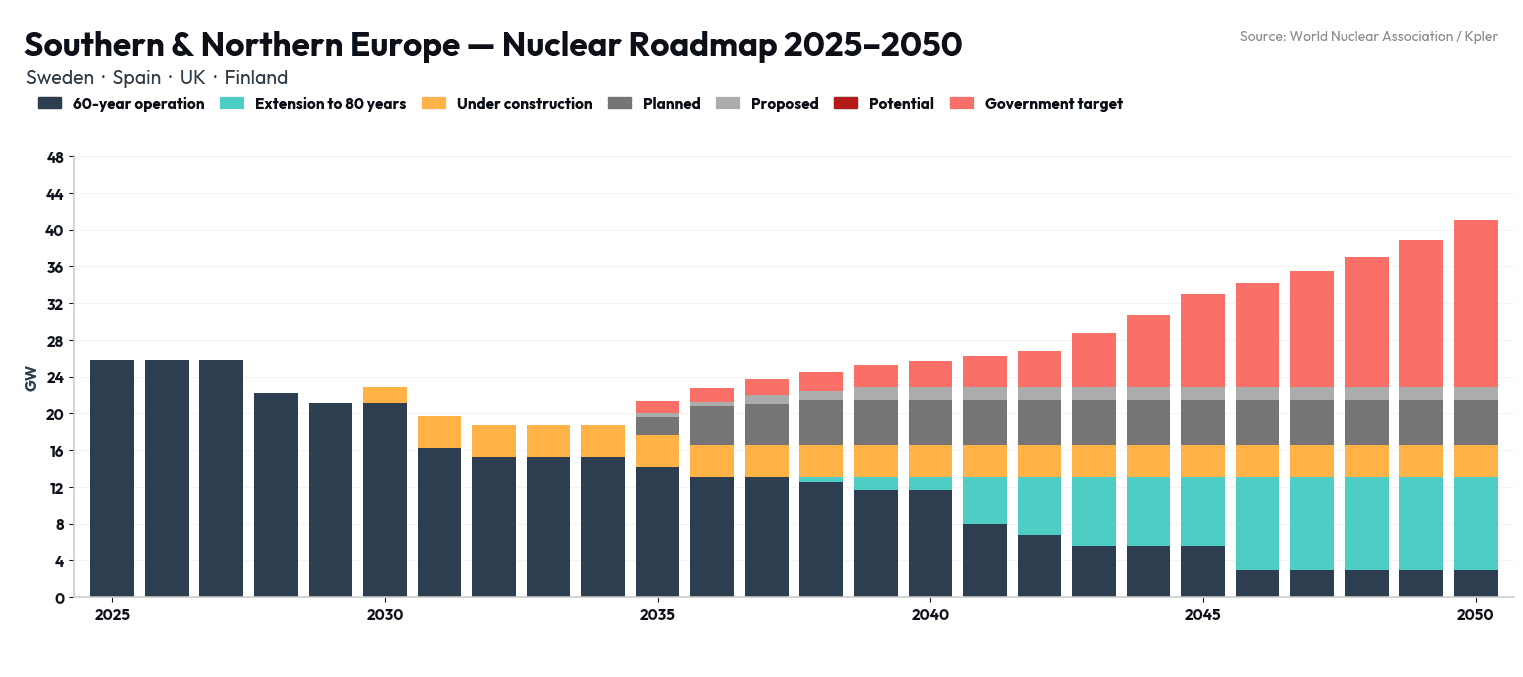
Based on the current roadmap, installed nuclear capacity across the five markets could increase from around 24.4 GW today to approximately 27–31 GW by 2040 and 35–40 GW by 2050, adding around 16–17 GW of new capacity over the next 25 years.
Most additions are expected in the United Kingdom and Sweden, supported by government-backed nuclear expansion programmes. In Southern Europe, Spain is currently assessing lifetime extensions to its existing fleet following the July 2026 favourable opinion from the Nuclear Safety Council, while Italy approved its nuclear enabling bill in June 2026, beginning the legislative process required to reintroduce commercial nuclear generation.
United Kingdom: Extending the Old Fleet to Bridge the New
The United Kingdom currently operates nine reactors across five sites, providing 5.8 GW of nuclear capacity and generating around 11% of generation mix. The existing fleet is dominated by eight Advanced Gas-cooled Reactors (AGRs) located at Hartlepool, Heysham 1, Heysham 2 and Torness, while Sizewell B remains the country's only Pressurised Water Reactor (PWR).
As almost 4.7 GW of AGR capacity entered service during the 1980s, the UK's immediate challenge is maintaining sufficient firm baseload generation until replacement capacity enters commercial operation around 2030.
Knowledge Pill- The UK's AGR fleet uses graphite moderators whose aging is gradually limiting reactor operating lifetimes.
The immediate priority is preserving the existing fleet while replacement capacity is delivered.
- AGR fleet: Heysham 1 and Hartlepool were extended to March 2030, while Heysham 2 and Torness remain scheduled to retire in March 2030, maintaining all four remaining AGR stations until around 2030.
- Sizewell B (1.2 GW PWR): Government and EDF agreed a 20-year lifetime extension to 2055
The second stage centres on replacing the retiring AGR fleet with a new generation of large nuclear reactors.
- Hinkley Point C (Somerset): 2 × 1.63 GW European Pressurised Reactors (EPRs) (3.26 GW) under construction since December 2018, with Unit 1 currently targeted for commercial operation around 2030 and Unit 2 expected shortly afterwards.
- Sizewell C (Suffolk): 2 × 1.6 GW EPRs (3.2 GW). Construction formally began in January 2024, with financial close reached in 2025. First operation is expected during the mid-to-late 2030s.
Together, the projects will add 6.4 GW of new nuclear capacity, increasing the UK's operating fleet to around 7.6 GW by the late 2030s.
Alongside large reactors, the UK is also developing a Small Modular Reactor (SMR) programme. Rolls-Royce SMR was selected as the government's preferred technology in June 2025, with Wylfa (Anglesey) chosen for the first three 470 MW units (1.41 GW).
A Final Investment Decision (FID) is targeted around 2029, with first grid connection expected during the mid-2030s, potentially increasing nuclear capacity to around 9-10 GW.
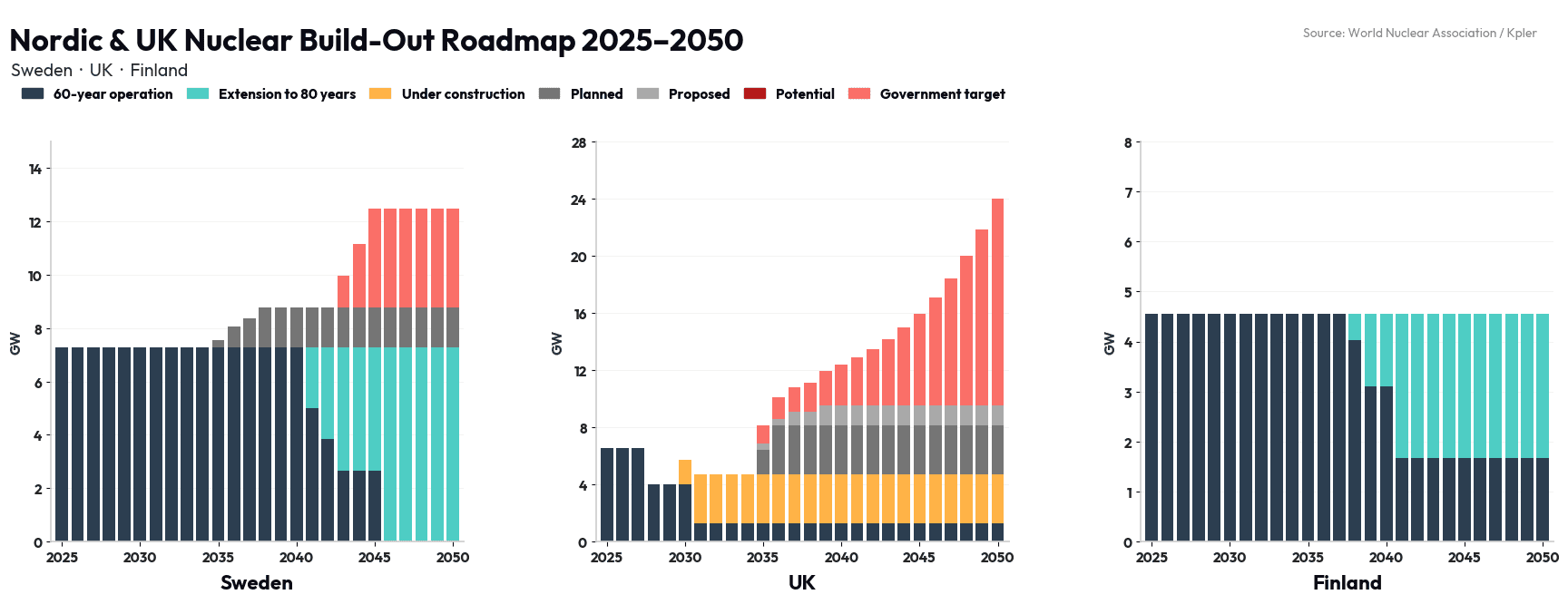
Kpler Insight estimates UK nuclear capacity could increase from around 5.9 GW YTD to approximately 10 GW by 2040. Achieving the government's 24 GW by 2050 ambition will require 3–7 GW of new nuclear investment decisions every five years from 2030, gradually increasing nuclear's share of electricity generation from around 11% today towards 25%.
Sweden: From Nuclear Phase-Out to Long-Term Expansion
Sweden currently operates six reactors across three sites, providing 7 GW of nuclear capacity and generating around 27% of national electricity, while hydropower contributes around 42%.
Most hydropower is concentrated in northern Sweden, whereas electricity demand is centred in the SE3 and SE4 zones, making nuclear generation particularly important for maintaining regional system stability and limiting imports into southern Sweden.
The country's 1980 nuclear phase-out policy was repealed in 2010, before the government replaced its 100% renewable electricity target with a 100% fossil-free target in June 2023, formally reopening the pathway for new nuclear construction.
The existing fleet therefore remains the first priority before significant new capacity is delivered.Forsmark 1–3 & Ringhals 3–4 are preparing for lifetime extensions from 60 towards 80 years, potentially extending generation into the 2060s.
Update – Ringhals 3 (1.1 GW): Following cooling-system inspections, the outage has been extended until 31 October 2026, keeping southern nuclear capacity constrained and continuing to tighten the SE3 and SE4 bidding zones.
Sweden's first new-build programme is centred on the Videberg Kraft project beside the existing Ringhals station, where three 470 MW Rolls-Royce Small Modular Reactors (SMRs) (total - 1.41 GW) were selected in June 2026.
The Swedish State will acquire a 60% ownership stake, Vattenfall (20%) and Industrikraft (20%), with FID expected around 2028–29 and first commissioning targeted during the mid-to-late 2030s.
Additional projects continue expanding Sweden's longer-term pipeline.
- Barsebäck (SE4): Nordic Baseload Power proposes 2 × large reactors (2.5 GW) at the former Barsebäck nuclear site, directly targeting Sweden's highest-demand electricity region.
- Studsvik, Blykalla & Nordic Nuclear Energy: advancing proposals for up to 1.7 GW of additional SMR capacity, alongside the BWR-N large-reactor concept targeting an initial four-reactor fleet across Sweden and Finland.
Government ambition: equivalent of 10 large reactors (12.5 GW) by 2050, supported by up to SEK 400 billion of state credit guarantees and financing support for new nuclear projects.
A similar shift is emerging in Denmark. Despite operating one of Europe's most renewable-dependent electricity systems, with renewables supplying around 92% of generation in 2026, the government has begun reassessing its long-standing 1985 nuclear ban. During 2025–26, it launched a formal review into the potential role of SMRs, although no decision has yet been taken to permit commercial nuclear generation.
Finland: Strong Existing Fleet, but No Replacement Pipeline
Finland currently operates five reactors across two sites, providing 4.37 GW of nuclear capacity and generating around 40% of national electricity. The fleet consists of Olkiluoto 1–3 and Loviisa 1–2, with Olkiluoto 3 (1.6 GW) becoming the Nordic region's largest generating unit following commercial operation in 2023.
The existing fleet remains the cornerstone of Finland's nuclear strategy.
- Loviisa 1 & 2: licensed to operate until 2050, supported by around €1 billion of long-term investment and the transition towards Westinghouse fuel.
- Olkiluoto 1 & 2: TVO is assessing uprates towards 1 GW per unit alongside lifetime extensions beyond 60 years.
Market Updates:
- Olkiluoto 2 (890 MW): Operating at around 735 MW following a generator-rotor fault, with full output expected after rotor replacement at the end of 2027. The repair programme includes an extended maintenance outage during April–June 2027.
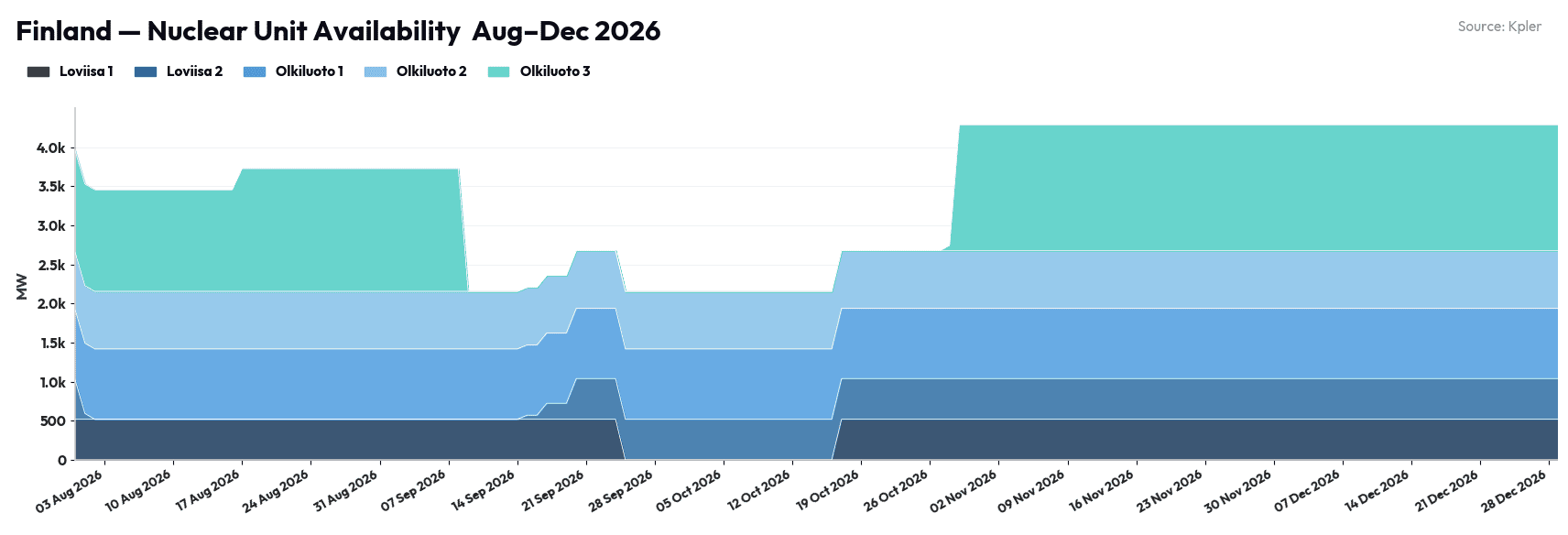
- Autumn 2026 (Q4 26): Olkiluoto 3 (1.6 GW) enters its planned maintenance during September–October, while Loviisa 2 remains offline until mid-September and Loviisa 1 undergoes a 15-day outage from early October, temporarily tightening Finland's nuclear availability during Q4 2026.
Finland currently has no committed replacement project.
Hanhikivi 1 (1.2 GW) was cancelled in May 2022 after Fennovoima terminated its contract with Rosatom following Russia's invasion of Ukraine, while Olkiluoto 4 was shelved because of weak demand growth.
Government policy has instead shifted towards creating the regulatory framework for future investment.
Nuclear Energy Act: reform submitted in March 2026 to modernise licensing for future reactors and SMRs.
Kpler Insight estimates Finnish nuclear capacity will remain broadly stable at around 4.4 GW through 2040 & 2050, with no committed replacement project beyond the existing fleet. Any meaningful capacity growth during the 2030s will depend on future investment decisions.
For the power market, reactor availability will remain the key focus through Q4 2026, with planned outages at Olkiluoto 3 and Loviisa 1–2 reducing available nuclear capacity from around 3.7 GW to nearly 2 GW during mid-September and mid-October, temporarily tightening Finnish fundamentals.
Spain: Phase-Out Policy Faces Political Pushback
Spain currently operates seven reactors across five sites, providing 7.1 GW of nuclear capacity and generating around ~20% of national electricity. Although renewables now account for more than 55% of generation, nuclear remains Spain's largest source of firm low-carbon baseload power.
Debate is no longer centred on new-build projects, but on whether the country's 2035 phase-out roadmap begins to unwind through lifetime extensions.
The existing fleet remains at the centre of this debate.
- Current closure roadmap: Almaraz I (Nov 2027), Almaraz II (Oct 2028), Ascó I & Cofrentes (Oct & Nov 2030), Ascó II (Sept 2032), Vandellós II & Trillo (2035).
- Capacity impact: declines from around 7.1 GW YTD to 5.1 GW by 2028, 3 GW by 2030, before reaching zero by 2035.
Almaraz (2 × 1.01 GW): Spain's Nuclear Safety Council (CSN) issued a favourable safety assessment on 17 July 2026, supporting operation until June 2030. The final decision now rests with the Ministry for the Ecological Transition. Approval would retain around 2 GW of nuclear capacity through 2030 and make Ascó I and Cofrentes the next likely candidates for lifetime extensions.
With no sanctioned large-reactor or commercial SMR programme, extending the existing fleet remains Spain's.
Political landscape: The April 2025 Iberian blackout intensified debate around energy security and system stability, increasing political support for nuclear lifetime extensions. The Partido Popular supports suspending the phase-out, while Vox advocates broader lifetime extensions and new nuclear. The governing Socialist Party maintains that any extension must satisfy safety, security-of-supply and consumer-cost criteria, although growing support from regional governments and plant operators has increased pressure to retain the existing fleet.
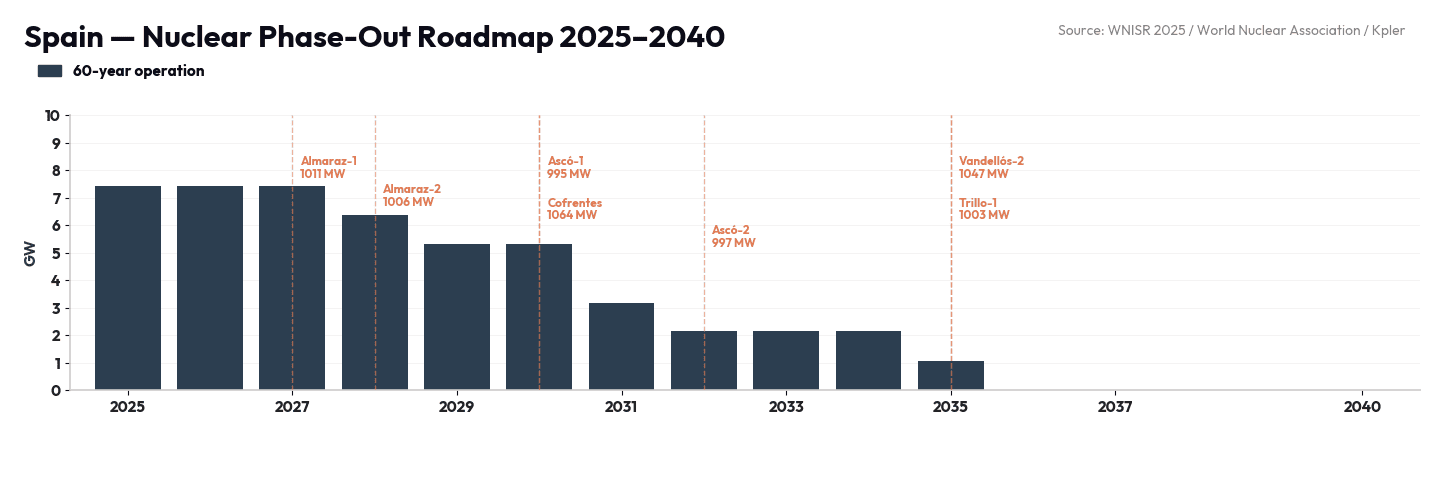
Kpler Insight estimates Spain's nuclear capacity will follow one of two pathways. Under the statutory roadmap, installed capacity declines from 7.1 GW YTD to zero by 2035. However, a limited Almaraz extension would delay around 2 GW of retirements until 2030, while subsequent renewals at Ascó and Cofrentes could retain 3–7 GW of nuclear capacity into the 2040s, fundamentally reshaping Spain's current phase-out trajectory.
Italy: Rebuilding a Nuclear Industry After Four Decades
Italy currently has no operating commercial nuclear reactors, having shut its final plants in 1990 following the 1987 referendum. Natural gas provides around 46% of domestic generation.
The government's current roadmap focuses on creating the legal and regulatory framework before construction can begin.
- Legislative update: The Chamber of Deputies approved the enabling bill on 4 June 2026 (155 votes in favour, 86 against), with final approval now expected after the bill moved to the Senate's September 2026 agenda.
- Implementation: Following parliamentary approval, the government plans to publish implementing decrees by the end of 2026, covering reactor licensing, safety regulation, waste management and a new Nuclear Safety Authority.
- Government ambition: first commercial nuclear generation targeted during 2033–35, although this remains a policy objective rather than a committed project schedule.
Delivering that timetable will require substantially more than legislation.
- 2027–early 2030s: reactor technology selection, site identification, licensing, financing and European Commission state-aid approval remain outstanding.
- Current status: policy is centred on SMRs and advanced reactors, but no licensed site, selected vendor, financing structure or Final Investment Decision (FID) has yet been announced.
Political support for nuclear power has strengthened under Prime Minister Giorgia Meloni's government, with the conservative parties Fratelli d’Italia, Lega and Forza Italia backing its return as part of Italy's energy security and decarbonisation strategy. Centre-left and Green parties continue opposing the programme.
Government ambition: 8–16 GW of nuclear capacity by 2050, supplying around 11–22% of electricity demand.
Italy is unlikely to deliver commercial nuclear generation before the late 2030s. Government ambitions of first electricity during 2033–35 remain dependent on regulatory approval, project financing and technology selection. Until then, natural gas, renewables and electricity imports will continue to dominate Italian power market fundamentals.

See why the most successful traders and shipping experts use Kpler