Europe’s refinery runs strengthen in 2026, but demand struggles under elevated fuel prices
Europe’s refined product market faces a widening supply (production)-demand divergence in 2026. A light maintenance season is supporting some of the strongest Q4 refinery runs since 2019, while high fuel prices and geopolitical disruptions weigh on demand. This is expected to lengthen Europe’s core product balances versus 2025. Diesel bears the brunt of the slowdown, while jet fuel and naphtha remain relatively resilient, supported by alternative supply (US, Nigeria), yield shifts and stronger petrochemical economics.
European refinery supply: lower maintenance supports strong 2026 runs
European refinery runs are expected to average 12.2 million b/d in 2026, around 130 kbd higher y/y, supported by healthy refining margins and a relatively light planned maintenance schedule.
Europe’s refinery runs (kbd)
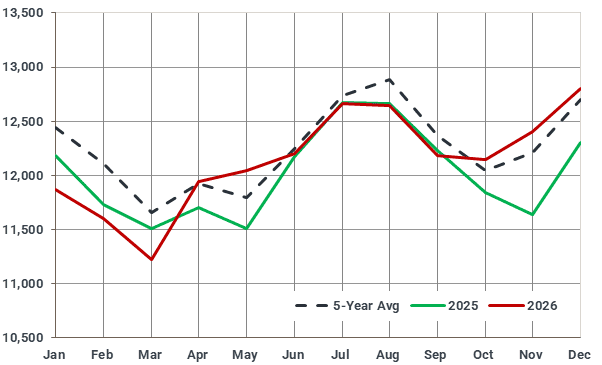
Source: Kpler
Runs are expected to remain strong through Q4, averaging around 12.45 mbd versus 11.93 mbd in Q4 2025 and a five-year average of around 11.4 mbd, putting throughput among the strongest Q4 levels since 2019. This is largely due to a lighter turnaround cycle rather than maintenance deferrals, with IIR data showing little material rescheduling despite recent geopolitical developments. Major turnarounds are typically planned years and are difficult to shift due to mandatory safety requirements and limited availability of specialised labour and contractors. Combined with healthy margins, this should keep European refinery runs elevated through year-end.
European refined product demand weakens in 2026
Europe’s demand outlook has weakened materially since the start of the year. In our latest forecast, we expect total European refined product demand to contract by around 150 kbd y/y in 2026, compared with broadly flat demand anticipated in our pre-war February outlook. The losses are concentrated in Q2 2026 and, product-wise, it’s in diesel, while gasoline demand growth has also slowed considerably. In contrast, jet fuel demand has proved more resilient, while the demand outlook for naphtha has improved.

See why the most successful traders and shipping experts use Kpler