

Panama Canal issues persisting into 2027 support higher LPG freight and delivered prices in East Asia
The Panama Canal Authority announced a reduction in transits as a dry period from a very strong El Niño is set to extend into next year. Peak water level impacts are likely in early Q2 next year just as new LPG export capacity is ramping up on the USGC, keeping upward pressure on VLGC freight rates and delivered prices in East Asia through Q2 2027.
Market & Trading Calls:
- A dry outlook for Central America from Q4 2026-Q2 2027 sets the stage for further reduction in Panama Canal transits, with April 2027 likely to set the low water mark at Gatun Lake.
- Canal congestion and transit auction fees are already significantly elevated, boosting VLGC freight and delivered propane prices as importers stock up ahead of peak heating demand. Continued dry weather in Panama and another leg up in USGC LPG exports in 2027 will keep upward pressure on freight and delivered prices in Asia persist through Q2 2027.
- A Panama Canal bypass pipeline is still years off and creative STS shuttle trades on smaller vessels are costly and will move only limited volumes, leaving most operators to choose between longer routes or more expensive Panama Canal transits.
Last week, the Panama Canal Authority (PCA) announced reduced transits through the Panamax and Neopamax locks as dry conditions impact Gatun Lake levels. Daily panamax transits will drop from 26 to 25 on 3 September, then again to 23 on 15 September. Neopanamax transits will drop from 10 to 9 on 3 September.
Gatun Lake levels have declined this year, with the downtrend persisting beyond the beginning of rainy season in May. In response, the PCA marginally limited drafts earlier this summer but limiting transits is a stronger lever to maintain lake levels by reducing the amount of water flushed out to sea during the operation of the locks. The chart below shows lake levels for 2026 as well as the 2023 drought year which heavily impacted LPG movements through the canal.
Gatun Lake Levels (feet)
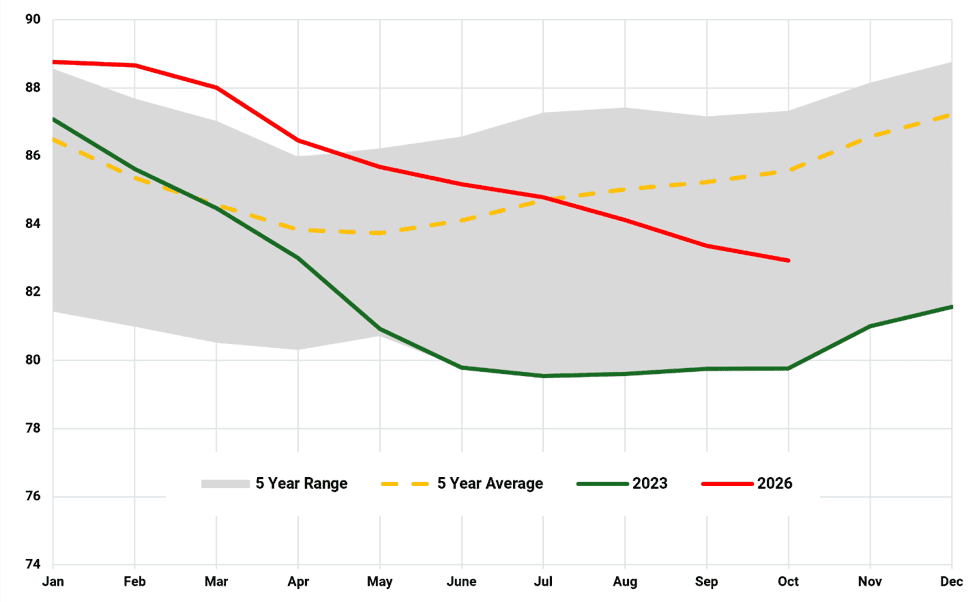
Source: Panama Canal Authority. 2026 values are actual through mid-August and PCA forecasts through October.
With lake levels trending the wrong direction seasonally, the region is also facing a likely dry winter. The US National Oceanic and Atmospheric Administration (NOAA) currently forecasts a >90% chance of a very strong El Niño this fall and winter. Central America typically experiences dry patterns during El Niño, with this winter’s outlook suggesting a very high likelihood of below normal precipitation in the region. Additionally, recorded precipitation for 2026 through mid-August has been 20% below the five-year average.

See why the most successful traders and shipping experts use Kpler






