Rising mainstream tanker penetration in Western Russian crude trades supports Aframax rates in July
Western Russian crude trades saw a notable increase in Western-insured Aframax participation in July, alongside higher regional crude exports. These developments supported commercial Aframax freight rates, although early-August corrections suggest that momentum may be fading. Looking ahead, geopolitical developments, crude price movements and the availability of Atlantic tonnage will remain key factors shaping regional rates and the broader Aframax market outlook.
Key Takeaways:
- Western-insured Aframax penetration of Russia trade rebounded sharply in July, reaching 40%, supporting higher Russian crude exports and reducing Russian freight rate premiums.
- Counter-seasonal Russian crude export growth, driven by lower refinery runs, strengthened Aframax demand and supported commercial North East Atlantic Aframax benchmarks.
- Early-August TD19 (Cross Med) rate correction and renewed Urals prices above $60/bbl raise doubts over sustained mainstream fleet penetration into Russian trades.
- Despite geopolitical upside risks, Atlantic Aframax oversupply remains the key structural constraint, with clean-to-dirty switching limiting the rally’s duration.
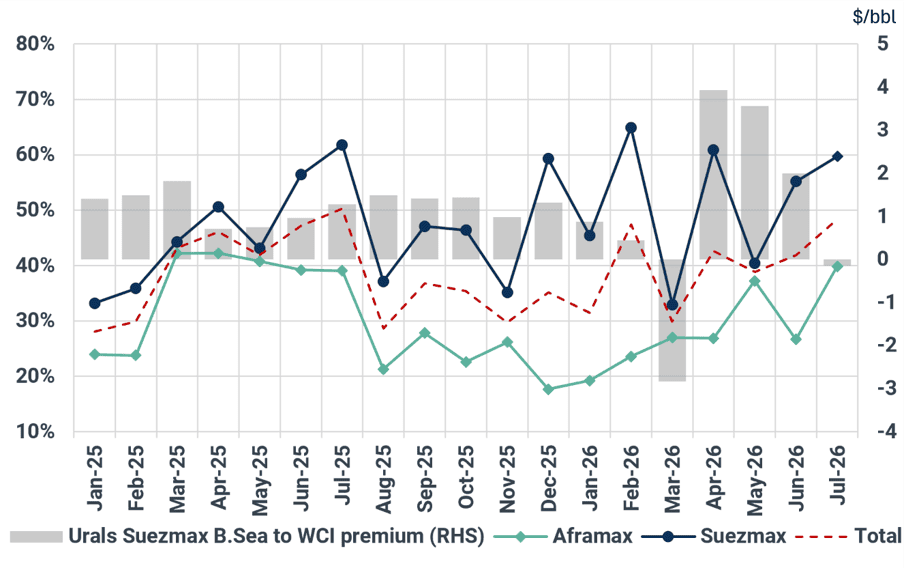
The penetration of Western-insured tonnage in Western Russia’s crude trades, excluding CPC Kazakhstan, rebounded to 48% of total traded volumes in July, marginally surpassing the February 2026 high recorded ahead of the outbreak of the US-Iran conflict and the subsequent spike in crude oil prices. The composition of this increase, however, differed from that observed in February. While the earlier peak was primarily driven by Suezmax activity, a segment in which Russia has traditionally maintained greater exposure to Western-insured tonnage, the July increase was also supported by Aframax employment.
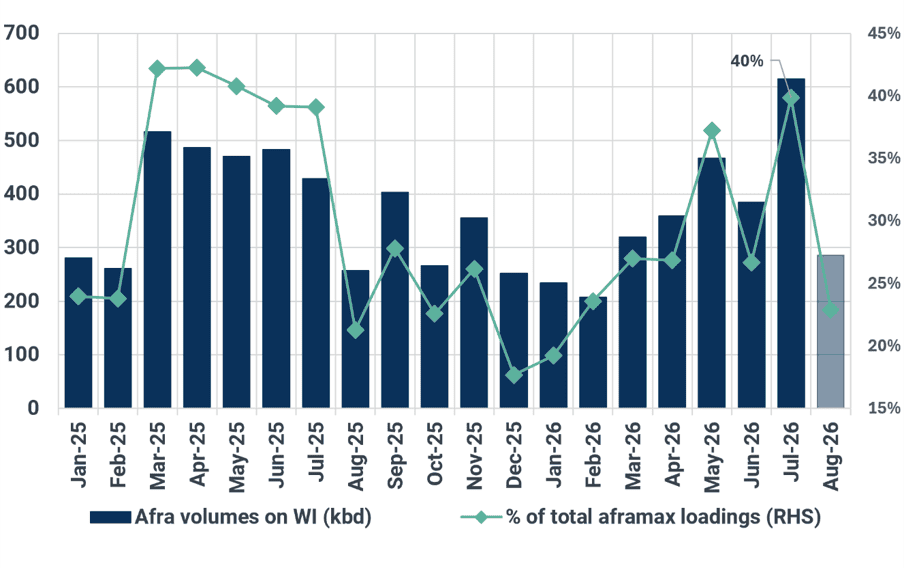
Unlike Suezmaxes, Western Russia’s exposure to G7+-insured Aframaxes collapsed in August 2025 following the introduction of the EU’s 18th sanctions package, which lowered the price cap for the first time and sought to close the loophole around imports of refined products produced from Russian feedstocks. Since reaching a low of 18% in December, exposure has steadily recovered, rising to 40% over the past month. This increased participation has, in turn, significantly reduced the premium of Western Russian freight rates over commercial freight rates, which appears to have been an important incentive for attracting new tonnage into these trades.
Share of Western-Insured tonnage in West Russia’s Crude Trades
Source: Kpler, Argus Media
A concurrent, counter-seasonal increase in Western Russian crude exports has amplified the impact of higher Western-insured Aframax penetration. This appears to be linked to the intensification of Ukraine’s drone campaign against Russian refining infrastructure and the resulting decline in the latter’s refinery run rates, allowing a greater share of crude production to reach the water. Consequently, Western Russian crude volumes carried on Western-insured vessels rose to circa 615 kbd in July, offering employment for approximately 26 Aframax vessels across the month.
West Russia’s Crude Trades on Western-insured Aframaxes (kbd)
Source: Kpler

See why the most successful traders and shipping experts use Kpler