Saudi buffer runs thin, Atlantic barrels reprice
Saudi Arabia’s East-West pipeline outage has removed a key bypass around Hormuz just as Yanbu inventories are running low. Dubai M1-M3 has widened sharply, reopening west-to-east arbs and increasing competition for Atlantic barrels. Europe remains tight as Forties moves east and Saudi availability falls, while WTI looks increasingly cheap abroad despite tightening US balances.
Executive Summary
Source: Kpler
Trading Calls
- Bullish Dubai M1/M3: The East-West pipeline outage is partly priced, but a month-long Petroline repair and dwindling Yanbu stocks leave further upside.
- Bullish prompt DFL: Lower Saudi availability and Forties moving east tighten Europe, while record margins keep refinery runs firm.
Middle East & Asia: Saudi buffer runs thin
November Brent traded above $107/bbl before settling at $104.61/bbl on Friday as concerns grew over how long Saudi supply could remain constrained. The East-West pipeline had been moving roughly 4mn b/d around Hormuz, while Yanbu inventories have fallen below 15mn bbl, leaving only a few days of export cover. With repairs at the pumping station potentially taking a month or longer, storage and Egyptian outlets provide only temporary relief before exports or upstream output need to adjust.
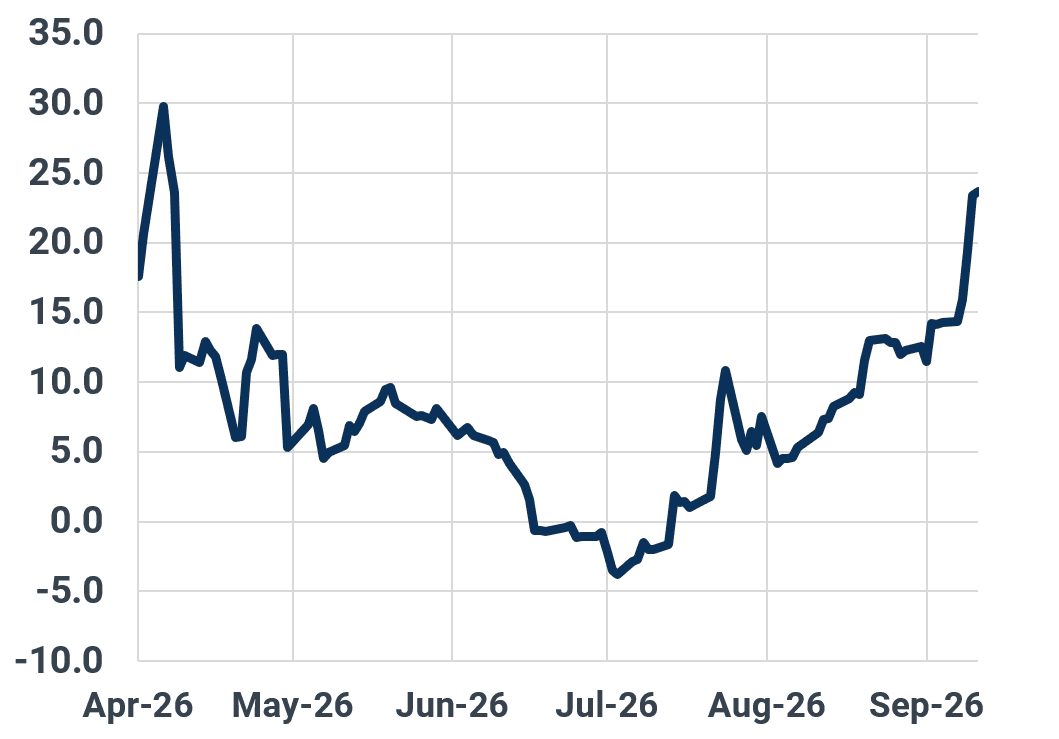
Dubai M1-M3 has widened to $23.41/bbl and should remain supported while the outage persists. We expect the spread to hold above $20/bbl and retest March highs if Yanbu loadings or October allocations fall. A partial restart would ease some pressure, but disruption through Hormuz and Bab el-Mandeb should limit the downside. MEG-China freight near $24/bbl also looks close to its ceiling, with further escalation more likely to reduce loadings than drive another sustained freight rally.
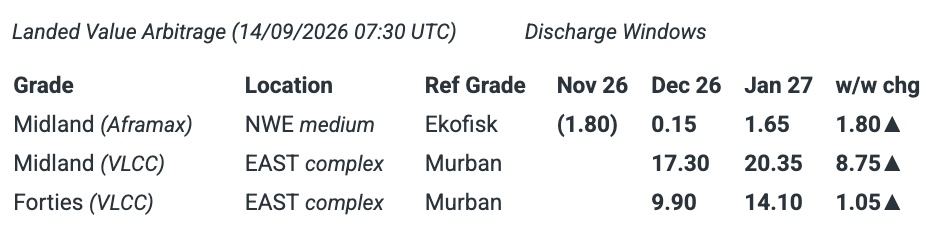
That keeps Atlantic replacement arbs open. WTI Midland, Djeno and Tupi are landing at least $17/bbl below Murban into Ningbo despite elevated freight. We expect Asia to pull more WAF and selected WTI, although high freight and Atlantic backwardation should keep flows selective. WAF looks particularly well placed to capture incremental Asian demand while these economics hold.
Dubai M1M3 Spread, $/bbl
Atlantic Basin: Europe and Asia bid for replacement barrels
North Sea differentials continue to strengthen despite roughly 500kbd of northern European capacity being offline. Two September Forties VLCCs heading to Asia leave less than 1mn bbl from the programme for Europe, while delayed Saudi cargoes and CPC uncertainty are pushing refiners towards nearby grades. Record margins are adding to that pressure, with some refiners delaying maintenance and keeping autumn crude runs higher than usual. We expect Europe to remain well bid, particularly for medium sours, until Saudi flows recover or CPC availability improves.
The replacement bid has also lifted Guyana, Nigeria and Angola, but the economics are increasingly pointing east. Payara is generating over $25/bbl more refinery margin in the East while barely breaking even in the West. WAF also looks competitive east, although steep Dated backwardation continues to weigh on the longer voyage.
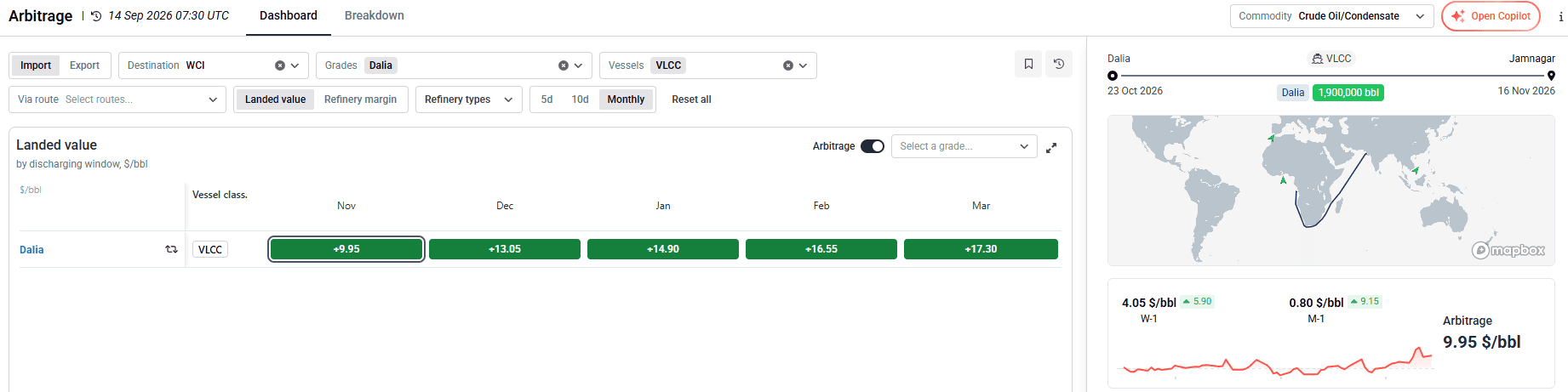
Dalia is a good example, with our screen showing its November landing into Ningbo around $10/bbl cheaper than Oman, an improvement of roughly $6/bbl w/w, although high TAN limits the buyer pool. WAF-WCI Suezmax freight is also slightly cheaper than VLCC, which could favour smaller parcels. With Europe still short of nearby supply, we expect competition with Asia to remain strong, particularly for WAF barrels where eastbound economics can absorb the higher freight.
Dalia refinery-margin advantage versus Oman into WCI
Source : Kpler
Americas: Europe to pull WTI despite the arb
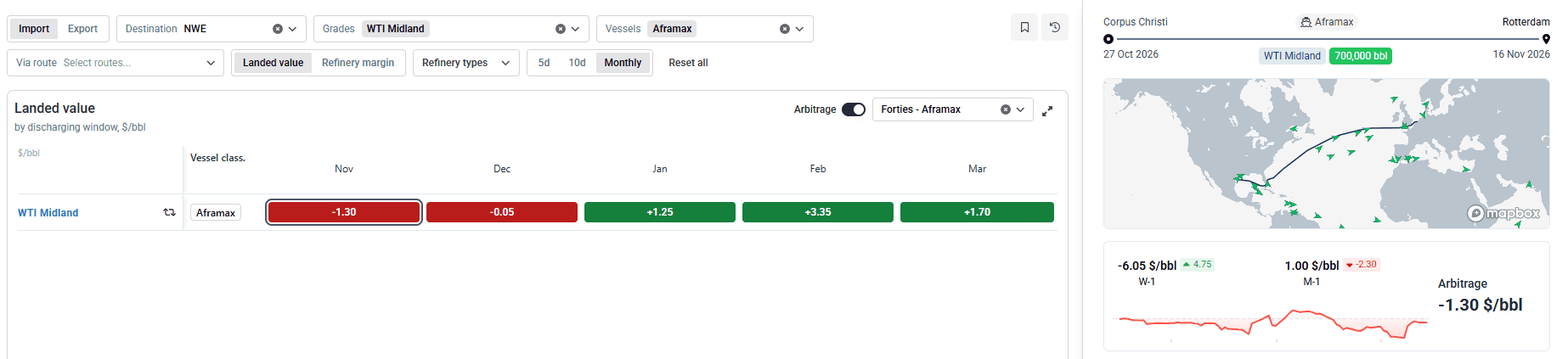
WTI Midland economics have improved into Europe, but the arb remains closed despite stronger North Sea pricing. For mid-November discharge, Midland lands around $1.30/bbl above Forties, while into Ningbo it lands more than $17/bbl below Murban. Despite the relative economics favouring Asia, limited European supply should keep refiners pulling Midland, which feels supportive for prompt WTI spreads. European refiners are already showing strong interest in delivered WTI.
The US market is tightening at the same time. Record USGC margins are keeping refinery demand firm, Mars has become relatively cheaper, and Cushing stocks have fallen to 21.8mn bbl. That limits how much WTI can weaken to clear additional exports, particularly if domestic refiners continue running hard. Our selected Mars USGC refinery margin remains near $4/bbl.
The bigger question is how long WTI can remain this competitive abroad. Cushing stocks are already low and US refinery utilisation is close to 98%, leaving limited room for exports to accelerate without tightening domestic balances further. We therefore expect MEH and Midland differentials to strengthen if European buying persists, gradually taking some of the advantage out of the arb. WTI looks cheap globally today, but with US balances this tight, that pricing looks difficult to sustain.
WTI Midland landed arbitrage versus Forties into NWE
Source : Kpler
Kpler Arbitrage
Kpler’s Arbitrage platform turns complex freight, quality, and benchmark data into simple, actionable arbitrage insights so you can discover value windows, rank opportunities, and build scenarios confidently.
With Arbitrage you can:
- Compare delivered crude values by region and freight cost
- Quantify refining margins and route profitability
- Spot open arbitrage opportunities quickly
- Breakdown value drivers like FOB differentials, spreads, and freight
- Model scenarios with custom market inputs

See why the most successful traders and shipping experts use Kpler
Related posts