The Fed joins the hiking camp
The September rate hike validates the hawkish shift underway since Jackson Hole. We see another hike by year end.
Summary
- The Hike Arrives: The FOMC raised the Fed Funds rate 25 bp to 3.75 – 4% at the September meeting, in line with market expectations and validating the hike camp we have occupied since early June. The SEP aligned with the move – 2026 growth was revised up to 2.3%, core PCE to 3.4%, and unemployment down to 4.1%, with the median dot at 4.1% implying one more hike before year end.
- Warsh Stays on Message: The chairman reiterated his Jackson Hole framing – a healthy economy, a balanced labor market, and inflation that remains too high. He stressed that too much of the consumption basket is seeing uncomfortably large price increases. Geopolitics also earned a mention, a reminder that commodity moves since the Iran war began (oil +50%, diesel +100%, wheat/corn +20%) are squarely on the committee’s mind.
- We Turn More Hawkish: Following today’s move, we update our long held one-hike call and now forecast another hike this year plus an additional hike early next year before the FOMC pauses to assess. Markets lean the same direction for now. Futures pricing has an 88% chance of at least one more hike in 2026. The 2y bond yield pushed above 4.7% for the first time since July 2024.
Market Analysis
Since early-June of this year, we have firmly resided in the “hike” camp for the Federal Reserve in 2026. A surge in energy-related inflation following the Iran conflict, which threatened to de-anchor inflation expectations, alongside a healthy US economy, helped along by robust AI capex, and a resilient household consumer, was the basis of our forecast. At the September 16th FOMC meeting, the committee finally decided to raise the benchmark Fed Funds rate by 25bp to a range of 3.75 – 4%, in line with market expectations heading into the decision.
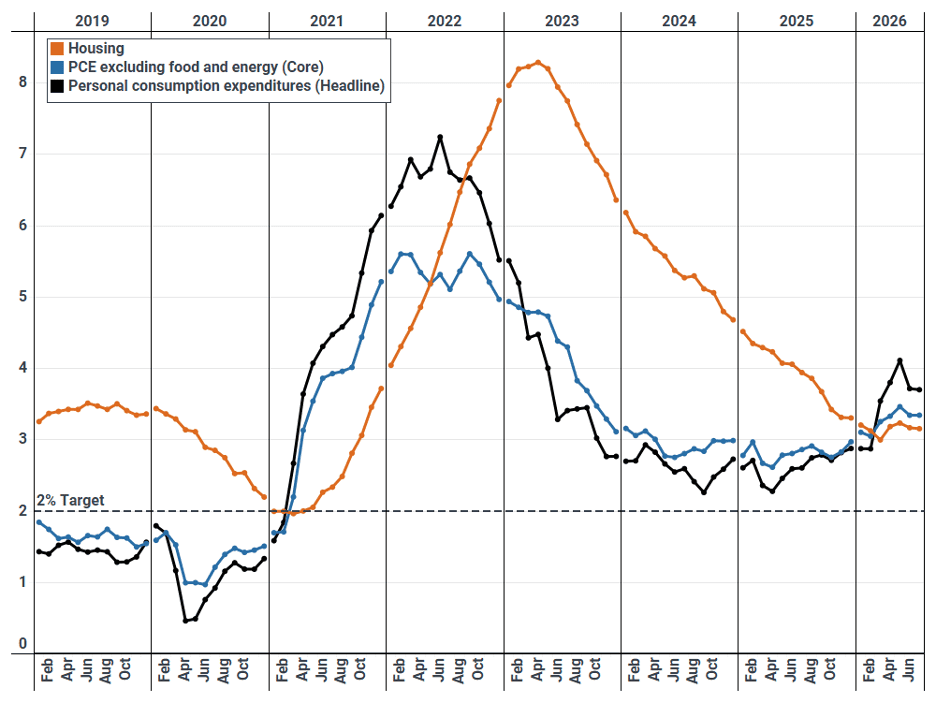
12-Month Pace of Core and Headline Rate of PCE-Based Inflation (%)
Source: BEA
The Summary of Economic Projections (SEP), which reports the FOMC’s median projections for growth, inflation, unemployment, and the Fed Funds rate all readily align with the decision to hike and opens the door for further tightening in the months ahead. The median projection for real GDP growth was revised higher against the June SEP for both 2026 (2.3%, +0.1pp) and 2027 (2.4%, +0.1pp). The pace of core PCE-based inflation was also raised for 2026 (3.4%, +0.1pp) and was kept steady at 2.5% for 2027, a figure that remains above the Fed’s 2% target. Expectations for the rate of unemployment were lowered for 2026 (4.1%, -0.2pp), and 2027 (4.1%, -0.2pp).
The Warsh press conference was kept to a tight 30 minutes. He largely reiterated what he felt to be true at Jackson Hole in August – that the US economy looks healthy, the labor market is balanced, and inflation remains too high. Warsh made it clear that the Fed should be focused on its inflation mandate, highlighting that too large a percentage of the consumption basket is undergoing price increases that are uncomfortably high. He added that most advanced economies are experiencing a lot of upside price pressure.
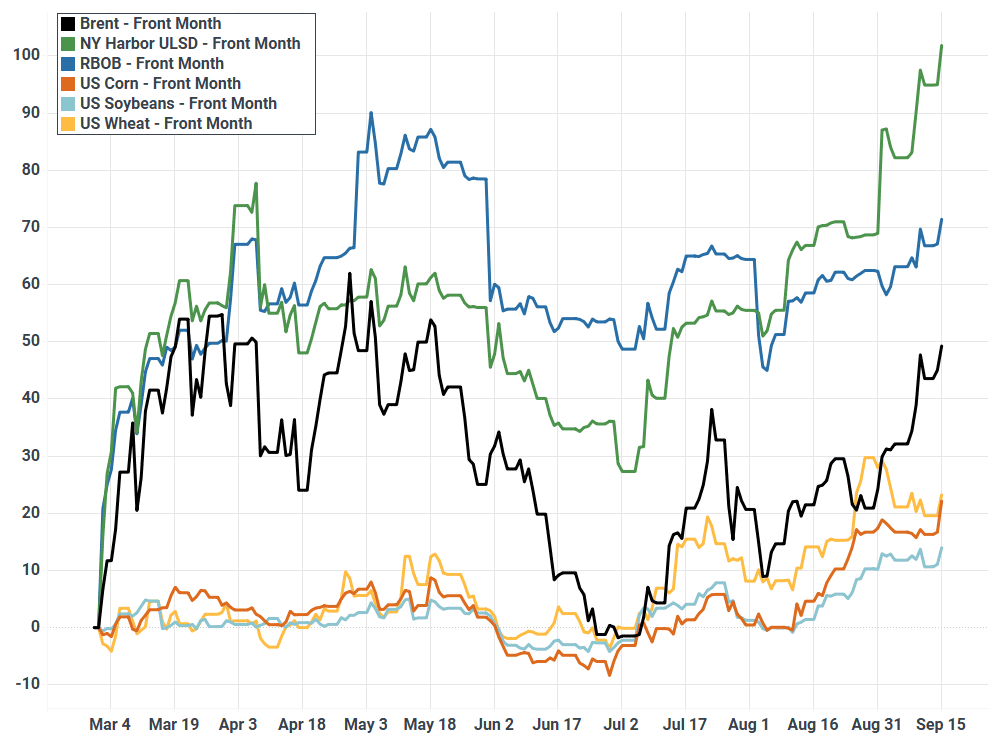
Warsh also spoke briefly on geopolitics as a critical factor under consideration at the FOMC. While supply-side disruptions are not easily handled by hiking rates, the fact that geopolitics were brought up is a reminder that events abroad are on the minds of committee members. Commodity prices have surged in recent months. Since the Iran war began, oil prices are up 50%, diesel prices are up more than 100%, and wheat/corn prices have risen more than 20%.
Daily Commodity Price Differential Against February 28 Baseline (%)
Source: CBOT, NYMEX
The SEP indicated a median Fed Funds rate of 4.1% by the end of 2026, implying another rate hike at one of the final two meetings of the year before pausing in 2027. Our view is slightly more hawkish. We held the Fed would hike at least once this year. We are updating this view following the move today, and now forecast one more hike this year, with another hike early next year before an extended pause where the Fed takes time to assess whether to continue the hiking cycle.
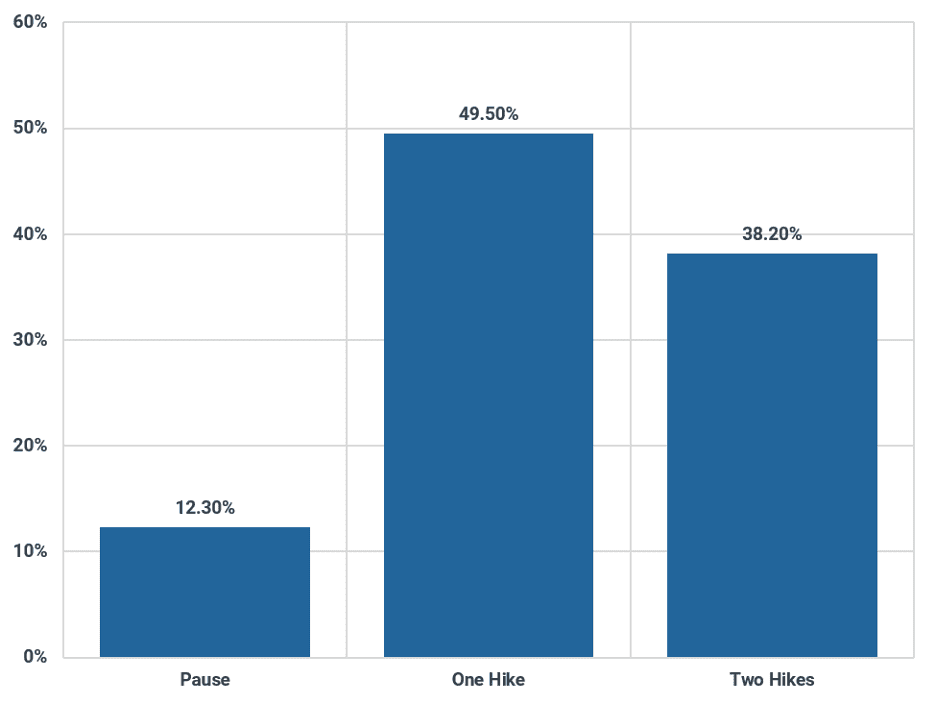
The market is clearly pricing for more hikes. CME Fed Funds Futures are tagging an 88% chance of at least one more hike this year, and a 38% chance of two more hikes, which would imply moves made at both the October and December meetings. The 2y yield, which serves as a proxy for monetary policy, pushed through 4.7% following the press conference, marking the first time above this level since July 2024, when the market was beginning to anticipate rate cuts.
Fed Funds Futures Rate Path Probabilities Through Year End (%)
Source: CME; figures are post-FOMC September rate hike

See why the most successful traders and shipping experts use Kpler