
Coal prices fall back after October overshoot
Coal prices eased in early November after overshooting our October forecasts.
Executive Summary
- Download Kpler's coal supply/demand balances and price forecasts.
- Market prices ran above our forecasts in October, as the US and Iran conflict lifted gas prices and coal followed. We had forecast lower prices, as we expected conditions to ease without firm demand fundamentals. Prices are now converging with our winter forecasts as LNG prices start to unwind, after running too high in October.
- LNG supply disruptions in the Middle East Gulf are keeping coal demand growth strongest in South Korea, Pakistan and Bangladesh.
- India is returning to the seaborne market to build inventories, while China’s thermal coal demand remains subdued. We expect premium low-vol metallurgical coal prices to ease as Shanxi capacity returns.
- EU-27 imports rose in October on low gas storage, but Germany’s coal capacity of under 10GW caps burn. Turkish prices will fall to a discount to cif ARA once Taman flows resume in the coming months.
Prices
Thermal coal price outlook: Weak fundamentals to keep upside capped
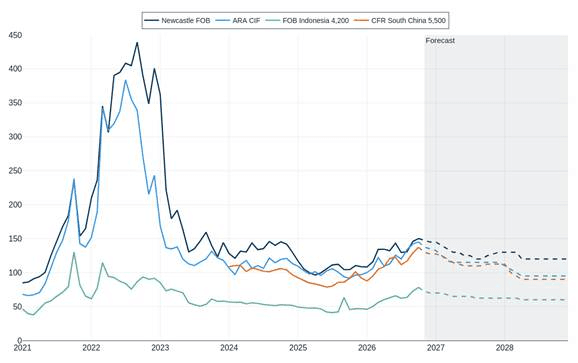
Our October forecasts sat below market prices across all coal benchmarks, as we expected conditions to ease without firm demand fundamentals. In the first week of November, prices converged with the levels we forecast in early October as the CIF ARA market fell below $140/t after nearing $150/t in late October.
Thermal coal price history and forecasts ($/t)
Source: Kpler Insight, Marketview, SXcoal
Coal is mirroring gas closely because demand from the Atlantic basin is limited. Gas futures fell sharply after the US midterm elections, in which Republicans lost control of the Senate and House. This points to a perceived higher probability of reduced escalation in the US and Israeli conflict with Iran.
We retain our view that Atlantic basin demand fundamentals are not strong. Low Rhine water levels in early October weakened the coal burn potential. After this winter, the EU is likely to need to rebuild gas stocks, which should provide some support for gas-to-coal switching and coal prices, but without significant upside potential for demand. Higher diesel costs also raise miners’ costs, lifting the FOB price floor by around $5/t, which is reflected in higher forecasts for 2H 2027. There is an underlying oversupply of coal in the Atlantic basin in the long term, given that demand is shrinking in the EU and also in Turkey due to the declining share of coal in the generation mix.
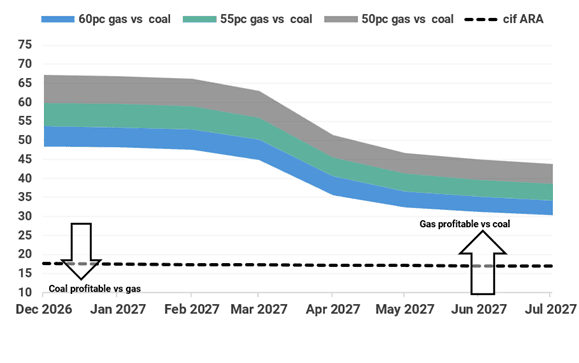
Germany 46% coal vs gas fuel-switching threshold ($/MWh)
Source: Enverus, Kpler Insight
Despite the weak underlying fundamentals, some short-term factors are supporting coal. Petcoke prices remain well above coal, which encourages switching to coal in the Mediterranean basin. The absence of Russian coal flows from the Black Sea also lifts demand for non-Russian supply. However, from a European end-user perspective, stocking coal at high prices is risky, because the window for coal burn is limited to winter in the EU, through Q1 2027.
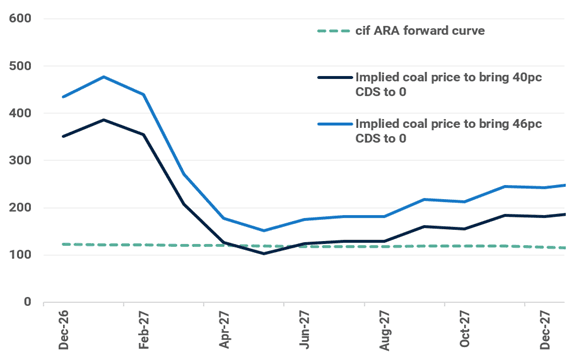
Theoretical coal price to bring coal generation margin to 0 in Germany vs CIF ARA forward curve ($/t)
Source: Enverus, Kpler Insight
Escalation in the US and Israeli conflict with Iran is the main counterpoint to this view. In the short term, coal would track gas higher if another escalation in the conflict drives gas prices up. Coal prices could then rise sharply tracking the Dutch Title Transfer Facility (TTF) gas benchmark.
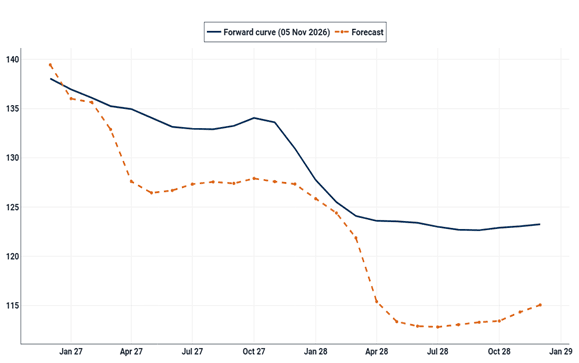
We retain our view that Atlantic basin fundamentals are not strong, so any such rise would be driven by gas rather than by coal demand. As a result, our current forecasts are lower than the CIF ARA forward curve for 2027.
CIF ARA coal forecast vs forward curve ($/t)
Source: Kpler Insight, Marketview
We revised our January 2027 FOB Newcastle forecast to $145/t from $140/t, despite the decline in gas prices. Japan is entering its peak demand period with low stocks, which have the potential to push prices higher. Japanese cargoes traded at a discount to the benchmark in recent months, and we expect this gap to narrow as buyers restock.
Coal remains the cheapest option versus gas across the wider Asia-Pacific basin, including South Korea, Japan and Taiwan. As in the Atlantic basin, we expect gas to remain the main price anchor for coal in Asia-Pacific. But prices should be more resilient to downswings in the Asia-Pacific basin due to firmer fundamentals for coal burn.
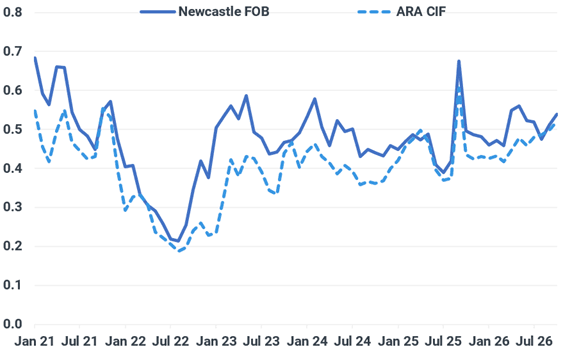
Indonesian coal has outperformed other benchmarks so far. The Indonesia 4,200 kcal/kg FOB price stood at 52% of Newcastle FOB in October 2026, up from 42% in November 2025. The ratio also remains well above those of other benchmarks.
Indonesian 4,200 kcal/kg vs FOB Newcastle and CIF ARA ratio (%)
Source: Marketview, Kpler Insight
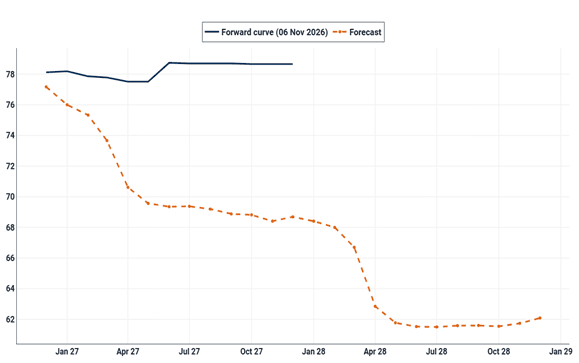
Indonesia’s supply outlook remains uncertain, as the government has not clarified the production schedule or its approach for next year. We expect the discount to other origins to widen in the long term, with our forecasts putting the ratio at 48% in January 2027. Indonesian coal needs to stay competitive against other origins to keep its industry operating.
India aims to raise domestic production further, and China has the ability to increase output. Both could come at the expense of Indonesia’s plans to sell its coal at a higher markup.
Indonesian 4,200 kcal/kg forecast vs forward curve ($/t)
Source: Kpler Insight, Marketview
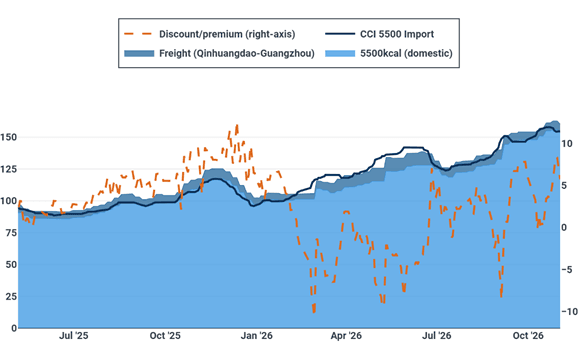
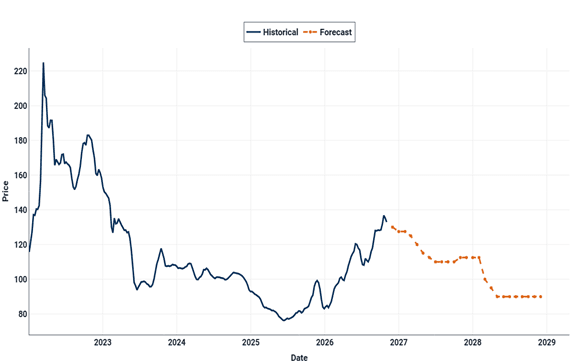
The import arbitrage into China is closed, which leaves little incentive to bid prices higher. We forecast CFR South China 5,500 kcal/kg to ease from current levels in the $130s/t to $120/t by the end of Q1 2027 and $110/t by the end of Q2 2027, in line with the direction of our other benchmark forecasts.
South China delivered imported vs domestic coal ($/t)
Source: Kpler Insight, SXcoal
CFR South China NAR 5,500 kcal/kg price forecast ($/t)
Source: Kpler Insight, SXcoal
Met coal: Chinese supply recovery caps prices
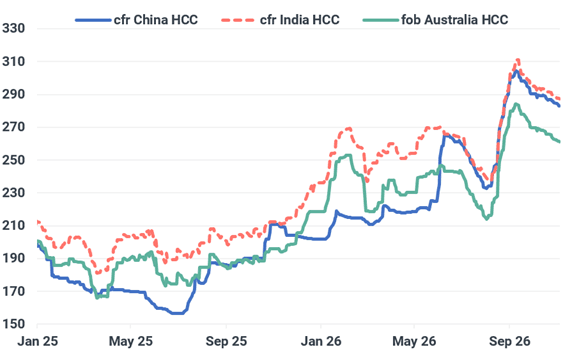
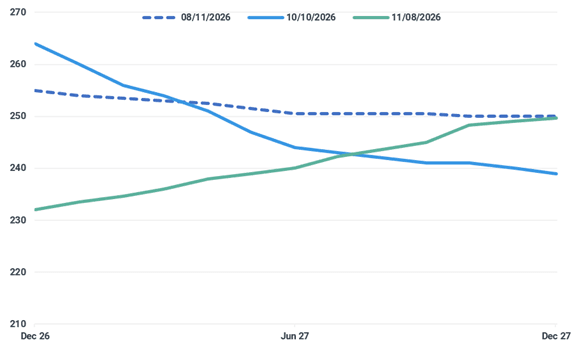
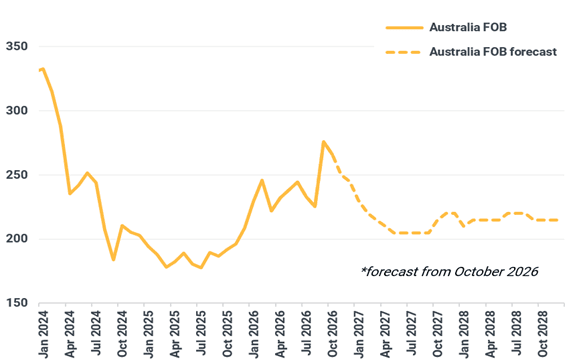
We expect premium low-volatile (PLV) metallurgical coal prices to ease gradually in the coming months. China’s need for imports should decline as Shanxi coal capacity returns. Government efforts to speed up mine resumptions are adding to domestic availability.
Chinese demand offers little support. Steel mills are keeping inventories lean and showing no urgency to build winter stocks, as steelmaking margins remain negative and hot metal production keeps falling. Elevated portside stocks should absorb short-term demand, which caps upside for seaborne prices.
Hard coking coal price history ($/t)
Sources: MarketView/Kpler Insight
FOB Australia premium hard metallurgical coal forward curve history ($/t)
Sources: MarketView/Kpler Insight
Premium hard metallurgical coal outlook price forecast ($/t)
Sources: MarketView/Kpler Insight
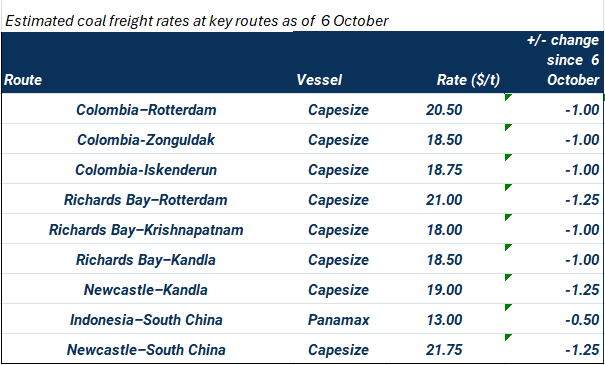
Coal Freight Rates
Implied coal freight rates, derived from Kpler's voyage calculator functionality. For feedback, please contact dry@kpler.com or fergene@kpler.com.
Source: Kpler Insight
Demand
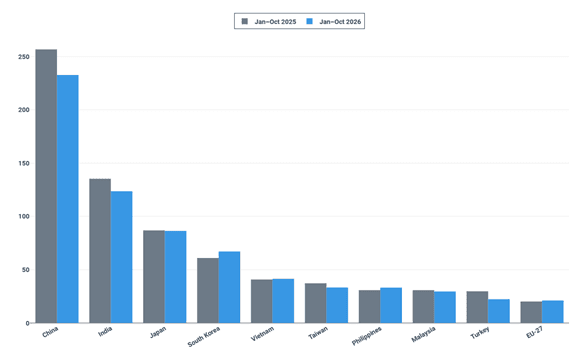
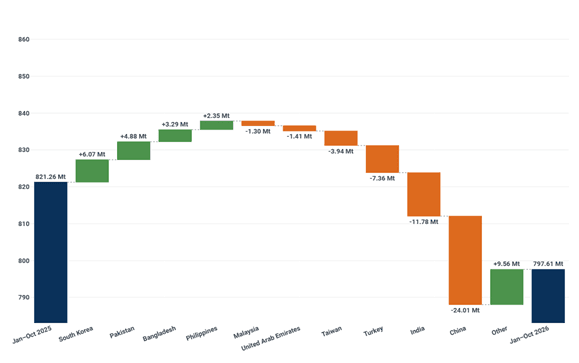
Seaborne thermal coal demand is strengthening into winter, led by Asian restocking and gas-to-coal switching where LNG supply remains short. Indian utilities are returning to the market to build inventories, and Japan needs 0.5 to 1Mt of extra imports in addition to its coal burn after entering the winter season with low stocks. South Korea’s coal-fired generation rose about 3GW y/y to 21GW in October, and the trend is likely to continue for the remainder of winter. Pakistan and Bangladesh need to source more coal while QatarEnergy’s force majeure on LNG runs through December.
China is the main restraint as we do not expect y/y gains for the rest of 2026. We expect higher receipts in 1H27 as winter drawdowns require restocking.
In the Atlantic basin, EU-27 imports rose in response to low gas inventories, but Germany has less than 10GW of available coal capacity, which caps coal burn potential. There is some emerging demand from Turkey for non-Russian supply, but this depends on Black Sea escalations continuing.
Key seaborne thermal coal imports Jan-Oct 2025 vs 2026 (Mt)
Source: Kpler
Key seaborne thermal coal y/y change Jan-Oct 2026 vs 2025 (Mt)
Source: Kpler
China: Import recovery pushed into 2027
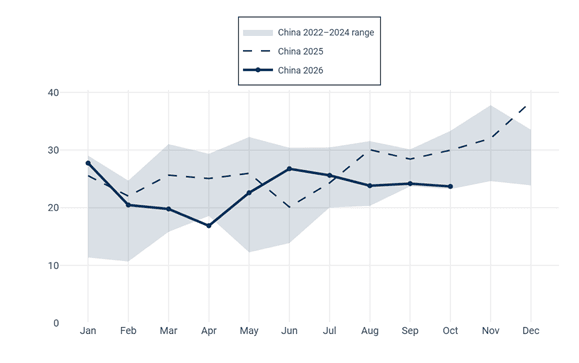
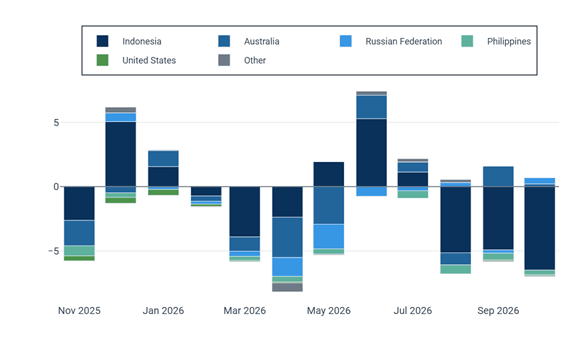
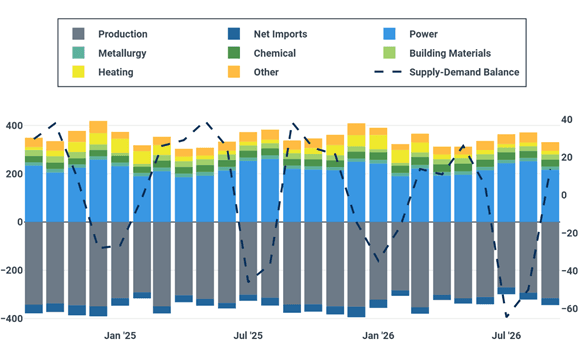
China has not increased its seaborne thermal coal imports since August, which tightened the supply-demand balance. Consumption rose gradually this year while domestic production did not, which pushed part of the demand potential into 2027. Imports in October were 25Mt, down by 4.5Mt y/y.
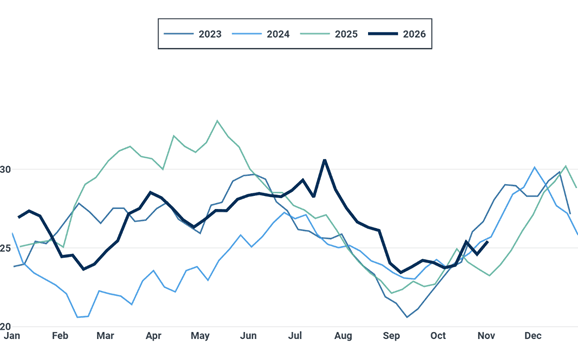
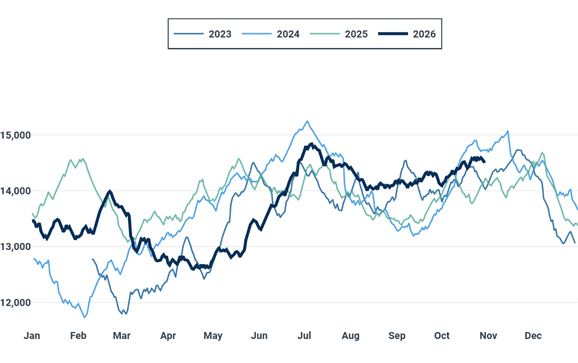
We expect this to translate into higher receipts in 1H27. Stockpiles at northern ports and southern utilities are in line with seasonal levels, at 25Mt and 14Mt respectively. Winter months should require higher imports, which leaves China with a firmer outlook.
However, we do not expect y/y increases for the remainder of 2026. Strong coal prices in global markets are making domestic supply more competitive, which leaves little room for China to boost receipts.
China seasonal coal imports (Mt)
Source: Kpler
China coal imports y/y (Mt)
Source: Kpler
China Bohai Rim coal stocks (Mt)
Source: SXcoal
China thermal coal supply demand balance (Mt)
Source: SXcoal
China coal stocks at six key utilities (Mt)
Source: SXcoal
India: Imports rebound sharply in October and stay elevated in November
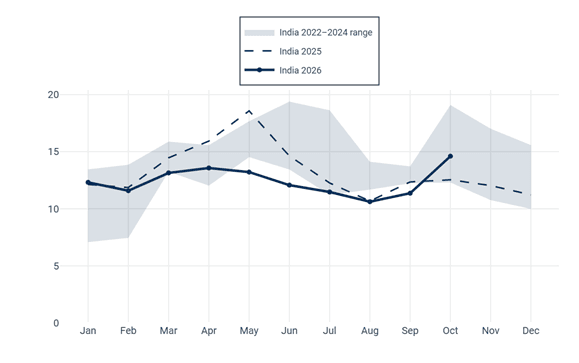
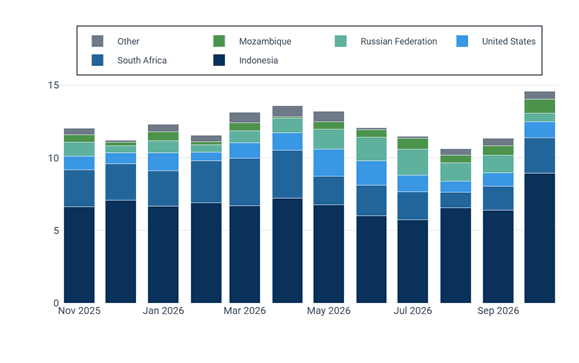
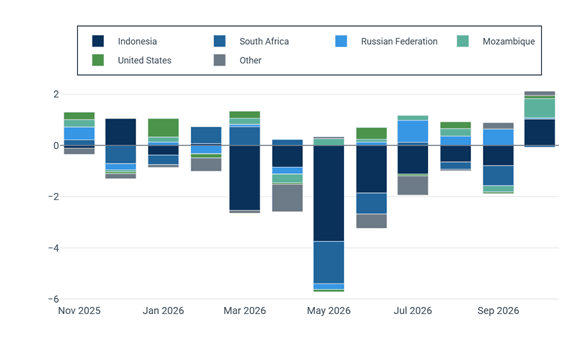
Indian thermal coal imports saw a sharp rebound in October gaining 29% m/m to 14.6Mt, driven by coal burn requirements. It was the highest month of 2026 and the first y/y gain since January, led by a 2.55Mt m/m rise in Indonesian arrivals. Imports were up 16% y/y from 12.55Mt as weak hydropower and warmer-than-usual weather conditions pushed more load onto coal. Power plant coal stocks fell to multi-year lows after months of record coal burn, with more than 50% of operating plants at critical stock levels. This forced utilities back to the seaborne market. India’s domestic production is failing to keep pace with increasing coal demand from the power sector.
India thermal coal imports (Mt)
Source: Kpler
India thermal coal imports by origin (Mt)
Source: Kpler
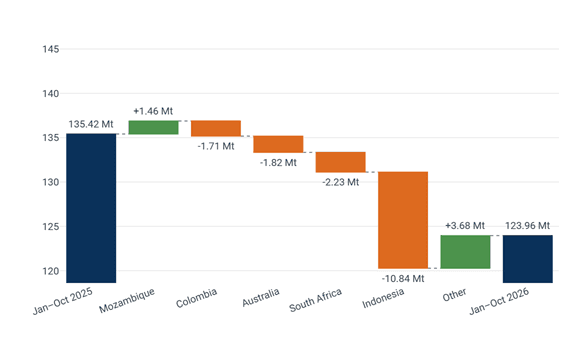
However, January to October imports fell 8.5% y/y to 123.96Mt, from 135.42Mt a year earlier. Indonesia drove the decline, down 10.84Mt and accounting for nearly all of the net decline. These losses were partly offset by Mozambique, up 1.46Mt, and other origins, up 3.68Mt.
India thermal coal imports (Jan-Oct 2026 vs 2025) (Mt)
Source: Kpler
India thermal coal imports y/y difference (Mt)
Source: Kpler
November imports in India are expected to rise y/y, with close to 10Mt of seaborne thermal coal already lined up to arrive. Coal stocks at power plants as of 28 October are still down 3% m/m at 20.39Mt, with 89 power plants at critical stock levels. Utilities should look to rebuild stocks before winter and festive demand strikes, starting in November and continuing into December.
Japan: Declining inventories to boost receipts
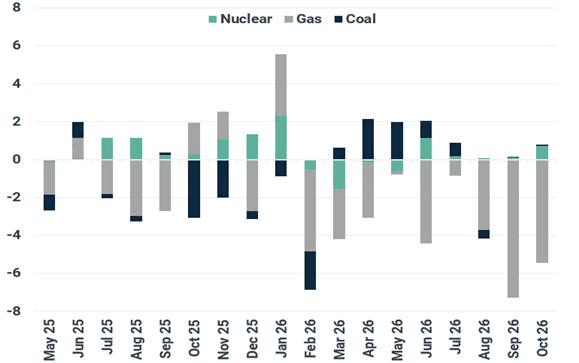
Fuel-switching fundamentals favour coal in Asia-Pacific’s premium markets of South Korea, Japan and Taiwan. However, residual power demand is lacking, as nuclear availability rose y/y and power demand declined. Coal generation is not growing and is only shielded from the demand destruction that gas is taking.
Japan’s coal-fired generation averaged around 24GW in October, almost unchanged y/y. The lack of demand growth led to a steep decline in gas-fired generation, which fell by around 5GW y/y over the month to 25GW. Nuclear availability is set to remain above 2025 levels until February, which is also likely to reduce the need for thermal generation by around 1GW y/y. This implies that, without a cold winter, there is limited scope for higher imports for Japan.
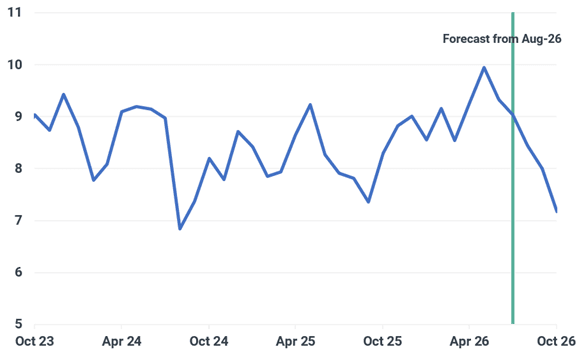
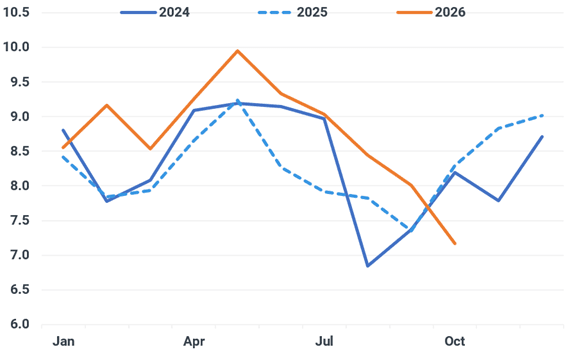
Meanwhile, Japan’s coal inventories are declining. We estimate utilities hold around 7Mt, below the seasonal level for winter. Japan burns around 8Mt/month of coal in winter, so current stocks cover less than one month of burn. We expect imports to step up above coal burn levels, as the buffer is thin. The current shortfall in inventories requires around 0.5 to 1Mt of imports in addition to existing coal burn levels in the country.
Japan baseload generation y/y (GW)
Source: Meti, Occto
Japan coal inventories (Mt)
Source: Kpler Insight, Meti
Japan seasonal coal inventories (Mt)
Source: Kpler Insight, Meti
South Korea: High gas prices increase coal burn
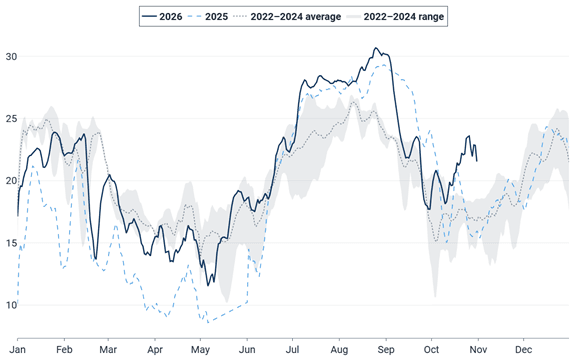
South Korea’s exposure to spot gas prices remains a catalyst for coal burn and gives it some of the largest switching potential in the region. Gas-fired generation declined by around 4GW to 13GW y/y in October. Average coal-fired generation rose by around 3GW y/y to 21GW as it displaced gas.
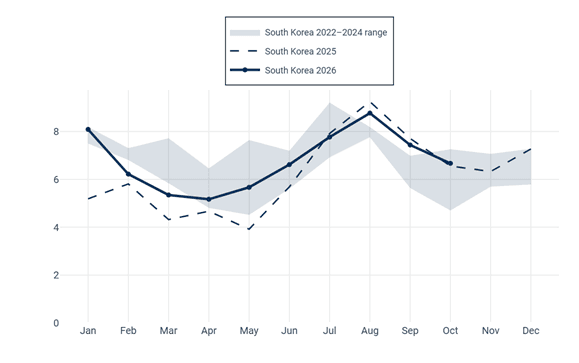
South Korea seasonal thermal coal imports (Mt)
Source: Kpler
Seaborne thermal coal imports were weak after utilities accumulated inventories ahead of summer. Imports are likely to recover in the coming months, as coal burn is on track to increase y/y. Utilities have also issued long-term tenders, including 1.6Mt from KOEN and 3Mt from KOSPO.
Current coal burn levels are well above 2025, averaging above 20GW, implying coal-fired generation is already climbing y/y.
S Korea coal-fired generation (GW)
Source: KPX
Philippines: Supply uncertainties to boost stockpiling efforts
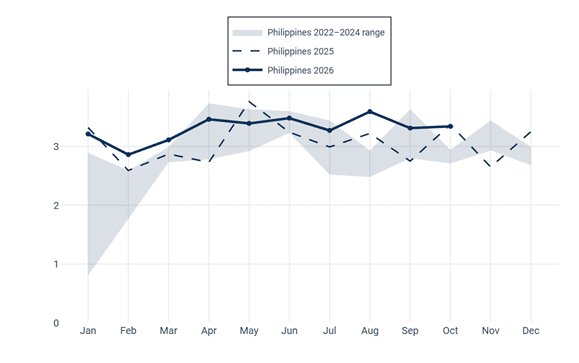
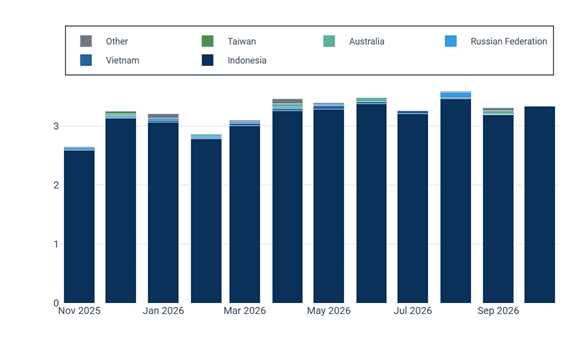
Philippine thermal coal imports were flat on a y/y basis, ending a four-month run of annual gains from June to September. Philippine buyers built precautionary stocks because of regulatory uncertainty around Indonesian coal. Indonesian authorities assured the government it would honour existing contracts, but relying on one country for around 90% of supply carries risk.
A possible drop in domestic supply availability also supports a firmer import outlook. Semirara Mining and Power Corporation's (SMPC) Acacia mine faced water-inflow problems, raising concerns over future coal production, while the government's mining contract auction was further delayed from October 2026 to November/December 2026 due to disagreements over bidding rules. SMPC's existing operating contract expires on 14 July 2027. A delayed award, insufficient preparation by a replacement operator and unresolved mining infrastructure issues look to disrupt domestic supply.
Philippine thermal coal imports (Mt)
Source: Kpler
Philippine thermal coal imports by origin (Mt)
Source: Kpler
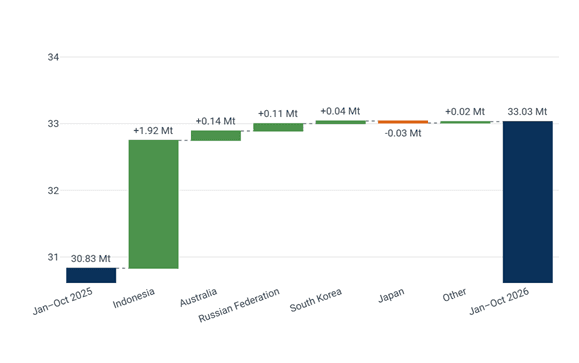
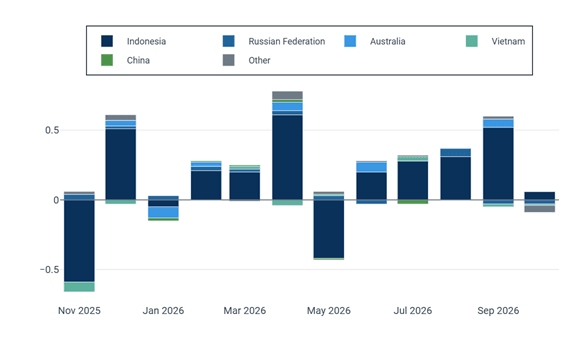
January to October imports rose 7.1% y/y to 33.03Mt, from 30.83Mt a year earlier. The increase was driven by Indonesia, which added 1.92Mt and accounted for nearly 90% of the gain.
Philippine thermal coal imports (Jan-Oct 2026 vs 2025) (Mt)
Source: Kpler
Philippine thermal coal imports y/y difference (Mt)
Source: Kpler
November imports are likely to rise on a y/y basis and stay above 3Mt, driven by the country’s limited domestic availability and inventory-building sentiment.
Vietnam: Imports return to growth
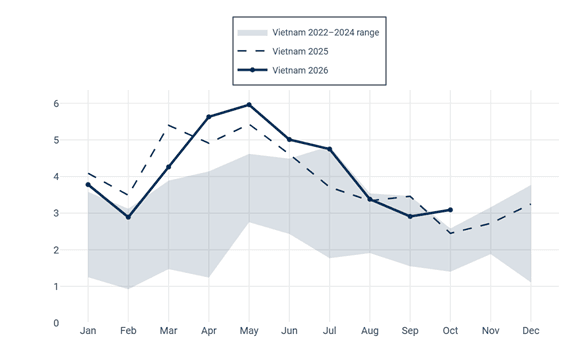
Vietnamese thermal coal imports returned to growth in October, in line with the country’s increasing coal burn potential.
The import uptick was largely driven by weak hydropower. The country saw lower-than-usual rainfall during the peak season and temperatures were 1-2 °C above seasonal levels between late September and late October.
Vietnamese thermal coal imports (Mt)
Source: Kpler
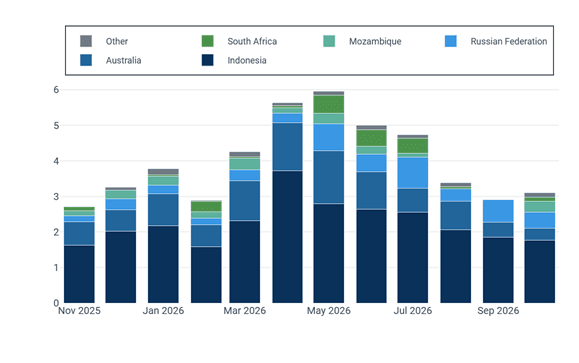
Vietnamese thermal coal imports by origin (Mt)
Source: Kpler
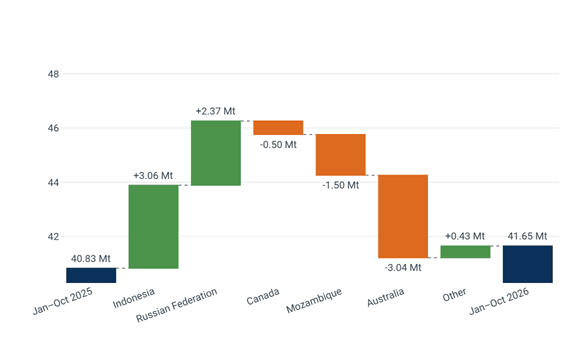
Vietnamese thermal coal imports (Jan-Oct 2026 vs 2025) (Mt)
Source: Kpler
Vietnamese thermal coal imports y/y difference (Mt)
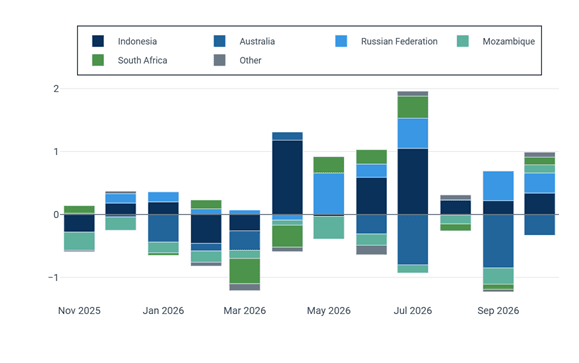
Source: Kpler
The Department of Water Resources Management has also warned that reservoirs may not hold enough water entering the 2027 dry season, giving generators a reason to build coal stocks early. Vietnam also relies on Indonesia.
Bangladesh: Thermal coal imports hit an all-time high
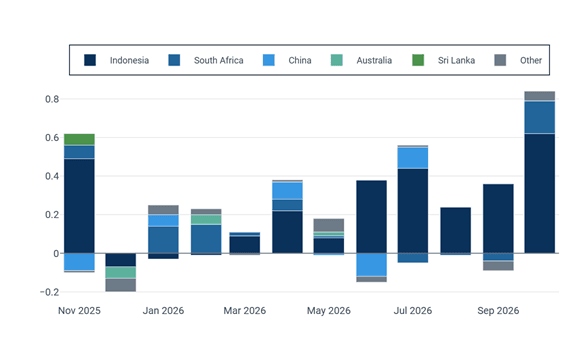
Bangladesh thermal coal imports hit an all-time high in October 2026, rising sharply on a m/m and y/y basis, driven by ongoing gas supply disruptions.
This import surge was largely driven by persistent gas shortages, coal restocking and seasonal demand from brick kilns. Limited LNG availability amid disruptions to international supplies constrained gas-fired power generation. As of 7 October, 35 gas power plants were shut and load shedding reached 2,500 MW, while gas-fired plants received only 895 million cubic feet per day against a requirement of 2,524 million cubic feet per day. This increased the need to maximise coal-fired generation to offset the shortfall in gas-based power.
At the same time, coal shortages forced major power plants to operate below capacity. The 1.3GW Patuakhali plant ran below a 50% load factor in September. The October jump in Indonesian coal arrivals is consistent with plants rebuilding inventories to raise generation and run closer to full capacity. Seasonal demand from brick kilns added further support, as kiln owners typically stock coal in October and November ahead of the dry-season brick-firing period.
Bangladesh thermal coal imports (Mt)
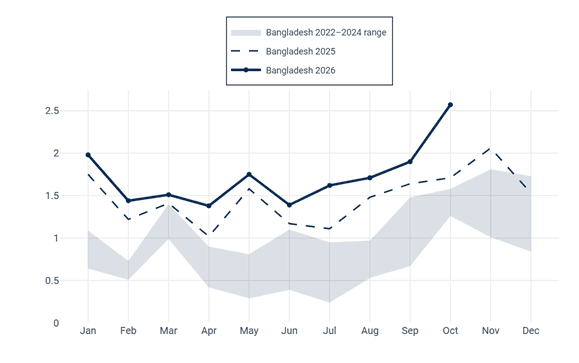
Source: Kpler
Bangladesh thermal coal imports by origin (Mt)
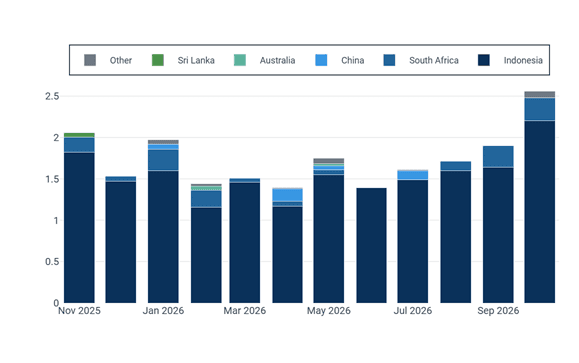
Source: Kpler
Bangladesh thermal coal imports (Jan-Oct 2026 vs 2025) (Mt)
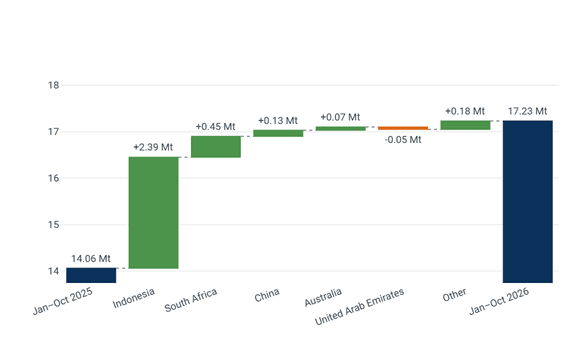
Source: Kpler
Bangladesh thermal coal imports y/y difference (Mt)
Source: Kpler
Bangladesh’s thermal coal imports in 2026 have already risen by nearly 5% y/y to 17.6Mt, setting a new annual record with two months remaining in the year. Surging gas prices and winter demand are likely to keep November imports up y/y for the country.
Pakistan: Imports to rebound in November, driven by lost LNG shipments
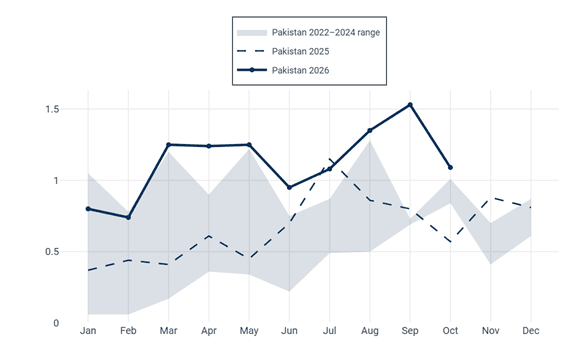
Pakistani thermal coal imports continued to increase in October, as the country turned to coal to offset its gas supply shortage.
Pakistani thermal coal imports (Mt)
Source: Kpler
Pakistani thermal coal imports by origin (Mt)
Source: Kpler
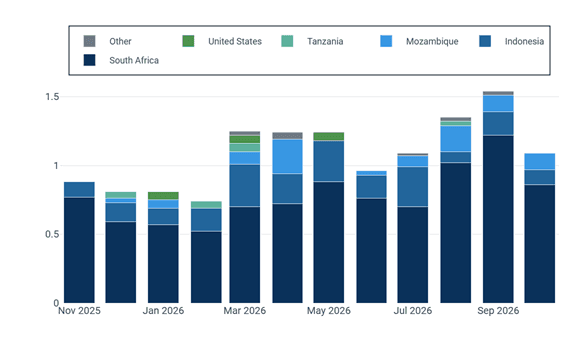
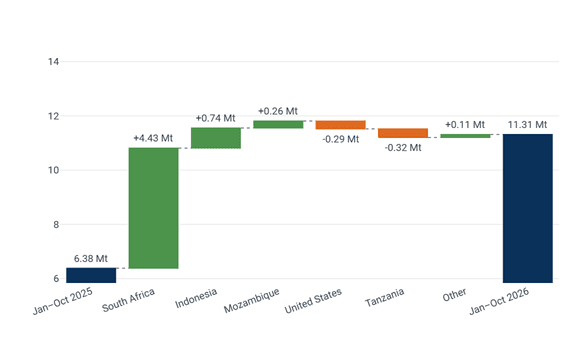
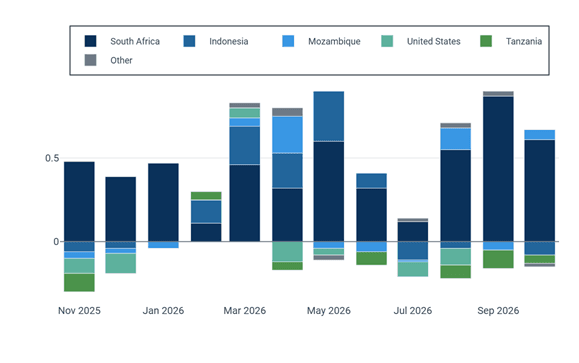
January to October imports rose 77% y/y to 11.31Mt, from 6.38Mt a year earlier. South Africa drove the increase, adding 4.43Mt and accounting for about 90% of the gain.
Pakistani thermal coal imports (Jan-Oct 2026 vs 2025) (Mt)
Source: Kpler
Pakistani thermal coal imports y/y difference (Mt)
Source: Kpler
Pakistan’s Sindh Engro Coal Mining Company (SECMC) also inaugurated the country’s Thar Block II expansion on 5 October. This expansion is set to raise the annual coal production capacity by 3.6Mt, increasing output to 11.2Mt per year from 2027 and has the potential to displace at least 1.9Mt of imported coal in Pakistan in 2027.
However, QatarEnergy’s extension of force majeure on contractual LNG deliveries to Pakistan through the end of December should support Pakistan’s thermal coal import demand for the last two months of the year.
EU-27/UK: Low gas storage supports coal burn
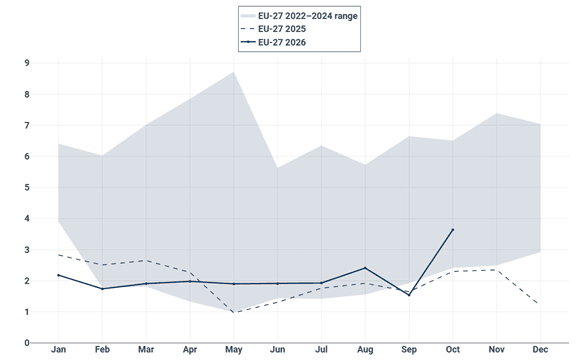
EU-27 seaborne thermal coal imports rose to around 3.65Mt in October, up from 1.55Mt in September and 2.3Mt in October 2025. Volumes remain in the lower half of the 2022 to 2024 range. Low Rhine water levels limited coal logistics over the month.
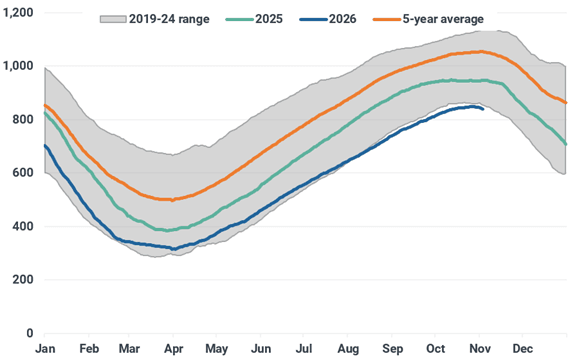
We see potential for higher y/y coal burn this winter. Gas storage is well below seasonal norms, and fuel-switching economics also favour coal over gas.
EU gas storage (TWh)
Source: GIE AGSI+
EU-27 thermal coal imports (Mt)
Source: Kpler
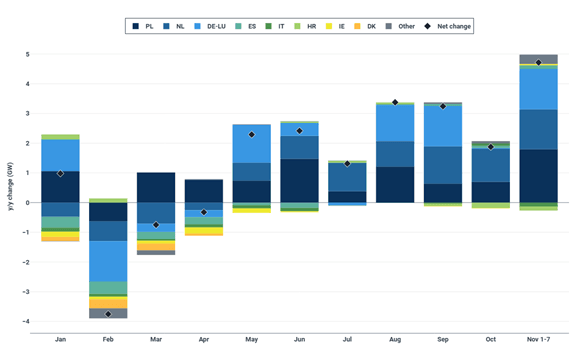
Coal-fired output rose in the first week of November, but this was mainly driven by the shortfall in wind generation as gas output did not decline sharply during the period.
Even under an aggressive gas-to-coal switching scenario, Europe’s coal burn potential is far below that of Asia-Pacific. Germany has less than 10GW of available coal capacity this winter. Italy and the Netherlands have less than 3GW combined on average. Poland’s coal needs are rising, as Poland must replace Kazakh coal, for which rail capacity through Russia is lacking. However, its burn potential is also limited.
EU-27 coal-fired (excluding lignite) generation y/y (GW)
Source: EEX
Turkey: Renewables and Black Sea disruption weigh on coal
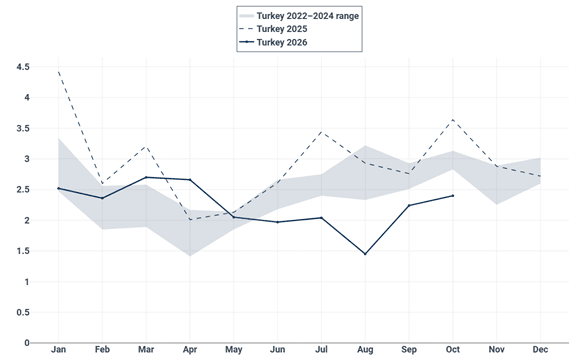
Renewables are pressuring coal burn in Turkey’s power sector, as wind and hydro generation remain above seasonal levels.
Hydro was up by 5.62GW y/y on average and wind rose by 0.58GW from January to October. Gas-fired output fell 4.04GW and hard coal fell 1.89GW. In October, hard coal generation was around 2.1GW lower y/y. Solar is also pressuring coal but is not visible in the statistics as plants below the reporting threshold are excluded from Energy Exchange Istanbul data.
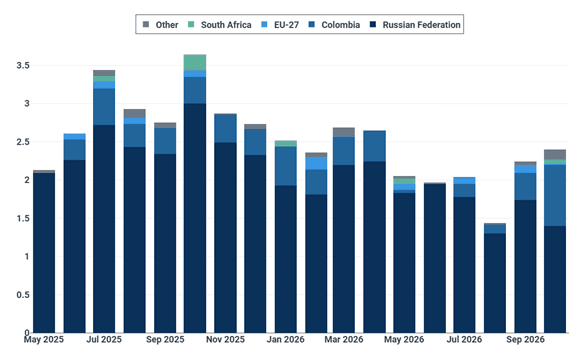
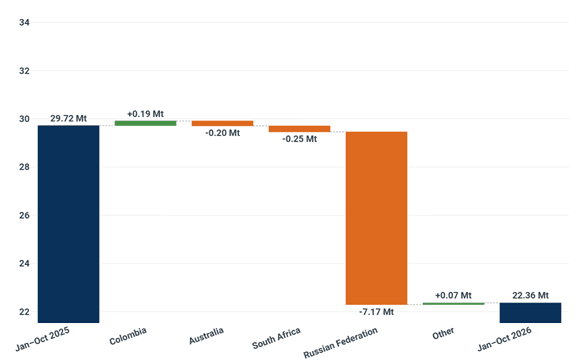
On the supply side, the lack of Russian flows from the Black Sea required higher imports from Colombia. We expect coal demand to close the year lower overall. Overall power generation rose only 0.51GW y/y in January to October, to 35.05GW from 34.54GW, which leaves little room for coal growth.
Turkey seasonal thermal coal imports (Mt)
Source: Kpler
Presidents Volodymyr Zelensky and Recep Tayyip Erdogan met in late October. Coal was not mentioned specifically in the aftermath of the meeting, but Erdogan voiced concern over civilian vessels being hit in the Black Sea, attacks that disrupted coal flows from Taman, the largest supplier port in the region. Once Taman reopens, we expect Turkish coal prices to fall to a discount to CIF ARA.
Turkey thermal coal imports (Mt)
Source: Kpler
Turkey thermal coal imports Jan-Oct (Mt)
Source: Kpler
Supply
Supply outlook: No constraints beyond Indonesia, Black Sea
Pacific supply remains tight, while Atlantic supply is being redistributed. Indonesian exports have recovered only mildly. Barging on the Barito River is normalising after the drought. Uncertainty over RKAB quotas adds risk to Indonesian supply. At the current balance, however, demand plays the larger role in setting prices in the Asia-Pacific basin.
Colombian coal stepped up to offset Black Sea disruptions, which curbed Russian exports, and to meet higher EU demand. The market enters winter with no major supply constraints other than Indonesia’s regulatory limits.
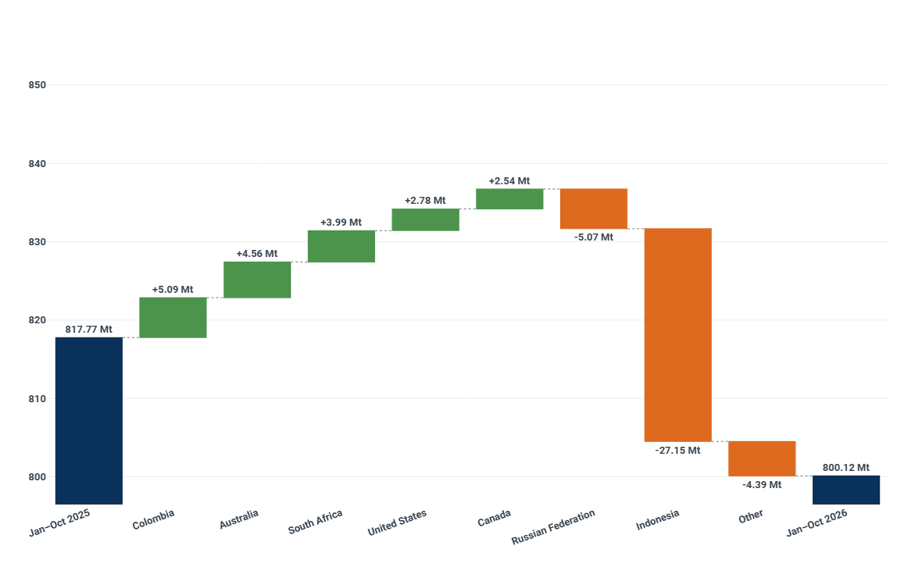
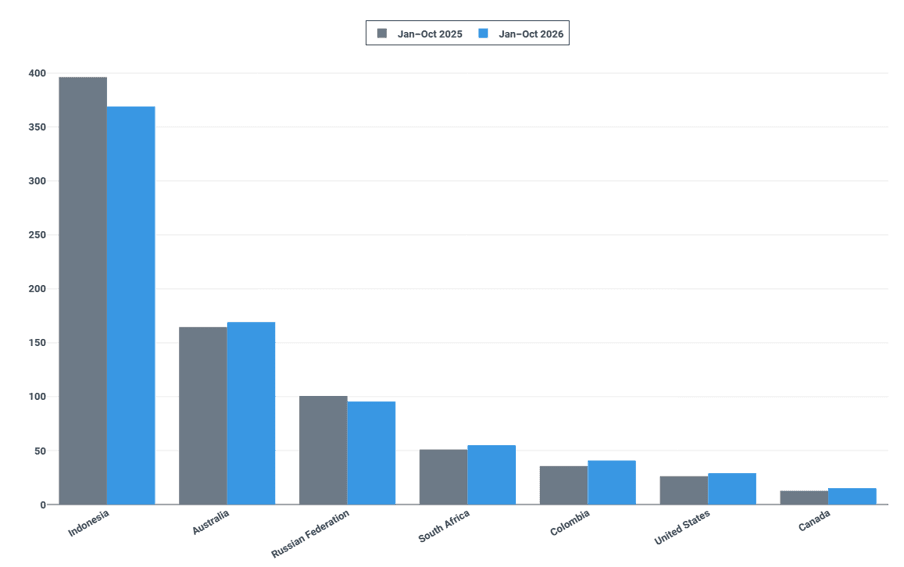
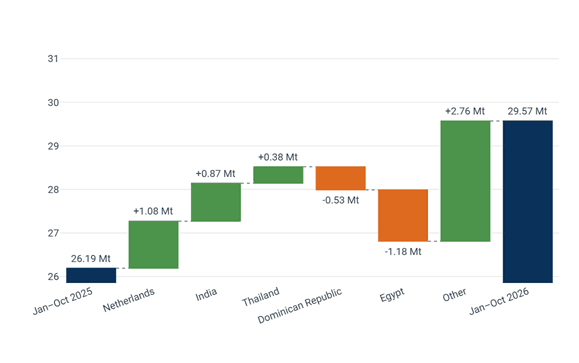
Russian western exports should stay limited while Black Sea tensions continue. Russian Railways has also restricted Kazakh export allocations, prioritising grain wagons. This is pushing buyers toward Colombia, where exports rose 14% y/y to 40.82Mt in January to October. South African exports rose 7% y/y to 54.75Mt over the same period. US exports rose 13% y/y to 29.57Mt on European demand and Asian tenders. A reopening of Taman would reverse part of this shift, which is the main risk for Atlantic suppliers.
Global seaborne coal exports (Mt)
Source: Kpler
Key seaborne thermal coal exports Jan-Oct 2025 vs 2026 (Mt)
Source: Kpler Insight
Key seaborne thermal coal exports 2025 vs 2026 (Mt)
Source: Kpler Insight
Australia: NE Asia’s demand recovery to support loadings
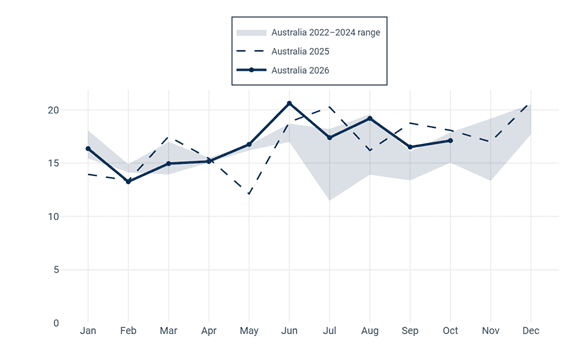
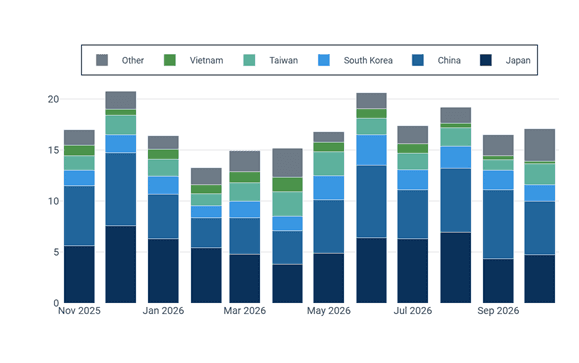
Australian thermal coal exports grew slightly, by 3% m/m, to 17Mt in October from September’s 16.5Mt, supported by resilient demand from Taiwan and Japan.
Taiwan’s coal burn has exceeded 7GW since the start of November, implying higher demand for the rest of the winter as higher LNG costs need to be absorbed in countries relying on spot LNG.
We expect November thermal loadings to rise to around 19Mt, as North Asian buyers stock coal ahead of winter. Japan’s utilities hold about 7Mt, below seasonal levels. Rebuilding that buffer requires 0.5 to 1Mt of imports on top of coal burn.
South Korea’s coal-fired generation averages above 20GW, up around 3GW y/y. China’s closed import arbitrage against domestic supply is likely to limit its demand for Australian thermal coal, suggesting limited room for growth above seasonal levels.
But China’s demand for metallurgical coal imports should continue to lift receipts of Australian coal. This boost is only temporary and is likely to ease once China’s supply conditions improve.
Australia thermal coal exports (Mt)
Source: Kpler
Australia thermal coal exports by destination (Mt)
Source: Kpler
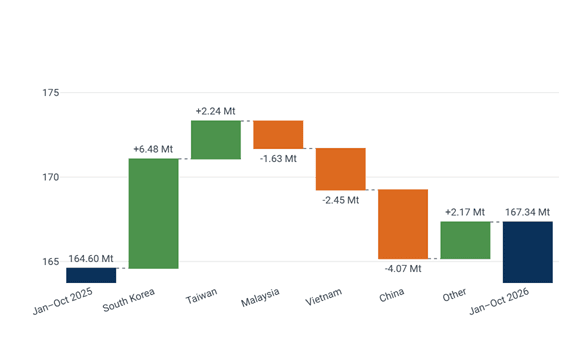
Australia thermal coal exports (Jan-Oct 2026 vs 2025) (Mt)
Source: Kpler
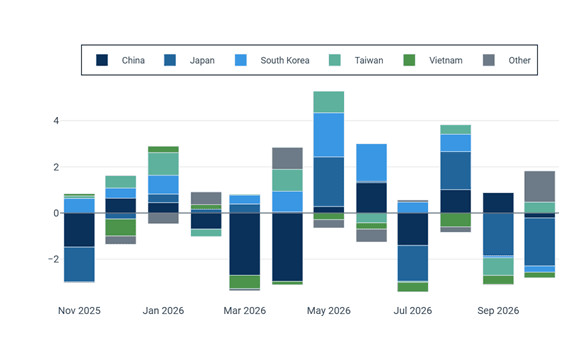
Australia thermal coal exports y/y difference (Mt)
Source: Kpler
Indonesia: Recovering water levels to support exports
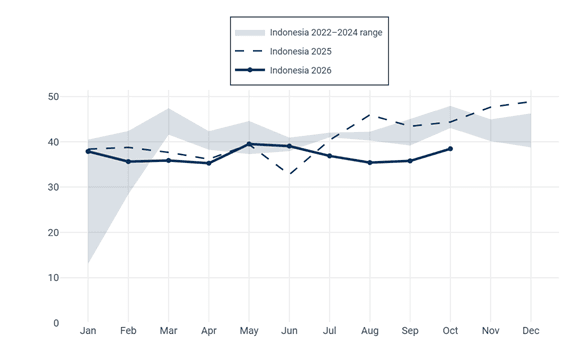
Indonesia’s export volume is mildly recovering after remaining in the mid-30s Mt since summer. The increase is attributable to demand-side recovery as India’s and China’s imports have started to edge higher.
Indonesian coal exports (Mt)
Source: Kpler
Drought since July lowered water levels on the Barito and Mahakam rivers. Heavier rainfall in mid-to-late October allowed barging to normalise gradually.
Government quota policy is the main constraint on supply. Indonesia’s energy minister confirmed that the government will keep strict control over RKAB (Work Plan and Budget) quotas to prevent overproduction and protect prices. This points to tight supply in 2027 too, but without its price advantage Indonesia would struggle to maintain market share.
Despite the ongoing LNG supply constraints in the market, seaborne thermal coal trade did not grow in 2026. India’s and China’s ability to boost production remains a long-term constraint on Indonesia’s strategy to limit volumes to raise revenue from its mining sector.
The Energy Ministry (ESDM) plans to exclude coal sales to smelters’ captive power plants from domestic market obligation (DMO) calculations. The regulation has not yet been enacted. If enacted this should direct more mid-calorific value (mid-CV) coal to grid plants run by state utility PLN, as producers would need to sell more volumes to the power sector to fill their DMOs.
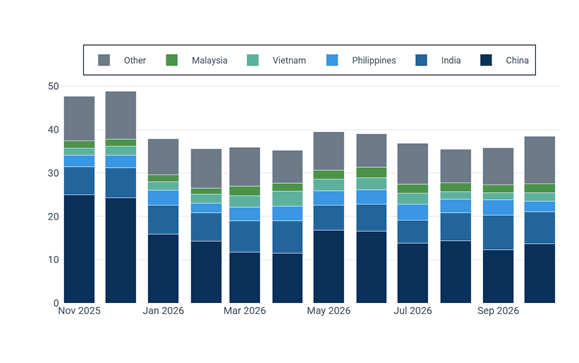
Indonesian coal exports by destination (Mt)
Source: Kpler
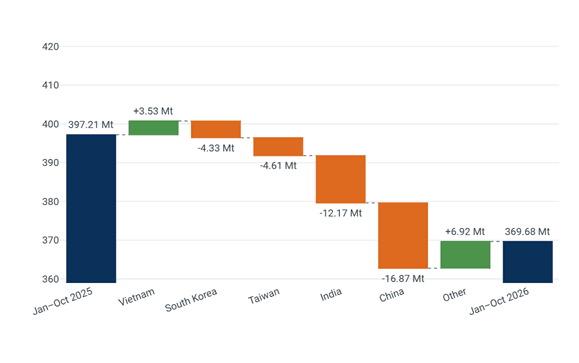
Indonesian coal exports (Jan-Oct 2026 vs 2025) (Mt)
Source: Kpler
Indonesian coal exports y/y difference (Mt)
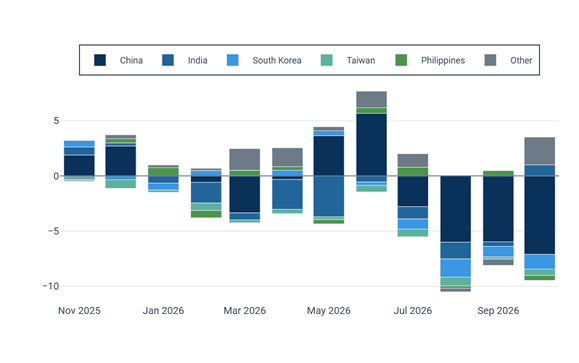
Source: Kpler
Russia: Western exports to remain limited in November
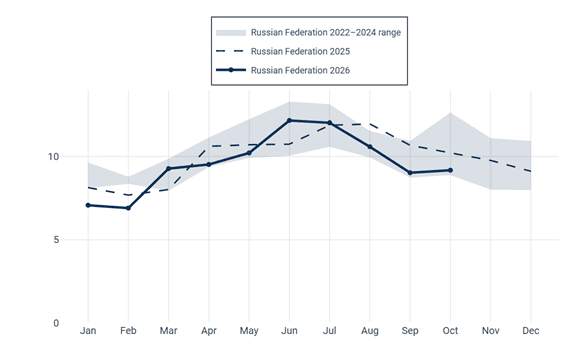
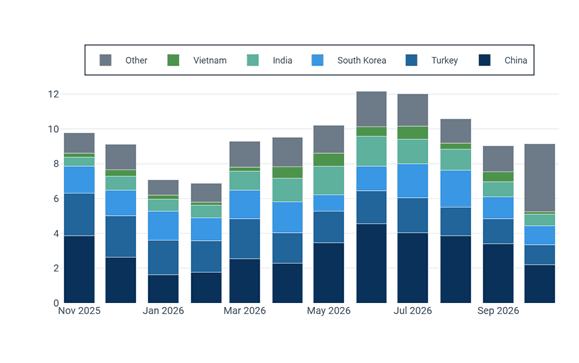
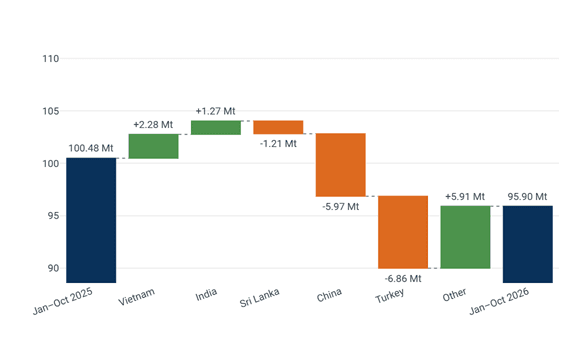
Russia is struggling to maintain volumes as demand from its main buyers, China and Turkey, remains sluggish. China’s winter buying should offer some relief in the coming months.
In the Atlantic basin, Russian producers cannot supply the Mediterranean basin unless tensions ease in the Black Sea. We expect Turkish cement sector buyers to bid higher for petcoke while coal loses competitiveness. Utilities are likely to increase Colombian purchases as availability from northwest Russian ports remains constrained.
Despite higher prices, the Russian mining industry is still under pressure, with major producers finding it hard to stay profitable due to high fuel costs and lack of growth potential from main markets.
Kazakh coal exports through Russia were also disrupted because Russian Railways restricted export allocations and prioritised grain wagons.
Russia thermal coal exports (Mt)
Source: Kpler
Russia thermal coal exports by destination (Mt)
Source: Kpler
Russia thermal coal exports (Jan-Oct 2026 vs 2025) (Mt)
Source: Kpler
South Africa: Asian demand to support winter shipments
South African thermal coal exports remain firm, as it is the most viable alternative for countries that were affected by the LNG supply disruptions.
South African thermal coal exports (Mt)
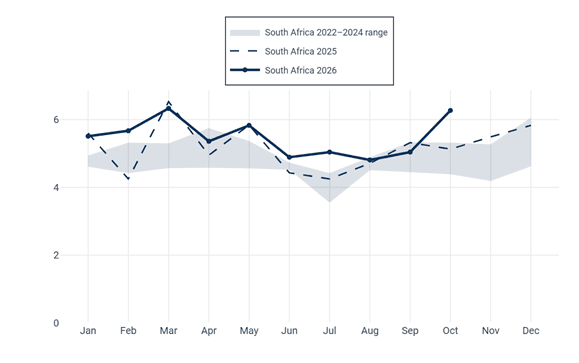
Source: Kpler
South African thermal coal exports by destination (Mt)
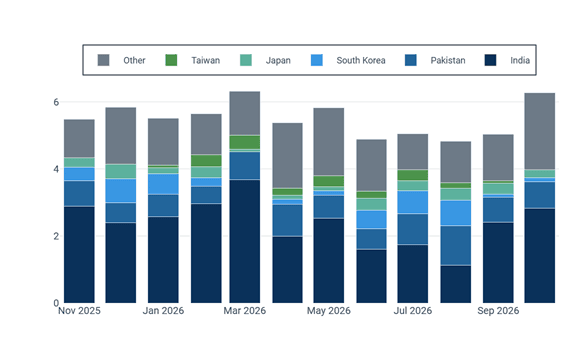
Source: Kpler
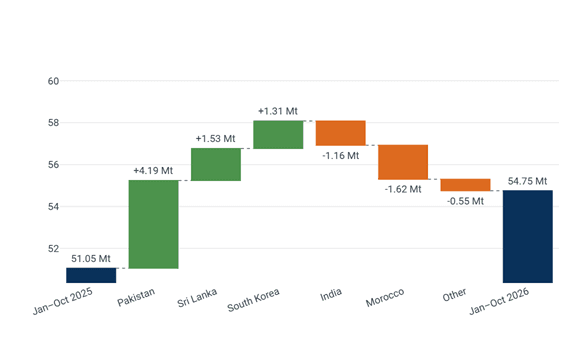
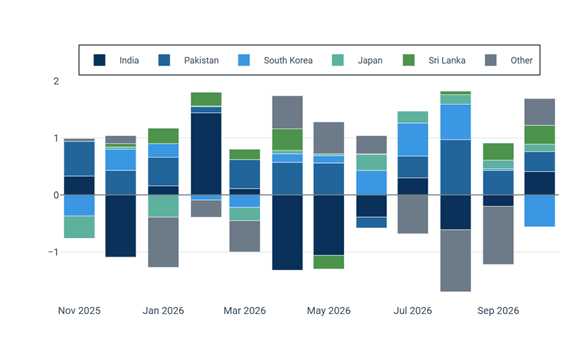
January to October exports rose 7% y/y to 54.75Mt, from 51.05Mt a year earlier. Pakistan drove the increase, adding 4.19Mt, with Sri Lanka adding 1.53Mt and South Korea 1.31Mt.
These gains were partly offset by lower shipments to Morocco, down 1.62Mt, India, down 1.16Mt, and other destinations, down 0.55Mt.
South African thermal coal exports (Jan-Oct 2026 vs 2025) (Mt)
Source: Kpler
South African thermal coal exports y/y difference (Mt)
Source: Kpler
Colombia: Atlantic basin demand lifts exports
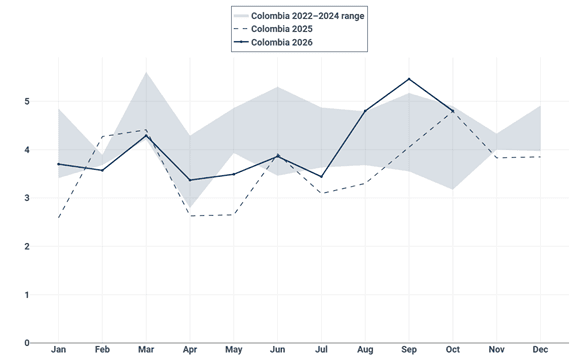
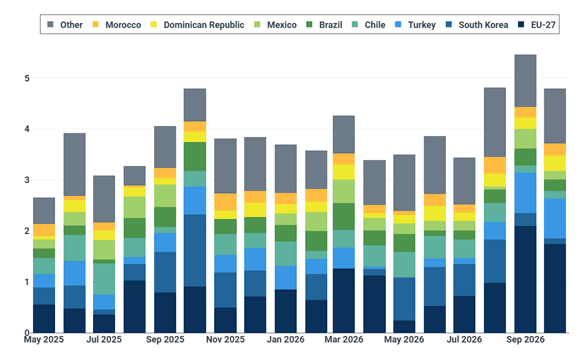
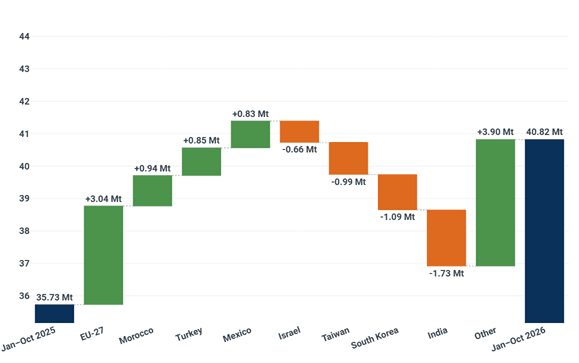
Growth in Colombian volumes is coming from the Atlantic basin, with exports up 14% y/y to 40.82Mt in January to October. Europe and Turkey emerged as the growth markets for Colombia this year.
Colombian seasonal thermal coal exports (Mt)
Source: Kpler
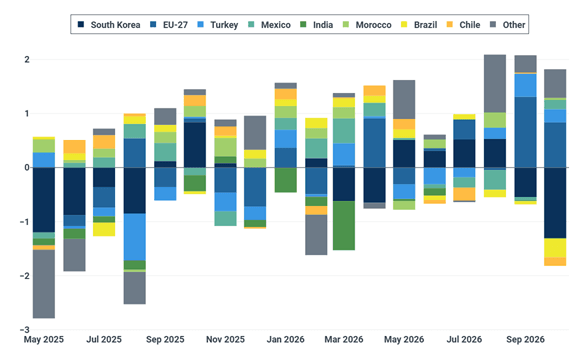
South Korea is not taking more Colombian supply, with volumes down 1.09Mt y/y. The displacement of Russian coal in Turkey is likely to be temporary, as it depends on continued disruption in the Black Sea. European volumes are rising from last year’s low base. Buyers are also anticipating higher coal burn this winter.
Colombian thermal coal exports by destination (Mt)
Source: Kpler
Colombian thermal coal exports (Jan-Oct 2026 vs 2025) (Mt)
Source: Kpler
Colombian thermal coal exports y/y difference (Mt)
Source: Kpler
North America: United States
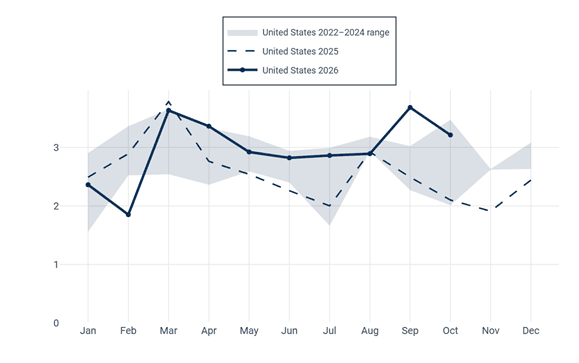
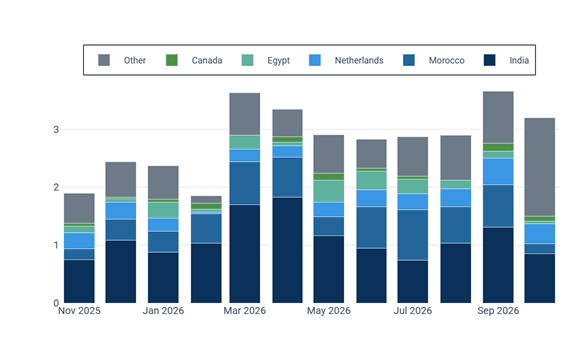
US thermal coal exports remain well above seasonal levels due to a combination of higher Atlantic demand and increased interest from India.
The increasing competitiveness of US Northern Appalachian coal against petcoke is driving higher loadings into India, and the EU’s import intake is increasing from last winter’s low base.
US thermal coal exports (Mt)
Source: Kpler
US thermal coal exports by destination (Mt)
Source: Kpler
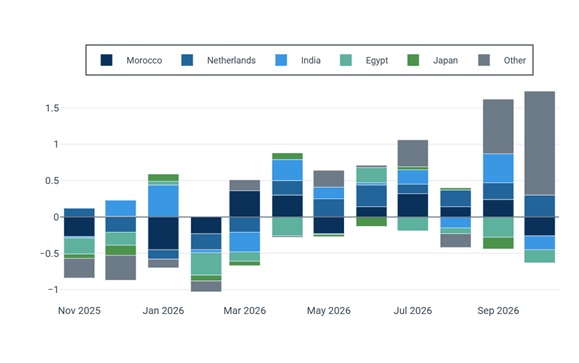
Higher shipments to India and the EU were partly offset by lower shipments to Egypt. Egypt has started to reduce its intake of petcoke and coal after a steep rise in receipts in July to build stocks.
US thermal coal exports (Jan-Oct 2026 vs 2025) (Mt)
Source: Kpler
US thermal coal exports y/y difference (Mt)
Source: Kpler

See why the most successful traders and shipping experts use Kpler