

CTA selling reinforces wheat’s pullback from three-year highs
On Sep 25, Trend-following CTAs cut wheat exposure to 45% long, the sharpest daily selling since Jul 2025, amplifying the pullback despite persistent supply risks.
In early September, US wheat rallied to its highest since Jan 2023, near 800 US¢/bu, amid a tightening supply backdrop, export disruptions and rising logistics costs. Elevated fertilizer and fuel costs have shifted acreage toward competing crops, with US wheat acreage at its lowest since 1960, while a weak Indian monsoon threatens the 2027 winter crop. At the same time, Russian and Ukrainian exports remain heavily disrupted, while Russia’s shift toward Baltic and Arctic ports has replaced only around a tenth of Black Sea volumes this month, from a region that accounts for roughly a third of global wheat trade.
Bullish momentum has eased over the past three weeks. Peace-talk optimism pressured CBOT futures on hopes of revived Black Sea flows, even as continued Russian-Ukrainian attacks kept exports minimal. At the same time, El Niño risks to Australia proved less severe than feared, with soil moisture showing limited stress, prompting an upward revision to Australian wheat production.
The loss of momentum has been reinforced by broad CTA selling. Trend-following CTAs held 100% long exposure from Sep 2–11, the first maximum-long position since Mar 2022, before selling ~5.8k lots (29 mbu) on Sep 14–15, reducing exposure to 82% long.
Selling accelerated on Sep 25, with ~19.5k lots (97 mbu) sold at 697–702 US¢/bu across three strategies (the sharpest daily selling since Jul 2025), cutting exposure to a seven-week low of 45% long and reinforcing the move below 690 US¢/bu. This unwind was preceded by Reversion CTAs shifting from 14% long on Sep 3 to -100% short by Sep 11, selling ~5.9k lots net (29 mbu) and adding to downside pressure.
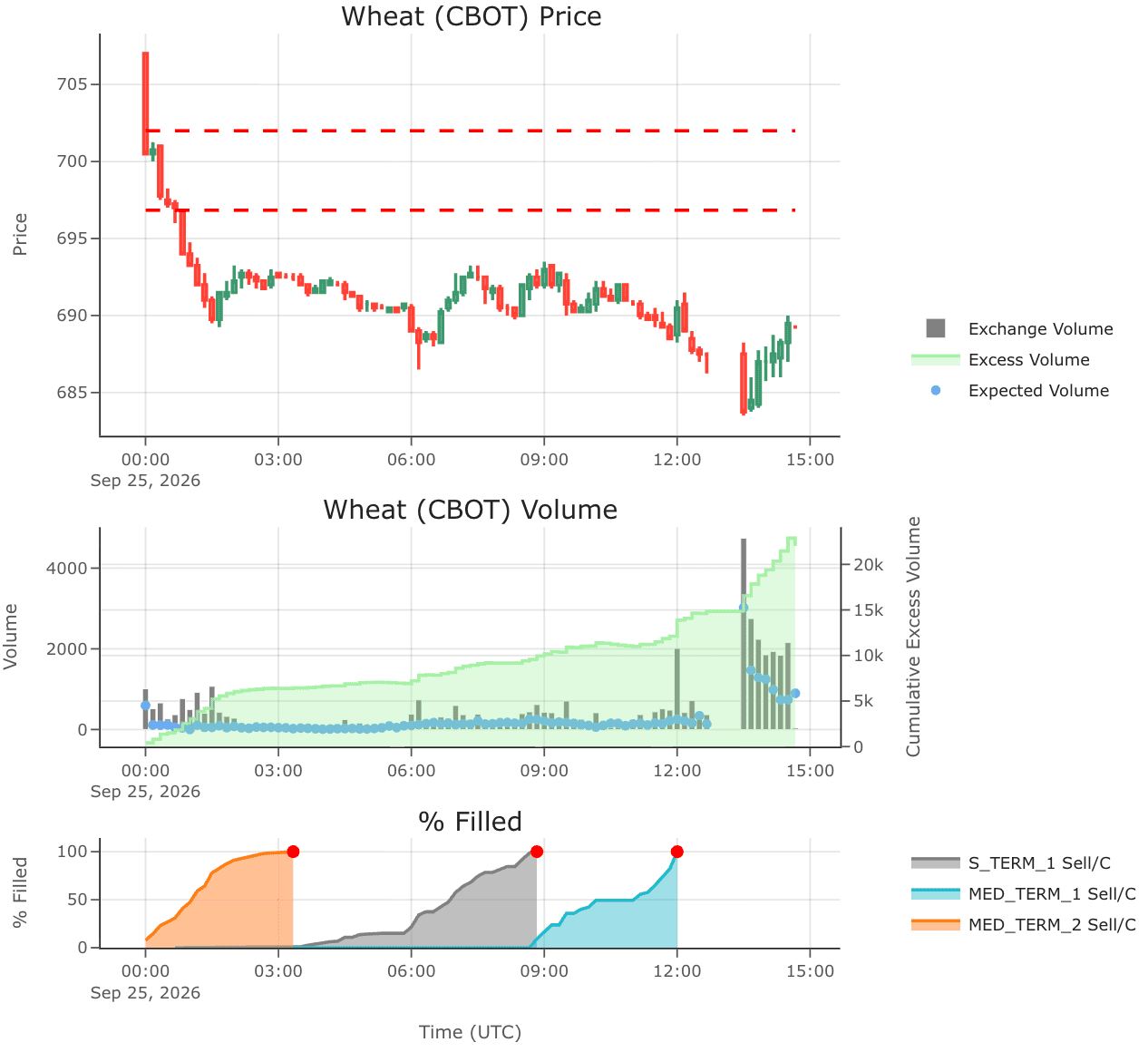
Source: Kpler Financial Flows
This report draws on Kpler Financial Flows. The full dataset delivers daily and intraday CTA positioning, order stacks, and flow estimates - allowing you to track systematic moves as they develop, rather than after the fact.

See why the most successful traders and shipping experts use Kpler
.jpg)