


Geopolitical risk to keep LNG prices elevated
A lack of perceived progress in negotiations surrounding a potential reopening of the Strait of Hormuz saw global LNG prices increase w/w. Though moderating temperatures is expected to lower consumption in many key markets, elevated Indian procurement and restocking needs in East Asia will keep prices near seasonal highs.
Market & Trading Calls
European TTF front-month price outlook: Slightly bearish, with improving fundamentals expected to weigh on prices. Higher LNG and pipeline supply, alongside an expected decrease in temperatures and improved wind speeds, will ease the European market balance into next week. However, declining nuclear generation in Eastern Europe and deteriorating hydro conditions could provide some support on the fundamentals front. Geopolitics will remain a key source of price volatility to the outlook.
Asian LNG front-month price outlook: Stable, as cooler regional weather, softer South Korean gas burn, and a slightly bearish TTF outlook cap upside, while stronger Indian LNG requirements, below-seasonal inventories in Japan and South Korea, and the near-flat rollover to the October contract provide a price floor. Persistent Strait of Hormuz supply risks remain the key upside risk.
Asian LNG – TTF spread outlook: set to slightly widen, as Asian LNG remains stable while TTF decreases slightly. Over the last week, the Asian LNG premium over TTF narrowed, with the spread at $0.83/MMbtu on 13 August, compared to $3.17/MMbtu on 5 August.
US Henry Hub front-month price outlook: Stable, as gains from hotter temperature forecasts for mid-August are offset by strong production and robust storage.
Key natural gas and LNG front-month prices ($/MMBtu)
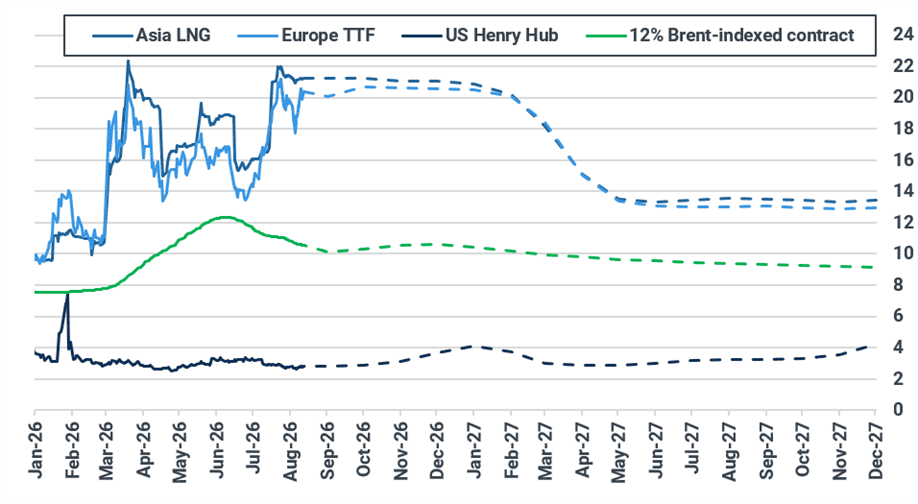
Source: ICE, NYMEX. Brent-indexed price represents 12% slope of 90-day moving average of Brent contract.
Asian LNG-TTF front-month spread ($/MMBtu)
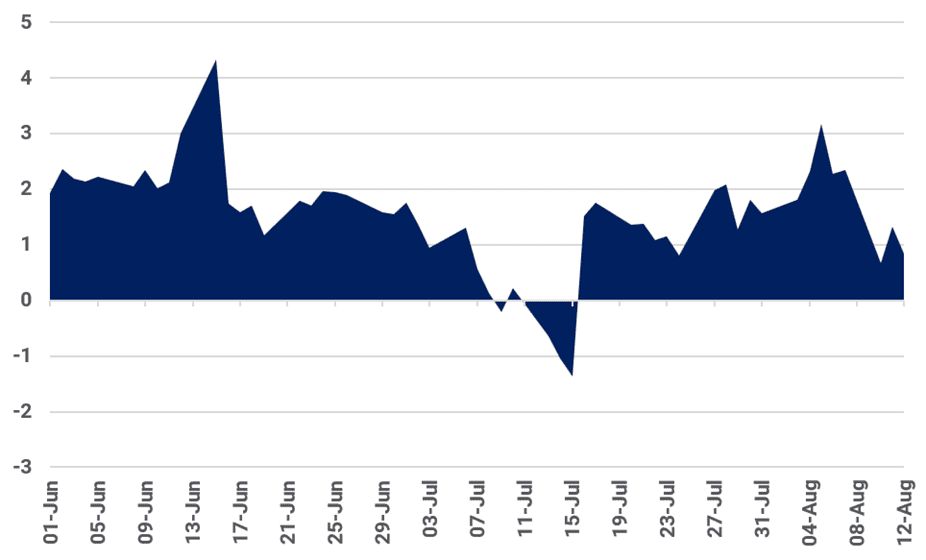
Source: ICE, Kpler Insight
Europe: TTF outlook turns softer on higher supply and weaker demand
The European TTF front-month contract rallied last week, settling at $20.41/MMBtu on 12 August, up 1.5% from $20.15/MMBtu on 5 August. The price increase was primarily driven by an update to the maintenance schedule for Norway’s Ormen Lange field, which will make around 1 bcm of gas supply from Norway to Europe unavailable during the winter period. Additionally, concerns regarding stalled negotiations that could lead to the reopening of the Strait supported front-month prices. Fundamentally, weekly gains in LNG imports more than offset the losses in net pipeline supply resulting from ongoing maintenance at the Shah Deniz field in Azerbaijan. However, relatively resilient consumption due to strong gas-fired generation led to a slight slowdown in net injections into underground gas storage facilities.
Looking ahead, Kpler Insight maintains a slightly bearish outlook on the TTF front-month contract for next week. Higher LNG and pipeline supply, alongside an expected decrease in temperatures and improved wind speeds, will ease the European market balance into next week. Though, declining nuclear generation in Eastern Europe and deteriorating hydro conditions could provide some support. Additionally, geopolitics will continue to pose both upside & downside risks to the outlook.
EU net pipeline imports declined 3% w/w to an estimated 3.08 bcm. The decrease was driven by lower imports from Azerbaijan, as maintenance continues at the Shah Deniz field throughout August, and slightly lower flows from the UK to the EU. All other major supply sources remained stable w/w. Looking ahead, Kpler Insight expects net pipeline imports to increase, as more supply is expected to be available from Norway in the coming days, according to Gassco’s maintenance schedule.
Azeri flows to the EU (bcm)
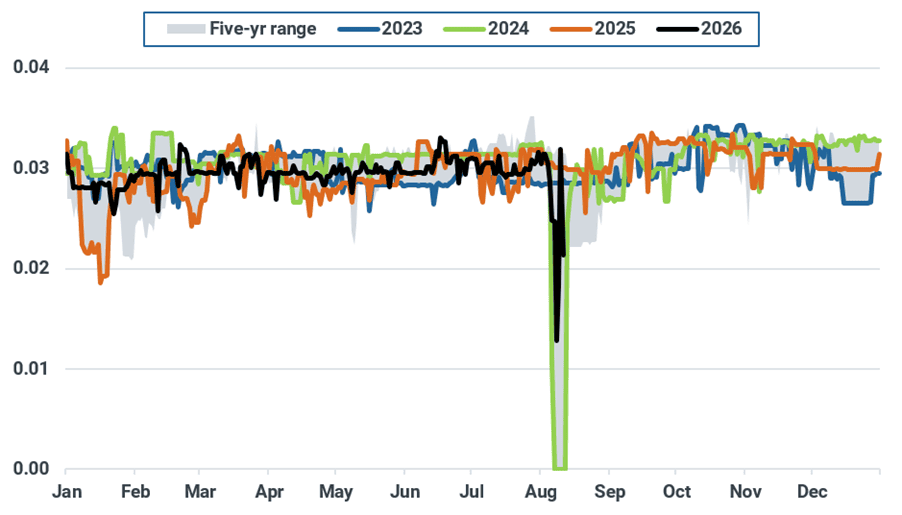
Source: ENTSOG
GASSCO scheduled unavailability for selected fields (mcm/m)
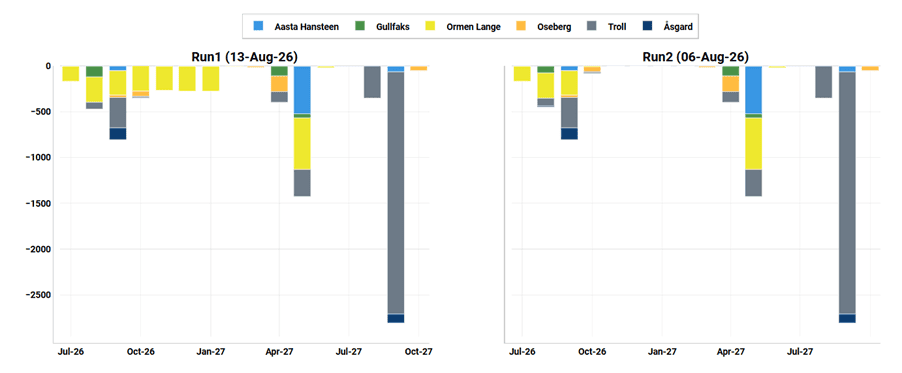
Source: GASSCO
European LNG imports grew by 14% w/w to an estimated 1.74 mt, driven by higher imports into Spain. The increase results partially from higher LNG capacity availability in the country following a period of deep maintenance at several of its LNG terminals as well as from vessel diversions from Egypt to Spain following an attack on Egypt’s Damietta port. Meanwhile, higher LNG imports into NWE were driven by higher imports in the Netherlands, likely due to a stronger TTF position relative to other regional hubs. Looking ahead, Kpler Insight expects LNG imports to increase, particularly in Spain, Italy and the Netherlands, mainly as domestic buyers continue to restock in LNG and underground gas storage facilities.
European weekly LNG imports by region (mt)
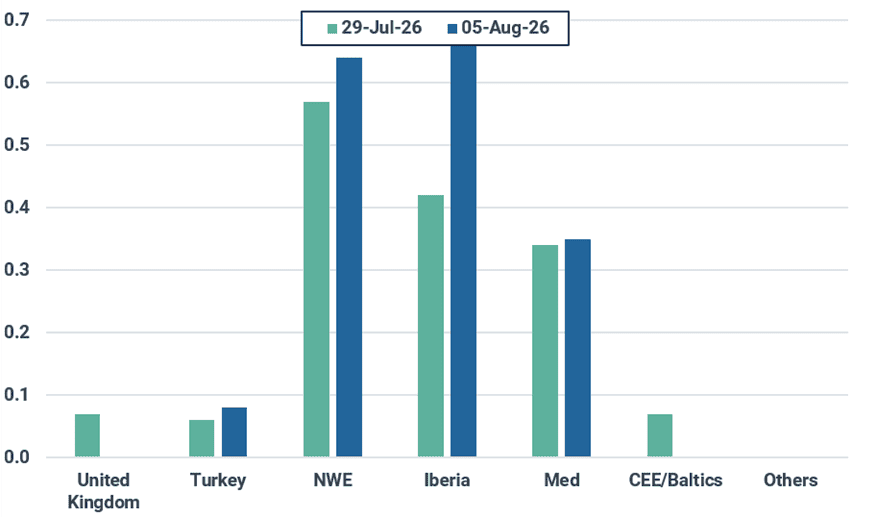
Source: Kpler Insight. Data represents week commencing 29/07 and 05/08. NWE=FR, BEL, NL, GER. Iberia=ESP, POR. Med=ITA, HVR, GRE. Baltics/CEE=FI, LT, POL. Others=SWE, MT.
Aggregate local distribution consumption across 16 EU countries decreased by 4% w/w to an estimated 0.81 bcm, largely due to above-average temperatures and the typical consumption slowdown expected during the peak holiday season. Looking ahead, Kpler Insight expects local distribution demand to remain subdued as the holiday season continues across several parts of Europe, particularly in Italy.
EU-16 weekly consumption in the local distribution sector (bcm)
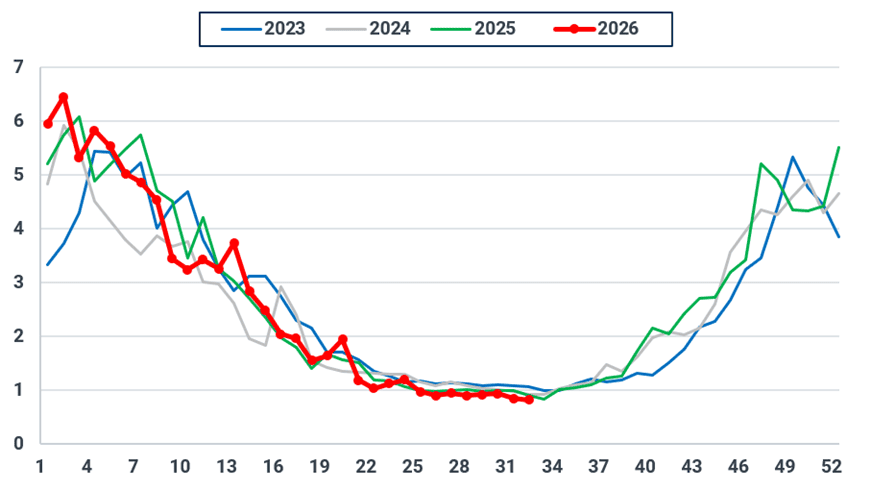
Source: ENTSOG, ENAGAS, Eustream, AGCM, Kpler Insight. The EU-16 perimeter includes AT, BE, DE, CZ, FR, HU, GR, IT, NL, LU, PL, PT, RO, SL, SK, and ES.
EU-25 gas-fired generation decreased by 5% w/w to an estimated 7.5 TWh, driven by lower power demand. However, gas burns remained higher than in previous years, due to lower nuclear and hydro generation, particularly in Eastern Europe, Italy, and France. Looking ahead, gas-fired generation is expected to decline as temperatures are forecast to edge lower into next week, alongside improved wind speeds in parts of Europe. However, lower nuclear generation in Romania and France could provide support if capacity remains constrained.
EU-25 weekly gas-fired generation (TWh)
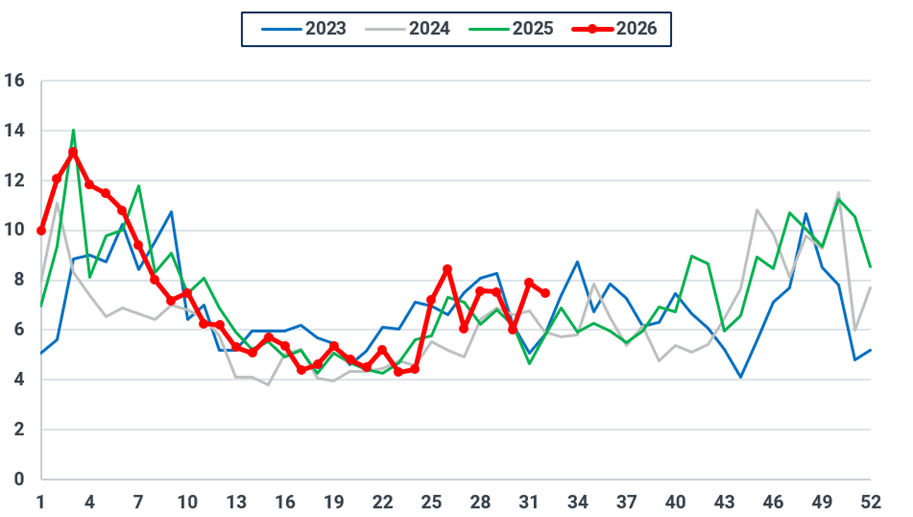
Source: Kpler Power, Kpler Insight.
Average daily temperature forecast for cooling-sensitive European countries (°C)
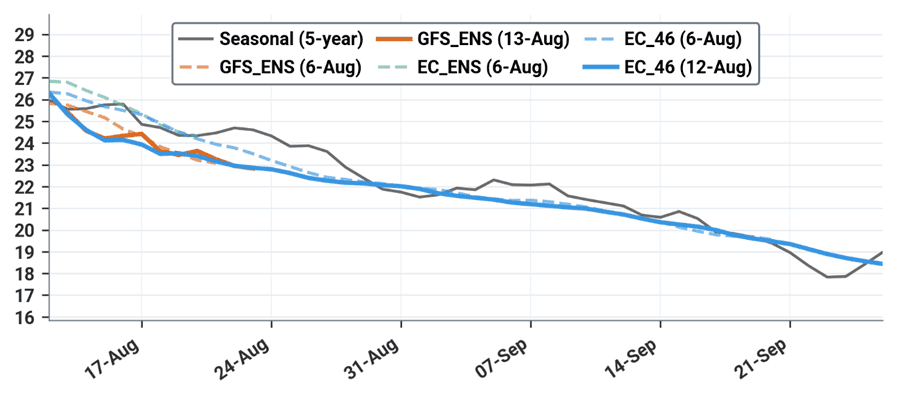
Source: Kpler Insight. Run comparison 06/08 (solid) vs. 13/08 (dotted), 00:00 UTC. Seasonal is a five-year average.
EU-27 underground gas storage levels rose to 59.3% full as of 12 August, up 1.4% w/w. Net injections averaged 0.21 bcm/d over the past week, down 0.04 bcm/d w/w. The slower pace of injections was mainly driven by Germany, where fill level declined by 0.2% to 47.3% full. However, French injections grew by 3.1% w/w as LNG imports increased as PEG traded at a premium to TTF and PVB, enhancing the country’s competitiveness to attract supply. Looking ahead, Kpler Insight expects injections to accelerate next week, driven by higher LNG imports and lower expected consumption. That said, injection economics worsened over the past week with the TTF Balance of Summer trading at a €2.02/MWh premium over the Winter 2026-27 contract €0.66/MWh higher w/w.
EU-27 net cumulative UGS injections since 1 April (bcm)
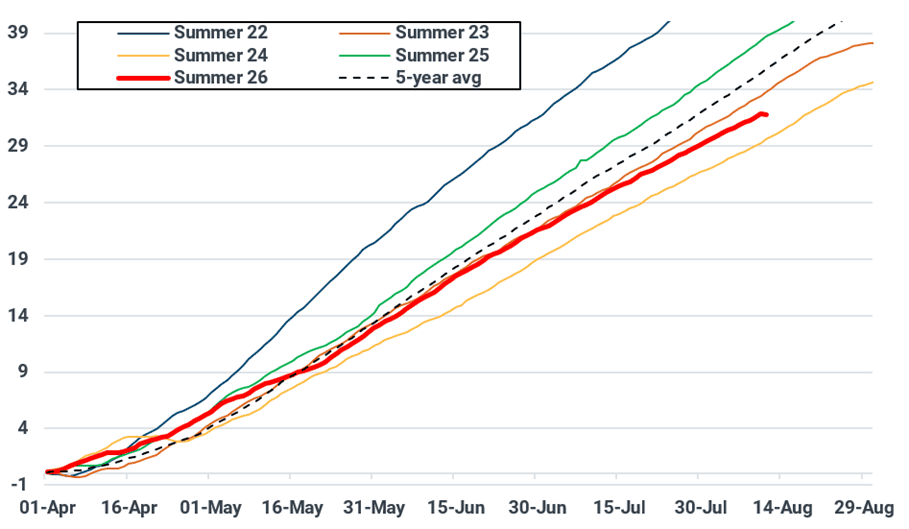
Source: GIE, Kpler Insight. Latest data as of 10 Aug 2026.
Selected TTF contract spreads (€/MWh)
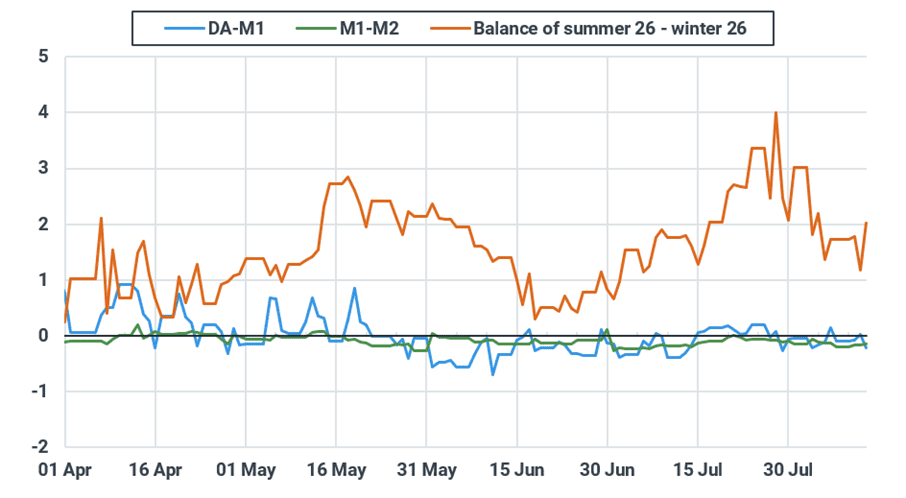
Source: Kpler Insight, Argus, EEX. DA = day-ahead; M1 = Month ahead; M2 = Two month ahead.
Want the complete report?
The full report is available within Insight and contains:
- Market & Trading Calls
- Europe: TTF outlook turns softer on higher supply and weaker demand
- Asia: October rollover and Indian demand provide a floor as cooler weather caps upside
- US: Henry Hub prices rally on hotter temperature forecasts, though robust supply to limit gains
- Global LNG Supply: Qatar loadings hit highest weekly level since the US-Iran war began, but exports set to slow as ballast vessel availability dwindles
Trade smarter. Request access to Kpler today.

See why the most successful traders and shipping experts use Kpler






