

Soybean crush margins in South America squashed by record exports
Current US-China trade policy prices US soybean exports to China out of competition, leading to record South American imports. Resulting market distortion has lifted the lid on the price of South American soybeans as they no longer need to price as competitively on the world stage for demand. This has tightened soybean crush margins in South America and China. The weaker crush margin will temper the rise of Brazilian soybean values and therefore see US soybean prices remain low in efforts to retain export demand. The slowdown in soybean oil and meal production in South America may also offer fundamental support to the crush margin.
- Chinese import tariffs on US soybeans have lifted the lid on South American soybean values, therefore challenging crush margin profitability.
- Soybean crush demand in Brazil and Argentina slows following tighter crush margins.
- Chinese demand for South American soybeans has been unprecedented with no imports of US soybeans on the books, but domestic crush margins have become tighter.
- As Chinese crush margins narrow, the price of Brazilian soybeans may weaken to support export demand. Therefore, US soybean values will need to remain competitive to uphold export demand.
- Dec-25 CBOT soybean board crush may widen under a tighter soybean by-product supply and US soybean price competitiveness.
South American soybeans prefer to sail then split
For Brazil, exports and crush are the two key factors of soybean usage and both compete for supply. At times when price is high, crush demand can slow first due to a weak margin if the sum return of soybean meal and oil is not higher than the input cost of the soybean.
After Brazil harvested a record soybean crop earlier this year, the next step has been finding demand to leave stocks near exhaustion come the end of the marketing year; with the market anticipating a larger soybean crop in 2026. This goal has been greatly assisted following the development of higher import tariffs between the US and China.
At a spot FOB basis, US soybeans have been pricing less than Brazil since mid-June. Recently, for Sep-Oct shipment, US soybeans were reported to be 80-90 ¢/bu cheaper than Brazilian origin but Chinese tariffs add $2/bu to US soybeans making them uncompetitive. This distortion in the market has supported Brazilian soybean exports to China, despite their rise in value, with the US having to find demand elsewhere.
Brazil acquires a greater share of Chinese demand, US sweeps up demand elsewhere (% exports)
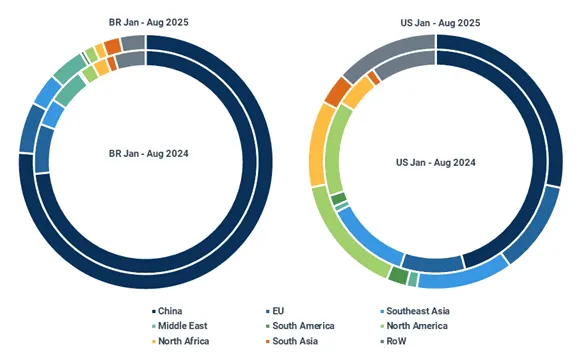
Source: Kpler Insight

See why the most successful traders and shipping experts use Kpler

Gain clarity on dry bulk flows, rates & fundamentals to navigate market shifts precisely