The diversification of MEG trading patterns is already underway
MEG exporters are diversifying trade patterns. Iraq leads this shift by using direct voyages as well as Malaysian lightering for long-haul routes, while Saudi Arabia relies on direct voyages supported by its national fleet. Skipping local shuttle hubs lengthens turnaround times, elevating structural freight rates across the region.
Key Takeaways:
- The scaling of MEG trades has already forced Middle East Gulf (MEG) exporters to bypass local Ship-to-Ship (STS) transfers in favour of direct voyages and alternative hubs.
- As the primary driver of regional diversification, Iraq is bypassing GoO transfers through a mix of direct deliveries and long-distance STS hubs.
- Saudi Arabia and its recent expansion of MEG loadings is also increasingly directing exports away from GoO transfers, supported by its national fleet.
- Bypassing local shuttle hubs increases vessel turnaround times, requiring a larger pool of tankers exposed to regional risks and driving a higher freight rate baseline.
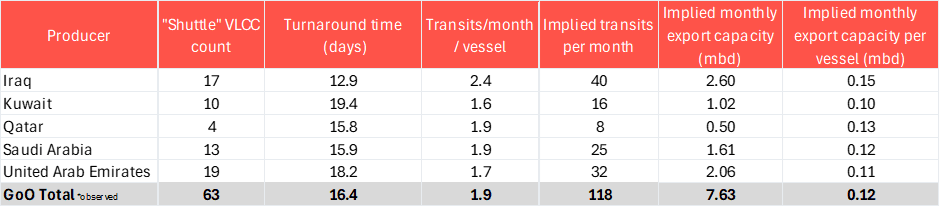
In the first stage of the post-MoU collapse era, crude loadings from the MEG remained heavily dependent on shuttle trades to the GoO, which allowed for a reduction in the number of owners exposed to the challenging navigational conditions in the Strait of Hormuz (SoH). Month over month, we have seen the specific fleet grow, reaching, as of the time of writing, a pool of at least 63 VLCCs, which, given the observed vessel turnaround times, suggests a Crude/Co export shipping capacity of circa 7.6 Mbd per month.
“Shuttle” VLCC fleet by most frequently called MEG producer
Source: Kpler
However, as MEG loadings continue to scale, recently boosted by the redirection of Saudi exports to the East, challenging STS capacity in the GoO, a diversification of the region’s trading patterns becomes increasingly inevitable. This diversification is not an expectation but rather an observed reality.
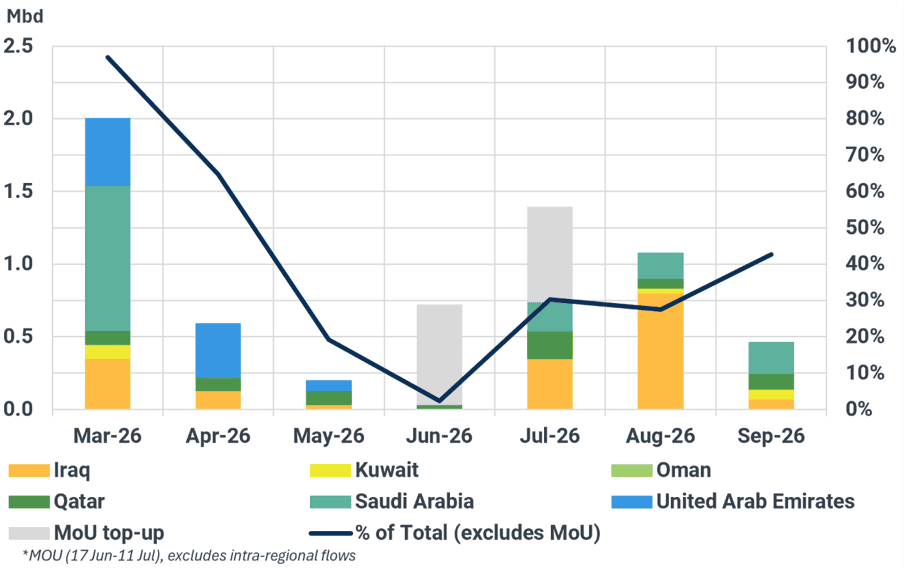
Indeed, we retrieve completed voyages from the MEG and isolate the share of delivered barrels that did not include an STS in the GoO. To truly assess the trajectory of volumes, it is important to exclude volumes loaded during the MoU (for this piece spanning from June 17 to July 11) as this period was characterised by higher navigational flexibility. Approximately 0.7 Mbd of the region's post-MoU loaded cargoes (30%) did not include a GoO STS in July, a figure that rose above the 1.0 Mbd (27%) in August and is assessed at 0.5 Mbd (43%) thus far in September. As a significant share (82%) of the running month’s barrels are still in transit, this latter figure is subject to significant revisions.
Share of delivered MEG Crude/Co loadings not shuttled in the GoO
Source: Kpler
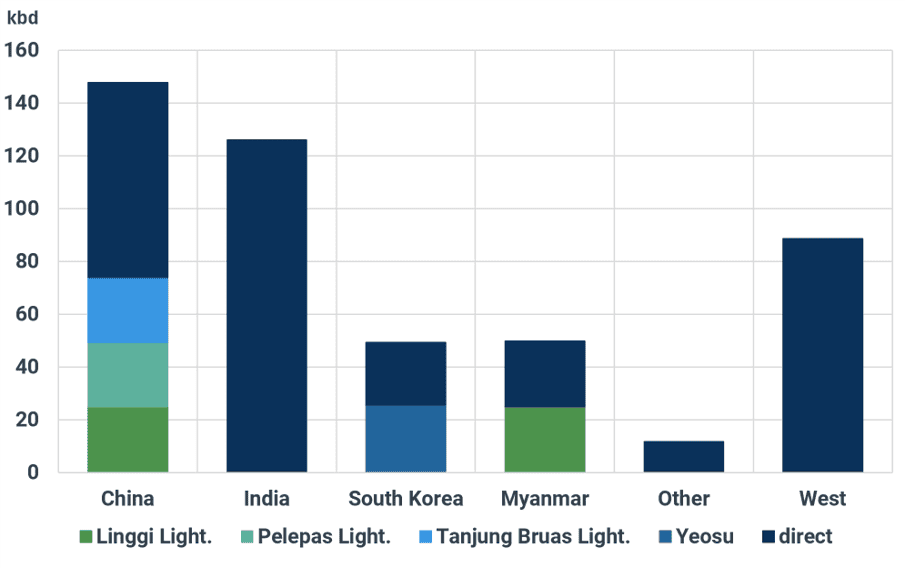
Iraq emerges as the undisputable frontrunner of the specific trend, accounting for the bulk of volumes to avoid STS operations in the GoO both over July and August. A closer breakdown of the specific Iraqi trades reveals a well-defined trend. Close-proximity trades are carried on direct voyages, with special reference to India (West Coast), where a direct voyage adds approximately 4 days to a round voyage versus a GoO shuttle. However, for East of Malacca voyages, a significant share of volumes is instead STSd in Malaysian waters, as evident in the case of China.
Trading profile of post-MoU Iraqi barrels not shuttled in the GoO
Source: Kpler
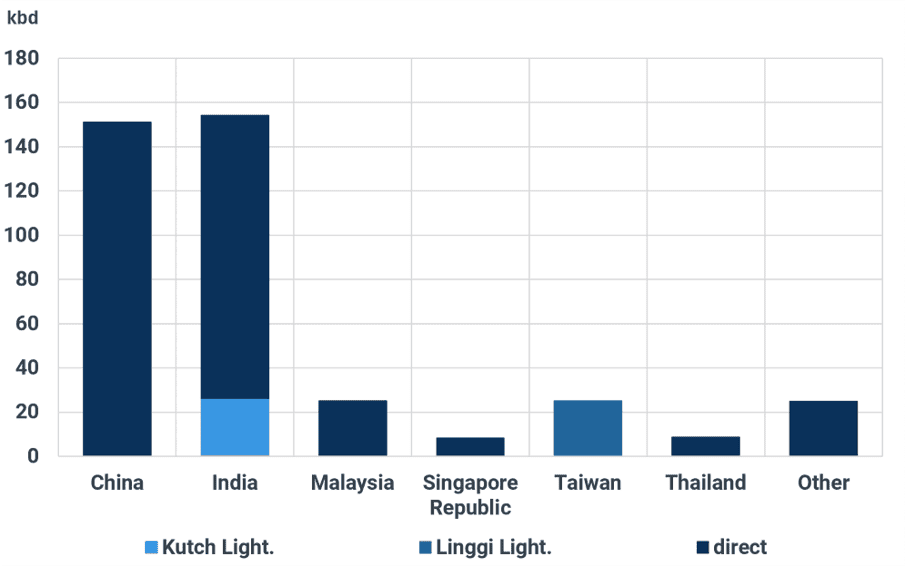
We extend the above analysis to the remaining regional producers, where Saudi barrels have recently come to account for an increasing share of barrels. There direct voyages appear to dominate even long-haul barrels, with some minimal STS activity in WCI and Malaysia primarily attributed to Qatar.
Trading profile of post-MoU Saudi, Kuwaiti, and Qatari barrels not shuttled in the GoO
Source: Kpler
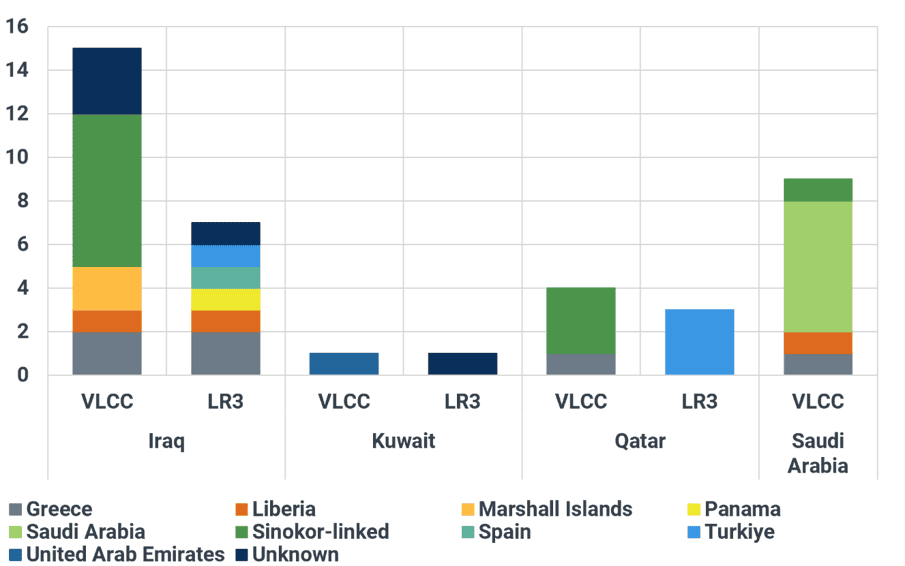
The ownership profile of vessels engaged in these specific trades appears relatively diversified, while broadly mirroring the patterns observed across shuttle trades. Sinokor-linked vessels account for the largest share of the fleet, particularly within the VLCC segment of Iraqi trades. A distinct pattern is also evident in the case of Saudi Arabia, where the country’s national fleet appears to have captured a significant share of these direct voyages. At the same time, more and more vessels present a mixed employment profile, with at least 5 “shuttle” VLCCs recently switching to direct voyages.
Trading profile of post-MoU Saudi, Kuwaiti, and Qatari barrels not shuttled in the GoO
Source: Kpler, Marine traffic
As MEG loadings continue to scale while additional STS capacity in the GoO remains constrained, the dominance of shuttle trades in MEG exports is increasingly being challenged, with vessels likely to adopt a more diversified employment profile. Longer voyage distances, however, imply a significant increase in the number of vessels required to navigate the challenging waters of the SoH. As the pool of vessels exposed to these risks expands, so do the associated freight premiums. At the same time, the periodic resurgence of regional hostilities creates the potential for sharper upside spikes in freight rates .Freight rates appear to have peaked for now, but remain elevated, broadly consistent with the trends outlined above.
Against this backdrop, the impact of higher Yanbu loadings as the East–West Pipeline gradually resumes operations remains conditional on the resulting changes in regional flows. If higher Yanbu volumes are accompanied by a reduction in MEG loadings, barrels could be reallocated away from higher-risk areas towards lower-risk alternatives, thereby tembering the risk premium embedded in freight rates. Conversely, if the producer maintains or increases loadings at both export points, the additional Yanbu volumes would generate incremental tonne-mile demand, on top of heightened risk exposure, providing further support to freight rates.

See why the most successful traders and shipping experts use Kpler