
UK and Japan crack down on Russia’s largest shipping company
The UK and Japan are tightening the net around vessels linked to Sovcomflot: London through new LNG carriers and Tokyo through oil tankers.
UK sanctions on Russian LNG shipping are also arriving earlier in a vessel’s life. The 1 October package listed PYOTR STOLYPIN (IMO 9904675) before Kpler recorded any cargo, and KONSTANTIN POSIET (IMO 9904704) before any direct international export. Arctic LNG 2 has exported 0.95 million tonnes (mt) so far in 2026, all since July and almost double the 2025 total. Sanctions authorities are therefore targeting the fleet while it is still being built up.
Market & Trading Calls
- A vessel can now be sanctioned before trading starts. The UK listed PYOTR STOLYPIN (IMO 9904675) as “likely to be involved” in Russian LNG trade before it had carried a cargo. This suggests that a vessel’s intended role in a Russian LNG project, rather than its trading history alone, can be enough to trigger a listing.
- Enforcement is moving from the company to individual vessels. Sovcomflot has been on the UK sanctions list since 2022, but the UK and Japan are now designating its ships one by one: LNG carriers in London and oil tankers in Tokyo. This makes it harder to separate vessels held through different registered owners from the wider sanctioned group, particularly ahead of the 1 January 2027 UK and EU LNG restrictions.
On 1 October, the UK added 31 entries to its Russia sanctions list, including eight vessels and Novatek Gas and Power Asia, the Singapore-based chartering arm of Novatek. The UK listed the eight ships because they carry, or are likely to carry, Russian-origin LNG to third countries. Among them are three new Russian-built Arc7 ice-class carriers, ALEKSEY KOSYGIN (IMO 9904546), KONSTANTIN POSIET (IMO 9904704) and PYOTR STOLYPIN (IMO 9904675), and three older conventional carriers, CHAIVO (IMO 9331048), PORTOVYY (IMO 9246621) and AVACHA (IMO 9319404).
A day later Japan imposed sanctions on individual vessels, alongside asset freezes on 33 Russian entities and nine individuals. The two packages target different parts of Russian shipping, but they share a common pattern: both include vessels owned, operated or linked to Sovcomflot, the shipping group behind the new Arc7 carriers.
Russia's new gas carriers are being sanctioned before their first winter at sea
Kpler export data show 14 cargoes from Arctic LNG 2 so far in 2026, loaded by 13 vessels between 17 July and 5 October and totalling about 0.95 mt. Every cargo with a known destination went to China, including ten to Beihai LNG (PipeChina). At the time of writing, two of those 13 vessels, ALEKSEY KOSYGIN (IMO 9904546) and AVACHA (IMO 9319404), were among the eight ships listed by the UK on 1 October.
The three Arc7 carriers show how short the gap between entering the trade and being sanctioned has become.
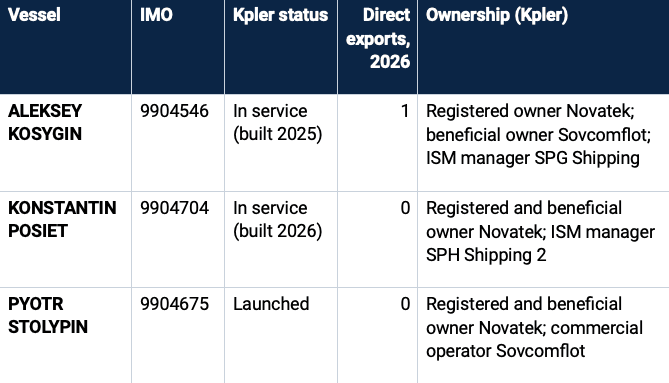
Selected vessel particulars. Source: Kpler export data (A-LNG-2, 2026 to 5 October), vessel particulars and ownership data; UK Sanctions Notice, 1 October 2026.
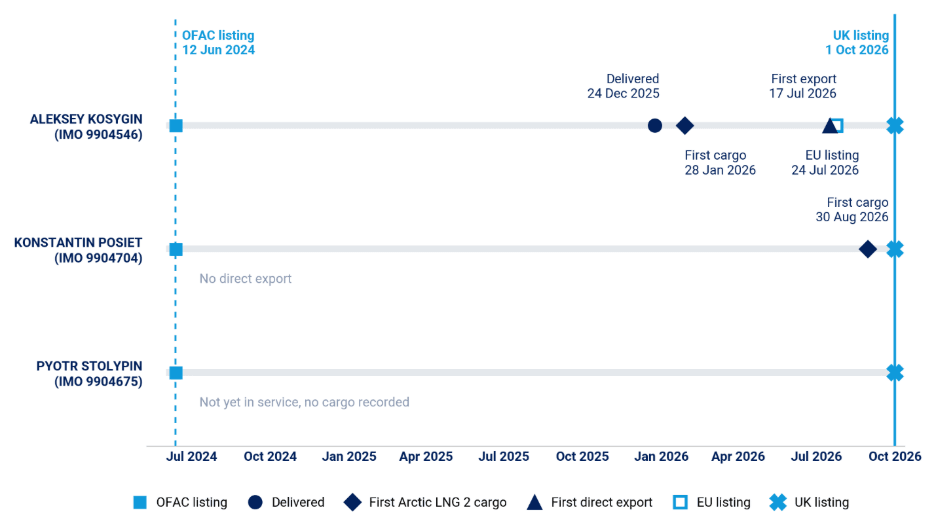
Risk timeline on selected vessels until UK 1 Oct designation. Source: Kpler Risk & Compliance
ALEKSEY KOSYGIN (IMO 9904546) had made just one direct international export when it was listed. But it was already active. Since January, it had moved cargoes from Arctic LNG 2 to the Saam floating storage unit at Murmansk. These movements do not count as international exports because the cargo remained within Russia. Its one direct export, a 75,339-tonne cargo, left Arctic LNG 2 on 17 July and reached PipeChina Beihai in China on 9 August. KONSTANTIN POSIET (IMO 9904704) has recorded no direct international export in the data. Together, the two delivered Arc7 carriers account for less than a tenth of the 0.95 mt exported from Arctic LNG 2 in 2026.
The designation of PYOTR STOLYPIN (IMO 9904675) is the clearest sign of the change. Kpler classifies the vessel as launched but not yet in service, and records no commercial cargo through 5 October. The UK listing says the vessel is likely to be involved in carrying Russian-origin LNG to third countries. Kpler AIS last placed it at the Zvezda shipyard about three months ago. Regulators are therefore not necessarily waiting for a vessel to build up a trading history before acting.
In earlier phases of Russia’s shadow-fleet expansion, regulators generally had years of trading history, ownership transfers and flag changes to analyse before designating a ship. For LNG vessels, that window now looks much shorter.
The project is scaling, so the fleet matters more
Kpler export data show Arctic LNG 2 exports of about 0.95 mt in 2026 to 5 October, all since July: 0.21 mt in July, 0.21 mt in August, 0.47 mt in September and one October cargo of about 0.06 mt in the 14-cargo set through 5 October. That is already almost double the 0.54 mt exported during all of 2025.
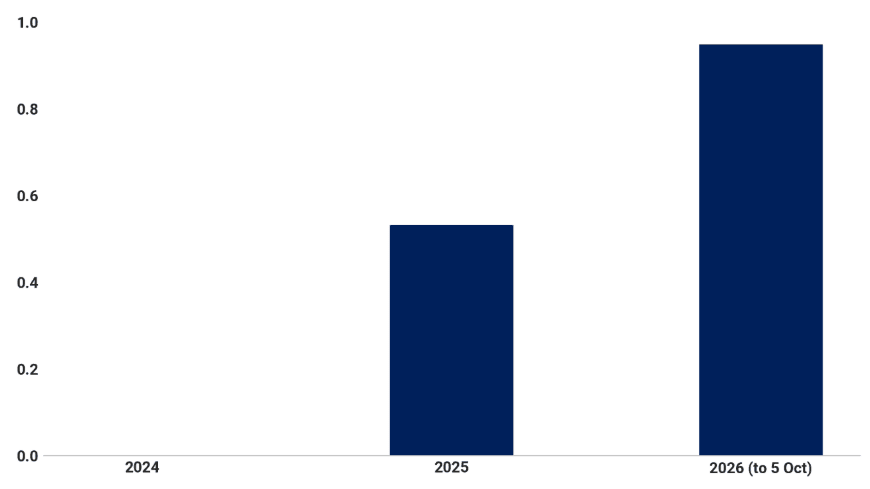
Annual exports from the A-LNG-2 installation in mt; YTD till 5 October. Source: Kpler export data
The sanctions are therefore targeting an export system that is already operating, rather than a future project. So far this year, most exports have moved on less specialised ships. Only two of the 14 cargoes were carried by Arc7 ships: ALEKSEY KOSYGIN (IMO 9904546) and CHRISTOPHE DE MARGERIE (IMO 9737187).
This matters because the newly sanctioned Zvezda-built ships are second-generation Arc7 carriers designed to sail the Northern Sea Route throughout the year. First-generation ships such as CHRISTOPHE DE MARGERIE are less suited to winter passages, with their Azipod propulsion seen as a weak point. The second-generation fleet becomes particularly important when ice returns because these vessels are designed to reach the Arctic LNG 2 terminal through heavy ice without an icebreaker escort.
This specialised fleet is also much harder and more expensive to replace than the large pool of ageing conventional tankers available for Russia’s oil trade. South Korean shipbuilders have traditionally held much of the expertise needed to build these vessels. Today, only Russia’s Zvezda yard is building Arc7 carriers, while Chinese yards would be the most likely candidates for new orders outside Russia. Their ability to build one from scratch has yet to be tested.
The links around these ships were visible before they were sanctioned
The UK notice and Kpler data place Novatek in the ownership and operating structure around the three Arc7 carriers, with SPG Shipping managing ALEKSEY KOSYGIN and SPH Shipping 2 managing KONSTANTIN POSIET. Kpler ownership data also show Sovcomflot, which has been on the UK sanctions list since March 2022, as beneficial owner of ALEKSEY KOSYGIN and commercial operator of PYOTR STOLYPIN.
A compliance team cannot predict which vessel a government will sanction. But a ship does not need years of suspicious voyages before its connection to a strategically important Russian export project becomes visible.
The listing of Novatek Gas and Power Asia shows the same approach. Authorities are targeting not only the vessels themselves, but also companies involved in arranging and supporting the trade.
Japan stays away from LNG but prioritizes Sovcomflot’s oil tankers first
Japan’s 35-vessel package focuses mainly on the oil trade. 27 are crude tankers, four are product or chemical tankers, and four are general cargo or ro-ro ships.
The main link is Sovcomflot. Five of the tankers, CARMA (IMO 9341081), LAVENDER (IMO 9339337), NOMAD (IMO 9610781), OKEANSKY PROSPECT (IMO 9866380) and TRUST (IMO 9382798), are beneficially owned by Sovcomflot.
In the LNG fleet, Kpler ownership data show Sovcomflot as beneficial owner of ALEKSEY KOSYGIN (IMO 9904546) and commercial operator of PYOTR STOLYPIN (IMO 9904675). Japan is therefore acting against the group’s oil tankers while the UK is acting against its LNG carriers. In Kpler data, Sovcomflot is the only owner that appears across both lists.
Japan’s dependence on Russian LNG is likely one reason for this difference. Kpler shows Sakhalin-2 exporting 7.12 mt in January–September 2026, about half of it to Japan, with recent cargoes heading to Hitachi and Kawasaki. Britain has extended targeted, time-limited licences covering LNG for Japan and South Korea.
These licences are much narrower than a general exemption.
For compliance teams, this creates two separate questions: whether a Russian LNG trade is allowed under the transition arrangements, and whether any vessel or company involved in that trade is itself sanctioned.
Further Arc7 hulls are still being completed at the Zvezda yard, so more pre-service designations are plausible
The UK ban on maritime and insurance services for Russian LNG takes effect on 1 January 2027, and the EU’s phase-out of Russian LNG under long-term contracts follows on the same date.
Japan’s next step remains an open question: whether it extends vessel listings beyond oil tankers to Sovcomflot’s LNG carriers, and whether either government widens its sanctions to more of the group’s fleet.
For maritime compliance teams, the question is no longer only what a vessel did yesterday. Increasingly, it is also who stands behind the vessel and what its ownership, technical design and intended role suggest it may be used for next.

See why the most successful traders and shipping experts use Kpler