


West African crude prices recover on Asian demand
Amid the ongoing restrictions in the Strait of Hormuz and continued supply threats in the Red Sea, some Asian refiners have turned to West African grades, driving up Nigerian and Angolan spot premiums. Moreover, support is coming from the Dangote refinery operating at close to 110% capacity.
Market & Trading calls
- Slight upward revision to Nigerian crude and condensate supply for H2 2026, reflecting consistently higher exports over recent months.
- Dangote refinery runs expected to rise to 700 kbd in August, maintaining these levels in September and causing crude imports to also remain elevated.
- WAF spot premiums expected to hold steady into September, as disruptions in the Strait of Hormuz and Red Sea persist and push buyers toward alternative barrels.
Nigerian crude and condensate exports (including intra-country flows) have remained elevated in recent months, rising from a Q1 average of 1.63 Mbd to 1.8 Mbd in Q2, and staying above 1.8 Mbd through July and August so far. Part of this increase reflects the new Cawthorne grade, which has consistently added 30–35 kbd since April. Kpler's cargo-tracking data also shows Bonny Light loadings climbing sharply, from 290 kbd in Feb–Apr to 370 kbd in June–July. These higher export volumes point to rising Nigerian oil production, prompting us to nudge our supply estimates upward for the rest of the year. We now expect crude and condensate production of 1.75 Mbd in H2 2026 — 80 kbd above H1 — with similar levels likely sustained into 2027.
Nigeria crude and condensate supply outlook, kbd
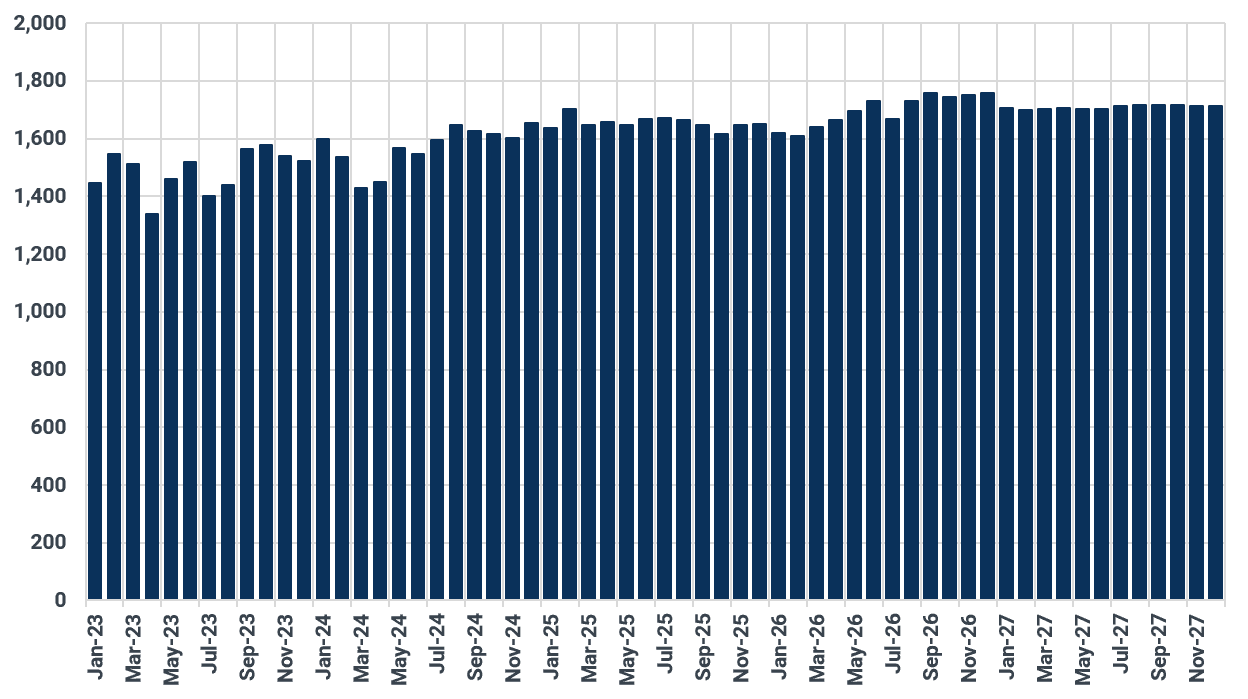
Source: Kpler

See why the most successful traders and shipping experts use Kpler






