Czechia’s coal phase-out roadmap and long-term nuclear outlook
Executive summary
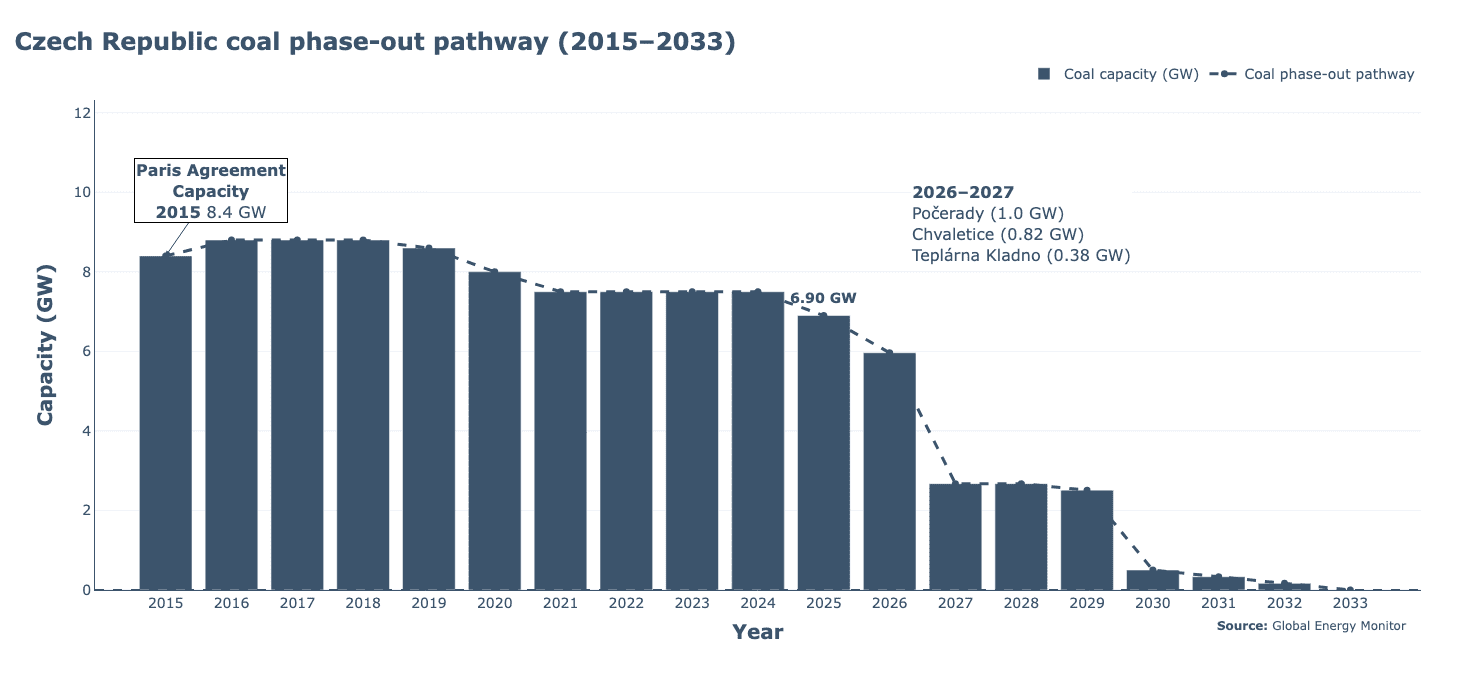
Czechia’s coal transition is shaped by the updated National Energy and Climate Plan (NECP) submitted in 2024. Czechia has defined a national objective to exit coal by 2033, supported by a managed reduction of coal capacity through the late 2020s.
Czechia’s decarbonisation strategy centres on renewables as the primary coal replacement this decade, supported by gas-fired flexibility for power and district heating. As of 2026, installed capacity stands at 4.7 GW of solar and 0.4 GW of onshore wind according to Kpler data, with policy targets of 10 GW solar and 1.5 GW wind by 2030.
Kpler Insights estimates the coal fleet to decline from around 7 GW in early 2026 to 0.4 - 0.5 GW by 2030, as large coal units are scheduled to retire or convert, leaving only a limited residual fleet of heat-led CHP plants.
Beyond 2030, nuclear power underpins the Czech power system, anchored by 3.8 GW of operating capacity at Temelín and Dukovany. Meanwhile, extending current plants lifetime, the financially state-driven expansion kick-started the Dukovany II project and aims for a longer-term SMR programme, with total nuclear capacity targeted to reach around 10 GW by 2040 and 14 GW by 2050.
Czech plans and coal roadmap
Czechia currently operates around 7 GW of installed coal capacity (Jan 26). Across the national coal fleet of 91 plants, 22 units have already been retired and three projects cancelled, indicating a sustained downward trend in coal utilisation.
Almost all major coal plants are scheduled to retire or convert during the second half of the 2020s. A limited tail of 10-12 smaller, heat-led CHP plants, including Opatovice, Třebovice, and Mondi Štětí, are expected to remain operational into the early 2030s.
The transition is primarily driven by two sector leaders: ČEZ, the dominant national utility, and Sev. en Energy, the largest independent coal operator.
On the utility side, ČEZ is executing a structured replacement program across coal-linked district heating hubs, stating that the transformation will deliver more than 1.1 GW of installed electric capacity through highly efficient cogeneration sources.
Broader ČEZ Coal-Site ConversionPipeline (2026–2030)
- Dětmarovice (800 MW) (Completion 2026)
- All coal units decommissioned in 2025
- Site redeveloped into a gas and biomass CHP hub
- Prunéřov (700 MW) + Tušimice (800MW) (Completion 2027)
- Prunéřov : gas engines + biomass + gas boiler
- Tušimice: backup gas boiler
- Trmice (200 MWGW) (Completion 2029)
- Biomass + CCGT (existing gas boiler supplemented)
- Poříčí (165 MW) (Completion 2029)
- Biomass with electricity generation + gas boiler
- Hodonín (107 MW) (Completion 2029)
- Biomass + gas boiler + smaller CHP units
- Mělník / Energotrans (350 MW) (Completion 2029–2030)
- CCGT + gas boilers + Waste-to-Energy integration
Alongside these conversions, the merchant coal segment is retiring assets. Sev.en Energy has confirmed that all its lignite-fired assets will cease coal operations by December 2026, or March 2027 at the latest. Overall, the retired plants include:
- Počerady (1 GW) → full shutdown by 2026/27
- Chvaletice (0.8 GW) → full shutdown by 2026/27
- Teplárna Kladno (0.38 GW) →
- heat production ends in March 2026, while the plant’s power capacity remains grid-connected only if required by ČEPS until March 2027.
Illustrating the deteriorating economics of coal, Sev.en Energy announced last week to anticipate the end of coal-based heat production in spring 2026, driven by high EU ETS costs and an unviable heat contract. ČEPS has confirmed the plant is not system-critical.
Overall, installed coal capacity is estimated to decline from 7 GW in January 2026 to 0.4-0.7 GW by 2030 according to Kpler Insight, with the remaining units set to fully exit by 2033.
Nuclear roadmap
Czechia’s current nuclear fleet consists of 2 sites: Dukovany (1.8 GW) and Temelín (2.0 GW), both undergoing lifetime extensions to at least 60 years. ČEZ acts as the sole operator. Both sites provide roughly 32 TWh annually, which is equivalent to around 35-40% of the national electricity supply, according to Kpler data.
Through long-term operation (LTO) programs, ČEZ is extending the lifetime of the existing reactors to 60 years, with Dukovany units licensed for indefinite operation subject to regulatory oversight and investments of approximately $2.3 billion through 2047.
The primary near-term expansion is the Dukovany II (EDU II) project. Following EU state-aid approval in April 2024 and final contract confirmation in April 2025, ČEZ and Korea Hydro & Nuclear Power (KHNP) will deliver two APR1000 reactors (2 × 1,063 MW). Site works and surveys began in 2025, construction is targeted around 2029, and commissioning is expected in the mid-to-late 2030s. The project is explicitly state-led, with government ownership and state loans of up to €7.7 billion, and holds a guaranteed offtake structure, insulating ČEZ from power-price volatility and lowering financing costs.
Beyond Dukovany, Temelín remains the strategic second pillar. The Dukovany contract includes options for up to two additional large reactors at Temelín, allowing capacity scaling depending on demand growth and electrification trends. Government energy policy envisions nuclear supplying at least 50% of electricity over the long term, with total nuclear capacity reaching 14 GW by 2050, or higher under accelerated electrification scenarios. This would require incremental additions beyond the currently committed projects.
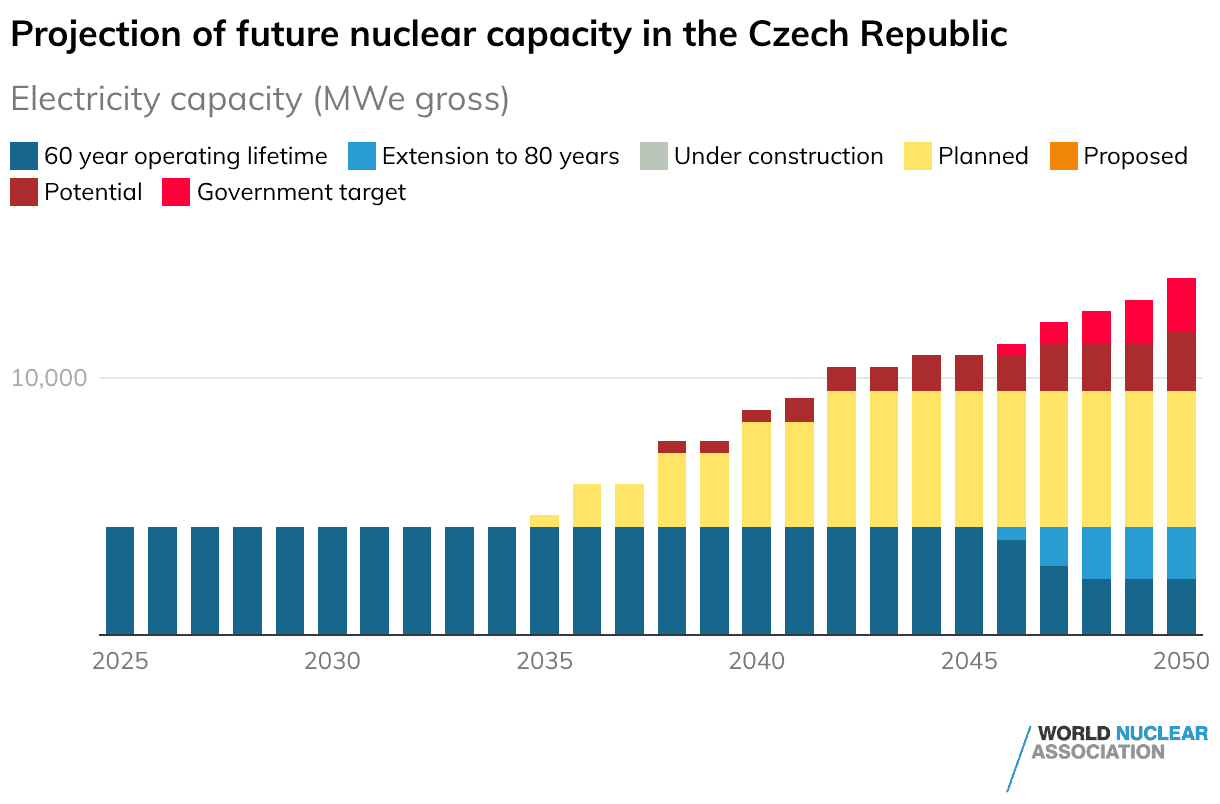
Complementing large reactors, ČEZ is advancing a Small Modular Reactor (SMR) program. In October 2024, the state-owned company acquired a 20% stake in Rolls-Royce SMR, targeting the first SMR commissioned at Temelín by 2035. Expansion foresees an additional five units by 2050.
Overall, Czechia’s nuclear roadmap is state-financed and aims to expand from the current 3.8 GW of operating capacity at Dukovany and Temelín to almost 10 GW by 2040, driven primarily by the deployment of SMRs at Temelín and the addition of two 1 GW reactors at Dukovany II from the mid-to-late 2030s.
Power market intelligence built for trading decisions.
Week-ahead calls, weather-driven forecasts, and seasonal outlooks for European markets. Designed to support real decisions, not just inform them.

See why the most successful traders and shipping experts use Kpler