Nuclear modulation insights: Volumes and units behaviours
Executive summary
Total French nuclear modulation volumes surged 17% year-on-year in 2025, driven almost entirely by commercial (economic-driven) modulation.
While total modulation encompasses fuel-saving and load-following activities, commercial modulation now accounts for 70% of all modulation volumes, confirming that EDF is increasingly using its nuclear fleet as a flexible tool to respond to market price signals.
Kpler Insight shows that commercial modulation not only follows intraday patterns, as abundant solar output depresses midday prices and incentivizes nuclear curtailment, but also holds a seasonal pattern.
Commercial modulation dominates, and it's accelerating
The defining trend of the past two years is the rapid growth of commercial modulation. Commercial modulation alone jumped 25%, meaning virtually all incremental modulation was market-driven.
In 2025, seven out of every ten gigawatt-hours of nuclear output curtailed were driven by economics rather than technical or safety constraints. This represents a structural shift: EDF is proactively adjusting nuclear output to optimize revenue in a power market increasingly shaped by renewable intermittency.
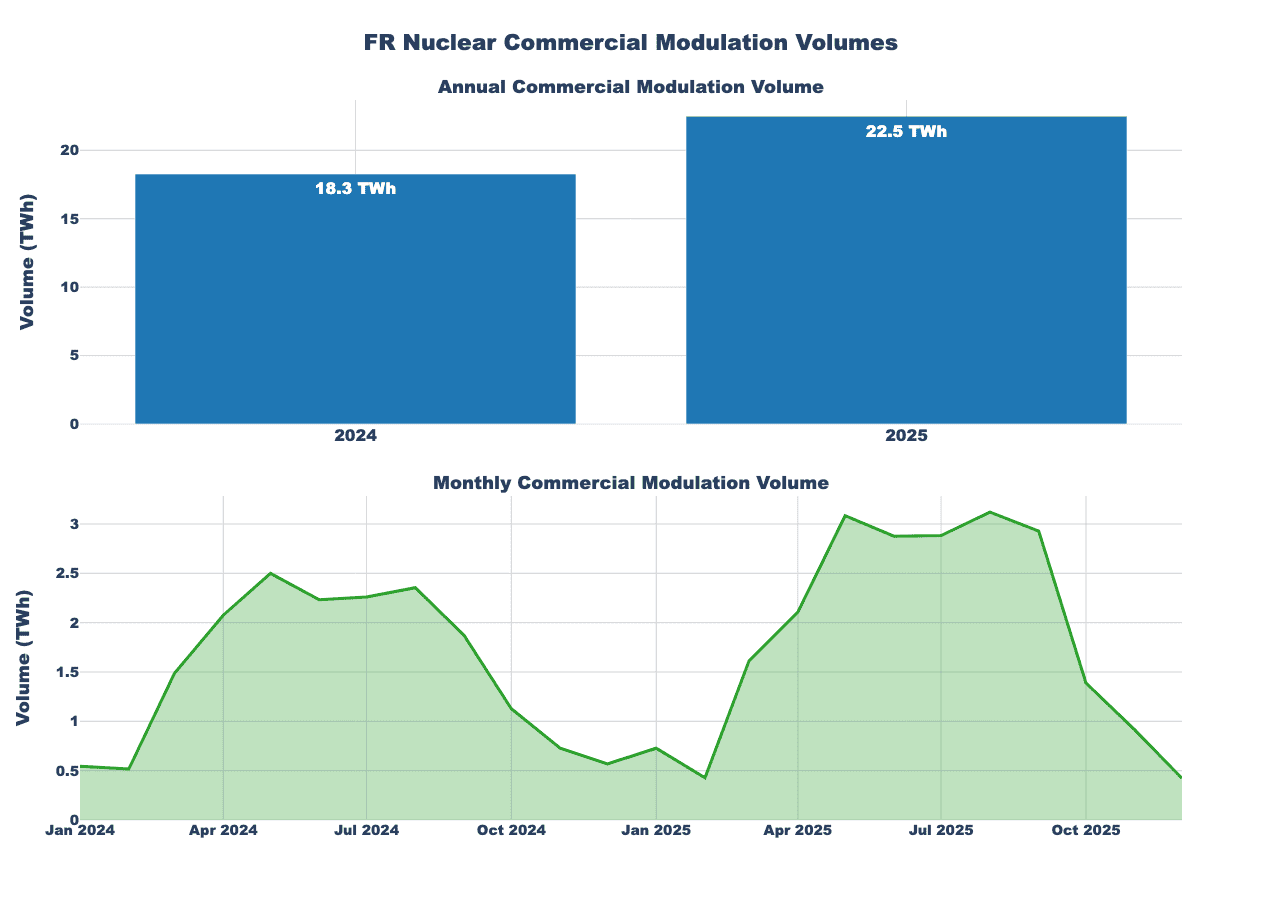
Commercial modulation volumes follow two distinct patterns: the classic intraday profile that mirrors the solar generation curve, and a seasonal curve that intensifies through summer before tapering off in autumn. These patterns reflect the fundamental economic logic: nuclear plants reduce output precisely when and where renewables make electricity cheapest.
The fleet's most flexible reactors
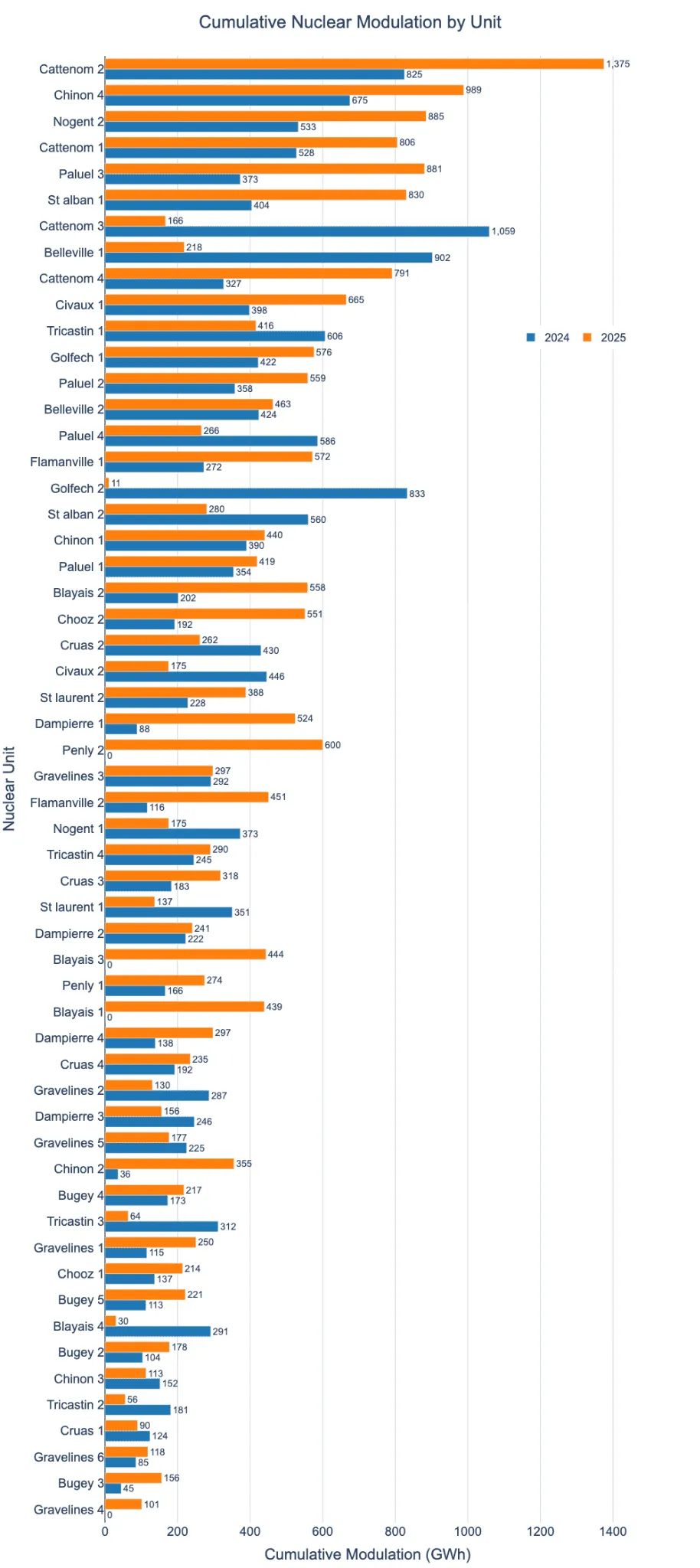
In 2025, Cattenom 2 stood out as the fleet's most modulated reactor, curtailing nearly 1.4 TWh, and over the full two-year period, it has accumulated roughly 2 TWh in modulation volumes, the highest of any unit.
Other top modulators in 2025 included Chinon 4, Nogent 2 (880 GWh), Paluel 3 (880 GWh), Cattenom 1 (800 GWh), and Saint-Alban 1.
In 2024, the picture was somewhat different: Cattenom 3 led with approximately 1 TWh, followed by Belleville 1 (900 GWh) and Golfech 2 (830 GWh).
Site-level rotation patterns
An interesting operational pattern emerges at multi-reactor sites. At the Cattenom production site, reactor 3 modulated heavily in 2024 but pulled back significantly in 2025, ceding flexibility duties to other units on the site, notably Cattenom 2, which ramped up. A similar rotation occurred at Golfech, where reactor 2 stopped modulating in 2025 while reactor 1 picked up the slack. This suggests EDF manages modulation strategically at the site level, distributing wear and operational cycles across units rather than concentrating them on a single reactor.
Looking ahead, Cattenom 2's heavy modulation track record is worth monitoring. The unit is expected to undergo its VD4 Phase A major inspection in 2028.
Power market intelligence built for trading decisions.
Week-ahead calls, weather-driven forecasts, and seasonal outlooks for European markets. Designed to support real decisions, not just inform them.

See why the most successful traders and shipping experts use Kpler