

Annual capacity auctions for Europe’s 2026-27 gas year: Legacy deals dominate, Germany stays congested
PRISMA, RBP, and GSA held annual capacity auctions on 6 and 20 July, adding roughly 97 GWh/h of fresh firm bookings for gas year 2026-27 across the three platforms. The results of this round confirm strong interest in interconnection points receiving Norwegian and Algerian supply, linked with long-term legacy supply contracts and in line with last year’s auctions results. Additionally, strong bookings were observed within the RBP perimeter, particularly for IPs along the Vertical Gas Corridor, suggesting growing market appetite for this route. Meanwhile, the most representative of the three bundled bookings allocated on the GSA platform was at the Vyrava IP SK-PL, which were higher y/y, likely driven by Polish buyers’ need to increase supply optionality at times of peak demand. Surcharges stayed tightly concentrated in a handful of contested corridors — Hungary-Romania and Belgium-Germany — while the large majority of capacity cleared at the regulated tariff with no premium at all. Bookings of interruptible capacity remained limited and largely concentrated at the Belgium-Germany VIP-THE-ZTP-E point and the Emden entry point. The former signals continued bottlenecks in the German gas grid, particularly regarding West-to-East flows, while the latter hints at opportunistic spot buying of Norwegian supply at lower transmission costs. More than half of the firm capacity now in place for the 2026-27 gas year on both PRISMA and RBP was locked in previous years, especially at the Belgian-German and Serbian-Hungarian borders, respectively.
The 2026 round: legacy contracts concentrate appetite, while congestion risks are likely to persist in Germany
The 2026 annual round added 78.98 GWh/h of new firm capacity bookings on PRISMA, 14.00 GWh/h on RBP, and 4.21 GWh/h on GSA — a combined ~97.2 GWh/h of fresh firm commitments for 2026-27 gas year in a single auction window.
- PRISMA: Italy and France led the round outright — Mazara del Vallo (13.07 GWh/h, unbundled) and Dunkerque (10.86 GWh/h, unbundled) topped the table, ahead of the perennial German entry cluster (Emden EPT, Dornum, in their usual FZK-tranche unbundled form). The Belgium-Germany VIP THE-ZTP corridor (4.92 GWh/h, bundled) was the largest bundled commitment of the round.
Selected annual capacity bookings on the PRISMA platform by round year for the 2026-27 gas year, including firm, interruptible, and backhaul products (GWh/h)
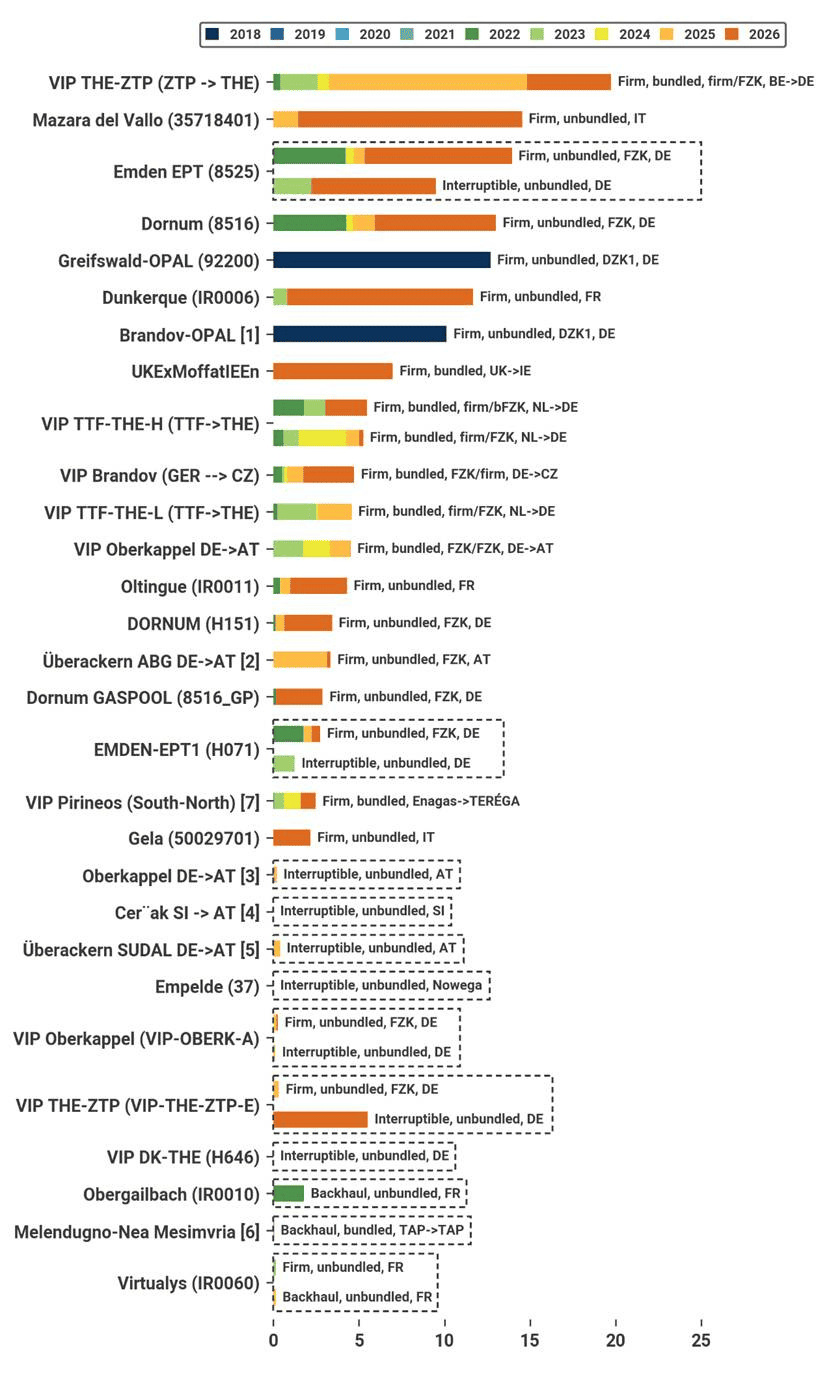
Source: PRISMA, Kpler European Gas, Kpler Insight. A dashed rectangle around a point's bars indicates that point has interruptible and/or backhaul bookings in addition to (or instead of) firm capacity — flagging it as "special" relative to the rest of the ranking. [1] Brandov-OPAL — EIC: 21Z000000000242V, [2] Überackern ABG DE->AT — EIC: 21Z000000000002E, [3] Oberkappel DE->AT — EIC: 21Z000000000001G, [4] Cer̈ak SI -> AT — EIC: 21Z0000000000058, [5] Überackern SUDAL DE->AT — EIC: 21Z0000000001240, [6] Melendugno-Nea Mesimvria — full name: Commercial Reverse-Route 1(Melendugno-Nea Mesimvria), [7] VIP Pirineos (South-North) — full name: PIRINEOS/PIRINEOS (PIRINEOS South-North)
- RBP: bookings at the Romania-Bulgaria corridor dominated — Negru Voda 1/Kardam alone took 3.63 GWh/h, along with strong interest observed at Kulata (BG)/Sidirokastron (GR), reflecting the increased commercial interest along the Vertical Gas Corridor. However, the largest booking on the platform for next gas year, 9.1 GWh/h, occurred in 2023 at the Kiskundorozsma 2 IP, part of the Balkanstream corridor, where Turkstream and Azeri volumes flow from Serbia to Hungary.
Selected annual capacity bookings on the RBP platform by round year for the 2026-27 gas year, including firm, interruptible, and backhaul products (GWh/h)
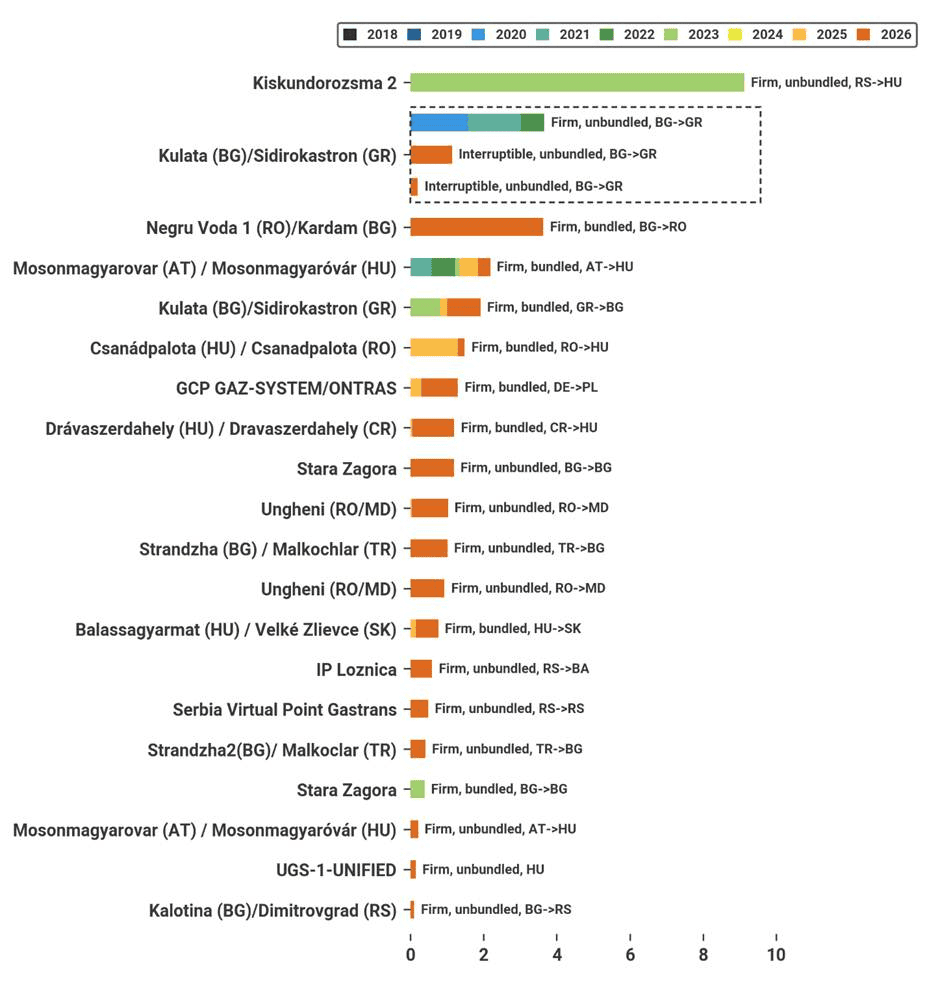
Source: RBP, Kpler Insight. A dashed rectangle around a point's bars indicates that point has interruptible and/or backhaul bookings in addition to (or instead of) firm capacity — flagging it as "special" relative to the rest of the ranking
- GSA: Vyrava (Slovakia-Poland) was the standout at 2.5 GWh/h — three times the size of the other two bookings cleared during the auctions.
Selected annual capacity bookings on the GSA platform by round year for the 2026-27 gas year, including firm, interruptible, and backhaul products (GWh/h)

Source: GSA, Kpler Insight
Surcharges concentrated at the Belgian-German and Romanian-Hungarian borders confirm bottlenecks in pipeline infrastructure.
Restricting to the 2026 round specifically, only 5 products on PRISMA and 5 on RBP carried any competitive premium above the regulated tariff at all in this round. Every other booked product — the large majority — cleared at exactly the regulated tariff, with zero premium.
Where premiums did appear, they were substantial:
- RBP's Csanádpalota (Hungary-Romania, bundled) posted the round's single largest surcharge in absolute terms: 1.21 EUR/MWh/year on top of a 1.15 EUR/MWh/year base tariff — a premium that actually exceeds the regulated tariff itself, pushing the effective cost to 2.36 EUR/MWh/year. The increase more than offsets downward revisions to transmission tariffs announced by Transgaz SA in June. High appetite for this corridor also signals insufficient capacity additions on the Romanian side of the interconnection point, as the Balkanstream pipeline operates close to nameplate capacity.
- PRISMA's VIP THE-ZTP (Belgium-Germany) carried the platform's largest premiums: both its DZK and FZK tranches added 0.66-0.75 EUR/MWh/year in surcharge on top of a roughly similar-sized base tariff — pushing effective costs above 1.7 EUR/MWh/year on both, a 60-70% markup over the regulated rate.
- GSA saw zero surcharge anywhere: the only GSA bookings in the 2026 round cleared exactly at the regulated tariff.
Surcharges across all platforms during annual capacity auctions for 2026-27 gas year (€/MWh)

Source: PRISMA, RBP, Kpler Insight. Note: Surcharges are annualized to a common EUR/MWh/year basis (dividing kWh/h/year rates by 8.76, kWh/d/year rates by 0.365) using ECB reference rates as of late July 2026 for currency conversion; RSD and MDL, not covered by ECB, use approximate non-ECB rates. RBP has no native surcharge field — it is derived as clearing price minus regulated tariff, per side, summed for bundled products. PRISMA reports surcharge as a single unsplit value per booking, treated here as an upper-bound approximation rather than a confirmed per-side split. Figures reflect the 2026 round only; surcharges are not comparable across rounds.
Interruptible capacity was largely concentrated in NWE
The 2026 round alone booked 12.78 GWh/h of interruptible capacity on PRISMA, largely concentrated in NWE. The standout single booking of the year was VIP-THE-ZTP-E — the unbundled, interruptible entry tranche at the Belgium-Germany virtual point — which took 5.51 GWh/h. This represents a structural feature of that specific corridor, as Belgium's Fluxys firm capacity at the VIP-THE-ZTP interconnector point significantly exceeds what the adjacent German operators (OGE, Thyssengas) can guarantee as firm entry capacity on their side, especially during times of peak demand, due to internal west-to-east bottlenecks in the German grid.
Regarding RBP, its only interruptible booking happened at Kulata (BG)/Sidirokastro (GR), totalling 1.35 GWh/h. GSA, by contrast, did not see any booking of interruptible capacity for the next gas year.
Most capacity for the 2026-27 gas year was already booked in earlier auction rounds
A large share of the capacity in place for GY2026-27 was locked in years earlier, through PRISMA's, RBP's, and GSA's annual rounds going back to 2018.
Bookings of annual firm capacity by platform
PlatformCumulative firm booked (all rounds since 2018)Booked in the 2026 round aloneShare already booked before 2026PRISMA174.46 GWh/h78.98 GWh/h55%RBP31.98 GWh/h14.00 GWh/h56%GSA4.70 GWh/h4.21 GWh/h11%
Source: PRISMA, RBP, GSA, Kpler Insight
On both PRISMA and RBP, more than half of all firm capacity now in place for this gas year was committed in earlier annual rounds. The two main examples of this are the annual firm capacity bookings for the 2026-2027 gas year at VIP THE-ZTP and the Kiskundorozsma 2 interconnection points, where the largest booking activity occurred in 2025 and 2023, respectively.
It is worth noting that two of PRISMA's largest cumulative points by volume — Greifswald-OPAL and Brandov-OPAL, the two ends of the OPAL pipeline linking the Baltic coast to the German-Czech border — contribute almost entirely to 2018-vintage bookings, with no meaningful activity in any round since. These points represent long-term contracts linked to Nord Stream 1 supply, which, in practical terms, means that capacity will not effectively contribute to this year's flows.
Looking ahead
Taken together, the 2026 round conveys three distinct signals for the year ahead rather than a single market direction. Firstly, a meaningful share of the headline bookings — at Mazara del Vallo, Dunkerque, and Dornum — reflects legacy contract structures becoming visible on these platforms rather than fresh competitive demand, and should be read accordingly. Meanwhile, Germany's west-to-east entry constraints appear structural, as evidenced by the concentration of interruptible bookings and surcharge premiums at the Belgian-German border; congestion is likely to persist through the 2026-27 gas year, assuming domestic gas consumption remains stable. Lastly, the Vertical Gas Corridor's growing bundled and unbundled bookings at Kulata and Negru Voda 1/Kardam suggest this southeastern route is gaining genuine commercial traction. This warrants close tracking in subsequent rounds as a possible structural shift in regional flows rather than a single-year anomaly.

See why the most successful traders and shipping experts use Kpler

Gain complete visibility over European gas markets for smarter, faster decision-making