Corn moves closer to fundamentals as funds depart
The bearish move in corn futures following the grain stocks report could be the beginning of a much bigger correction. High prices will cure high prices by making US corn uncompetitive.
Production scares fuelled fund position build-up
After a sharp sell-off in June, CTAs started building long trend-following positions on corn futures at the turn of July. In August, low reported crop tour yields led to production worries, and the rally became self-fulfilling as systematic strategies latched on to the trend. The September WASDE report did cut production, but not as much as the market had hoped, and yields stayed well above some crop tours. However, prices did not decline sufficiently to prompt exits.
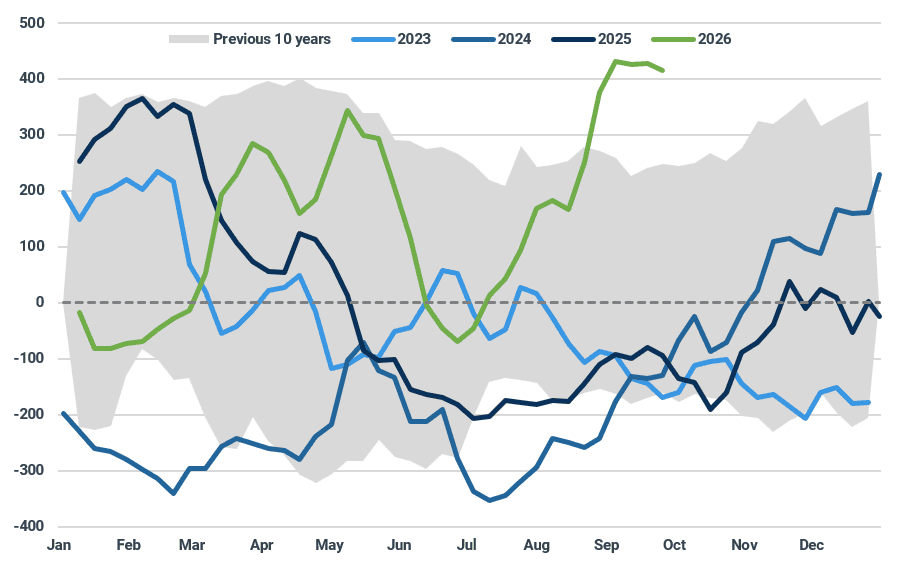
Managed money net positions pushed CBOT corn to record levels in September (k lots)
Source: CFTC
Net managed money positions remained stable through most of September according to CFTC data. Kpler Financial Flows shows a few early exits started on 21 September, but CTAs remained over 60% long towards the end of the month.
US corn exports lose out to competition after two years
Fundamentally, the US corn balance sheet has provided bullish impetus in the form of production cuts. However, strong production in 2025 has pushed 2025/26 ending stocks to its highest since 2020. The September grain stocks report further increased the ending stocks to 2.1 billion bushels. These higher stocks provide a buffer against lower production expected in 2026.
Competition from South American exporters is also catching up. Argentina’s record production is expected to increase its 2025/26 exports by a third y/y to over 40 Mt. In Brazil, domestic demand has dominated over the last two years. Ethanol producers have not only consumed the grain, but also stocked up. This domestic competition kept Brazilian export prices uncompetitive for most of 2024 and 2025. Export pipelines were also catering to record soybean exports, crowding out other grains. However, as soybean exports seasonally slow, corn exports are showing an increase.
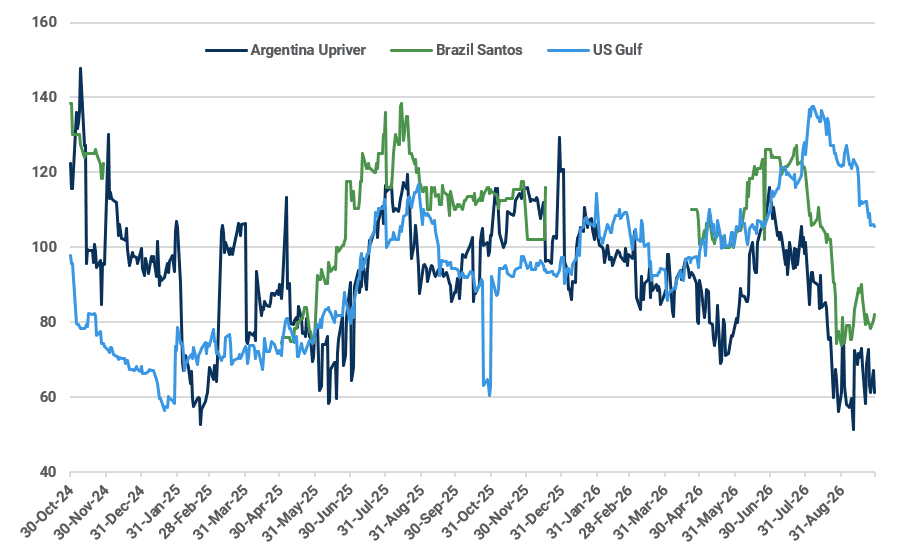
Corn FOB basis shows US losing export competitiveness (¢/bu)
Source: Barchart
Since the 2024 harvest, US corn has continually been the cheapest in the market, except for brief seasonal competition from Argentina after its harvests in May 2025 and 2026. The spreads have now diverged and buyers are making the switch in the physical market.
As a result, our 2026/27 US corn exports is much lower than the USDA’s, and ending stocks higher, similar to 2025/26 levels.
Surprise Chinese buying could change things
In the past, China has provided a floor to US corn prices. Chinese buying swiftly came in at times of high US ending stock projections and low prices. Their insatiable appetite for feed-grains and ability to store made them an opportunistic buyer. This happened in earnest in 2020/21, when China bought over 20 Mt to reduce stocks from a projected 2 bn bu to 1.2 bn bu. However, through the low prices of the last two years, China’s absence from the US market has been conspicuous, and contributed to the US stock build-up.
Plateauing domestic demand, along with trade tensions with the US has kept China away from buying corn. Last week’s meeting of the Presidents did not result in any concrete commitments, providing little confidence to markets.
Nevertheless, if China were to fulfil its May promise of buying at least $17bn of US agricultural products excluding soybeans, it must buy US corn. A surprise announcement to the effect could take the market by surprise.
A cascade of selling could follow
Lower prices will trigger further CTA sell-to-close levels. Kpler Financial Flows estimates significant volumes will be triggered on further down-moves. The selling momentum could lead to further breaches as medium and long-term strategies close out tens of thousands of lots down to 450¢. Physical markets could offer support at those levels.
Lack of competition has allowed the US to export a record 3.4 billion bushels (87 Mt) in 2025/26. The USDA expects a repeat in 2026/27. However, it is unlikely to happen at today’s prices.

See why the most successful traders and shipping experts use Kpler