

Global LNG and natural gas prices surge as US and Iran resume hot war
With the Strait of Hormuz closed once again and hostilities between Iran and the US renewed, Kpler Insight has adjusted our LNG supply base case forecast to reflect a more prolonged conflict scenario. We now expect traffic through the Strait to remain severely constrained through the rest of the year, recovering throughout Q1 2027. Already, the continuation of armed conflict in the Middle East has caused TTF and Asian LNG prices to significantly increase in recent days as Europe and Asia compete for supply.
Call to action: Launch of LNG and natural gas S&D API
Kpler Insight has recently launched the LNG and natural gas supply and demand API, which includes full natural gas balances and forecasts for over 25 countries modelled on a bottom-up basis. To find out more, book your demo here.
Market & Trading Calls
European TTF front-month price outlook: Bullish, as European buyers are likely to bid higher for Atlantic Basin LNG amid escalating tensions in the Middle East and the risk of slight dip in near-term US LNG exports due to Tropical Storm Bertha. Fundamentally, Kpler Insight expects LNG imports to decline, pipeline supply to stay rangebound, and gas consumption to hold steady.
Asian LNG front-month price outlook: Slightly Bullish, although last week's rally already added a significant geopolitical premium, Kpler Insight's revised prolonged conflict Hormuz scenario further tightens the prompt balance through expectations of lower Qatari exports over the September–December period. September delivery prices are expected to remain well-supported, as buyers compete for a smaller pool of Atlantic Basin cargoes amid persistent geopolitical uncertainty surrounding Hormuz transit.
Asian LNG – TTF spread outlook: set to slightly narrow, as TTF is likely to see a sharper increase relative to Asian LNG. Over the last week, Asian LNG rose to a premium over TTF, with the spread at $1.09/MMBtu on 22 July, compared to a discount of -$1.36/MMBtu a week earlier.
US Henry Hub front-month price outlook: Stable, as strong production, robust storage levels, and relatively weak demand keep prices rangebound.
Key natural gas and LNG front-month prices ($/MMBtu)
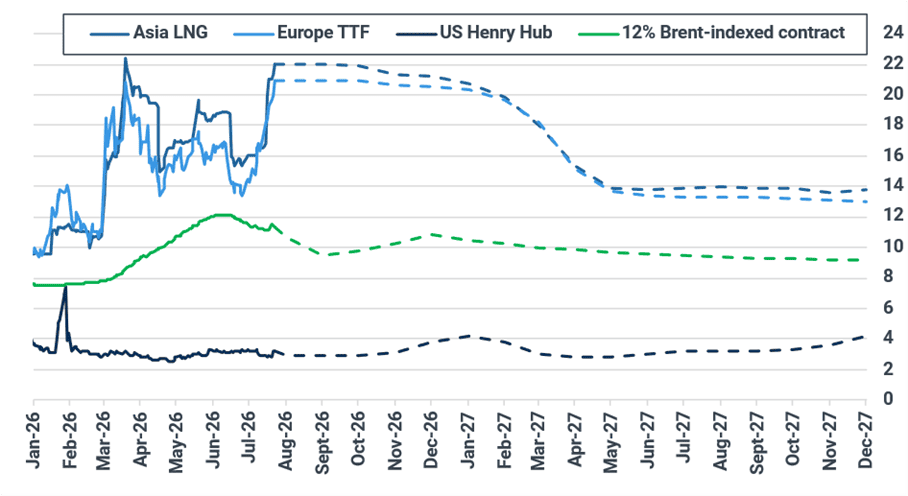
Source: ICE, NYMEX. Brent-indexed price represents 12% slope of 90-day moving average of Brent contract.
Asian LNG-TTF front-month spread ($/MMBtu)
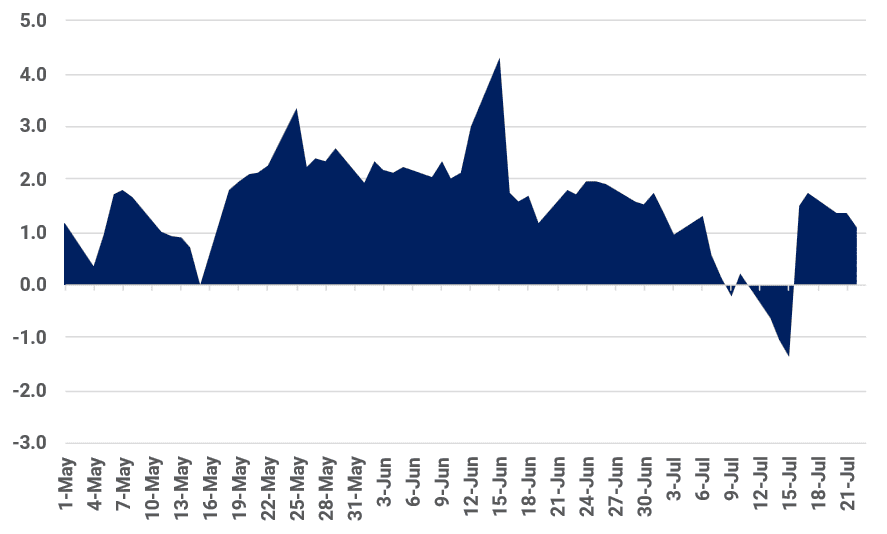
Source: ICE, Kpler Insight
Europe: Middle East tensions to continue driving bullish pressure on TTF
The European TTF front-month contract continued its rally last week, settling at $20.91/MMBtu on 22 July, up 15.1% from $18.17/MMBtu on 15 July, marking the highest close for the main European benchmark since January 2023. Most of the gains stemmed from the re-escalation of the US-Iran conflict, with renewed attacks across the region. The events, coupled with a decrease in loadings at Qatar’s Ras Laffan and the reduction of LNG vessel crossings in and out of the Strait, are seen by market participants as a longer-term supply disruption from the Middle East Gulf, which will likely intensify inter-basin competition for flexible supply. Additionally, the bullish sentiment was supported by lower LNG imports w/w, which contributed to a slowdown in net UGS injections amid stable pipeline supply and gas consumption. Lastly, the passage of Tropical Storm Bertha across the US Gulf Coast also raised concerns about a potential delay in US LNG loadings over the next few days, adding to bullish momentum.
Looking ahead, Kpler Insight maintains a bullish outlook for the TTF front-month contract, as we expect European buyers to bid higher to secure LNG supply from the Atlantic Basin amid a continued deterioration in the Middle East conflict and the risk of a temporary decline in US LNG exports in the coming days. Fundamentally, we anticipate LNG imports to decrease w/w, pipeline supply to remain rangebound, and gas consumption to hold stable.
EU net pipeline imports remained rangebound, rising only 0.4% w/w to an estimated 3.17 bcm. Higher imports from Norway, Libya, and the UK offset minor declines in Algerian exports to Italy. Looking ahead, Kpler Insight anticipates net pipeline imports to remain stable, as a slight decrease in Norwegian flows, driven by unplanned maintenance at Dvalin, is likely to be mitigated by expected small increases in Algerian exports due to forecast declines in temperatures in Northern Africa.
Gassco daily unavailability in fields and processing plants (mcm/d)
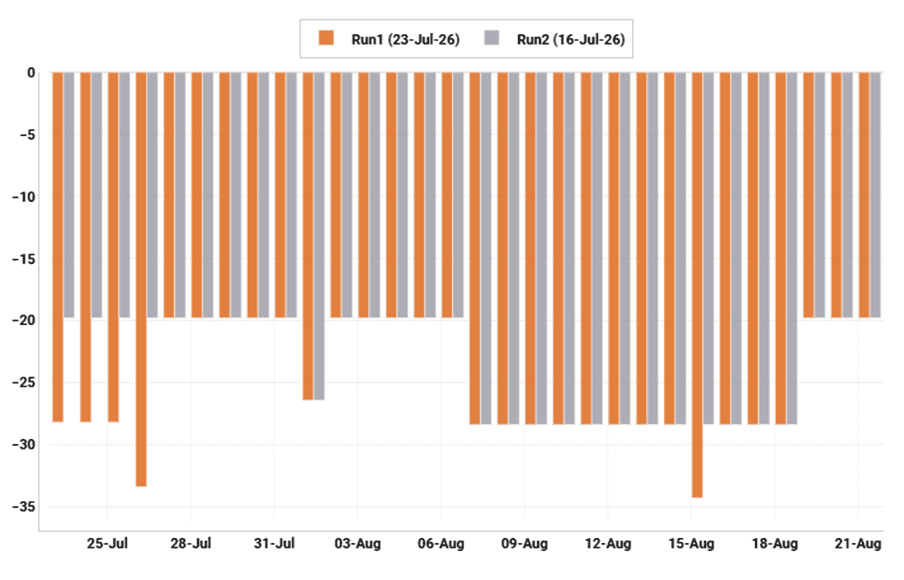
Source: Kpler European Gas, GASSCO.
European LNG imports decreased 21.7% w/w to 1.26 mt, with domestic gas hub prices in NWE markets proving too low to attract supply. Lower imports into Iberia resulted from ongoing planned maintenance at several Spanish terminals. Reduced LNG volumes into Spain amid high gas-for-power demand have increased PVB prices to a premium over the TTF, attracting pipeline imports from Algeria and France. Looking ahead, LNG imports are expected to slightly decrease, mostly as a result of intensified competition with Asian buyers for Atlantic Basin supply amid an unfavourable seasonal spread that limits market incentives to increase UGS injections.
European weekly LNG imports by region (mt)
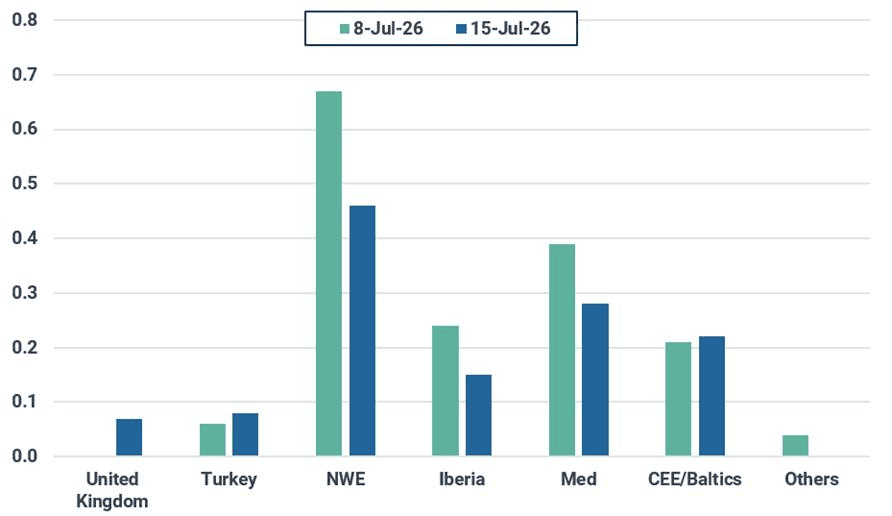
Source: Kpler Insight. Data represents week commencing 01/07 and 08/07. NWE=FR, BEL, NL, GER. Iberia=ESP, POR. Med=ITA, HVR, GRE. Baltics/CEE=FI, LT, POL. Others=SWE, MT.
Aggregate local distribution consumption across 16 EU countries increased slightly by 1.7% w/w to an estimated 0.91 bcm but remained in line with seasonal averages. Looking ahead, we expect local distribution demand to remain broadly rangebound, as temperatures across the continent are forecast to remain near the 5-year average.
EU-16 weekly consumption in the local distribution sector (bcm)Source: ENTSOG, ENAGAS, Eustream, AGCM, Kpler I

nsight. The EU-16 perimeter includes AT, BE, DE, CZ, FR, HU, GR, IT, NL, LU, PL, PT, RO, SL, SK, and ES.
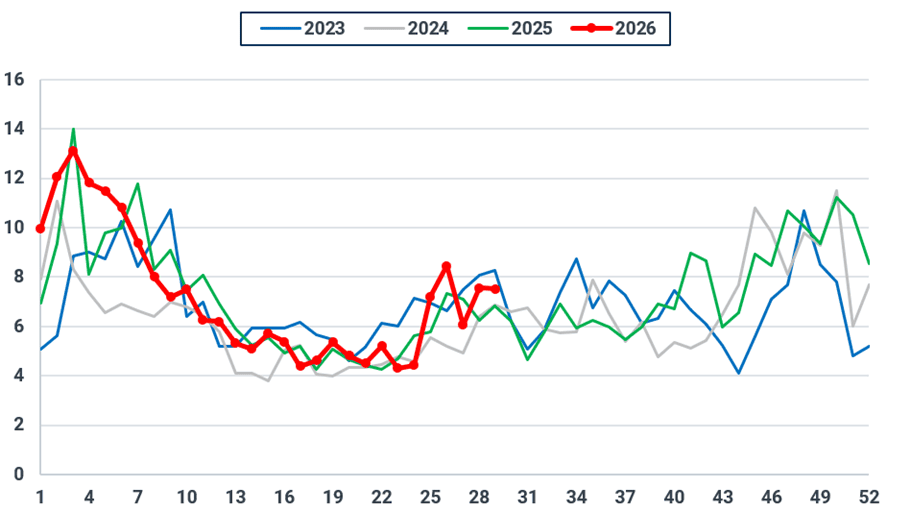
In the power sector, EU-25 gas-fired generation was stable, down just 1% w/w to an estimated 7.5 TWh. Despite a slight increase in power demand (+0.4% w/w), higher wind output, together with increased coal and nuclear generation, weighed on gas-fired generation in NWE. However, this decline was almost offset by higher gas-fired output in Southern and Southeastern Europe, driven by elevated temperatures, leaving overall gas-fired generation broadly stable w/w. Looking ahead, gas-fired generation is expected to remain stable. Low gas use is anticipated for the first half of the week, amid low temperatures and strong wind speeds in NWE and Southern Europe, before higher gas burns towards the back end of the week, as temperatures rise above seasonal norms and wind speeds decline across most of the continent from 26 July onwards.
EU-25 weekly gas-fired generation (TWh)
Source: Kpler Power, Kpler Insight.
Average daily temperature forecast for cooling-sensitive European countries (°C)

Source: Kpler Insight. Run comparison 23/07 (solid) vs. 16/07 (dotted), 00:00 UTC. Seasonal is a five-year average.
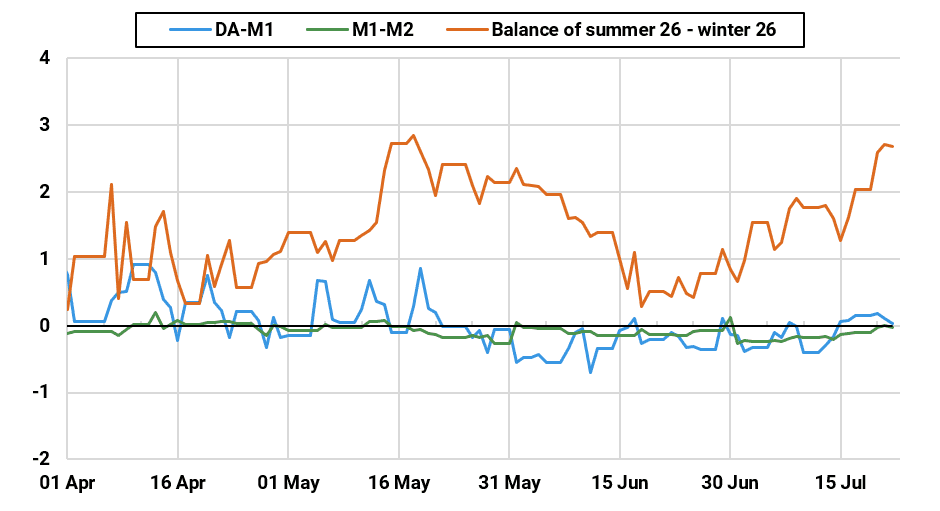
EU-27 underground gas storage levels rose to 54.4% as of 21 July, up 1.6% w/w. Net injections averaged 0.23 bcm/d over the past week, 0.05 bcm/d below the five-year average. The slower pace was mainly driven by weaker net injections in Spain, as the country relied on underground gas storage, LNG inventories, and pipeline imports to offset the loss of LNG import capacity due to planned maintenance. Strong gas consumption, driven by high power demand, also led to a slowdown in injections, widening the cumulative injection deficit versus the five-year average by 0.07 bcm w/w. Looking ahead, Kpler Insight expects the pace of storage injections to hold steady, as reduced gas-fired generation is balanced by softer LNG and pipeline supply. Meanwhile, the TTF balance of summer contract’s premium over the winter 26/27 contract widened to €2.68/MWh as of 22 July, reflecting the recent spike in the balance-of-summer prices and reducing the incentive to inject gas into storage.
EU-27 net cumulative UGS injections since 1 April (bcm)

Source: GIE, Kpler Insight. Latest data as of 21 July 2026.
Selected TTF contract spreads (€/MWh)
Source: Kpler Insight, Argus, EEX. DA = day-ahead; M1 = Month ahead; M2 = Two month ahead.
Asia: Downward revision to Qatar’s LNG supply outlook supports higher prompt LNG prices
Asian spot LNG prices rose sharply from $16.81/MMBtu on 15 July to $22/MMBtu on 22 July (+$5.19/MMBtu w/w), in line with our expectation of a strong September contract rollover. The rally was driven by escalating geopolitical risk around the Strait of Hormuz, sustained strength in European gas hub prices, and fresh spot LNG transactions in Asia that reinforced higher price levels as buyers priced in tighter Middle East supply and increased competition for Atlantic Basin cargoes.
Asian LNG prices are expected to remain modestly bullish in the week ahead. While last week's rally has already added a significant geopolitical premium, Kpler Insight's revised prolonged conflict Hormuz scenario increases the prompt supply deficit by reducing expected Qatari LNG exports. This is expected to keep September delivery prices firm and sustain the prompt risk premium as buyers compete for a smaller pool of available cargoes.
Temperatures in Japan are expected to ease towards seasonal averages next week, while southern China is forecast to experience cooler-than-normal conditions. Elsewhere in Asia, temperatures are anticipated to remain broadly in line with seasonal norms. Softer cooling demand in Japan and southern China is likely to weigh on near-term spot prices; however, tighter Middle East LNG supply and persistent geopolitical risk should largely offset the weather-driven downside.
Forecasted average temperatures for Asian countries (°C)

Source: Meteostat, Kpler Insight. As of 23 July 2026 00:00:00 UTC. Population-weighted average temperature of selected major cities across a country is shown for both historical and forecast.
Japan's major power utilities' LNG inventories rose by 0.09 mt w/w to 2.51 mt as of 19 July, reflecting stronger restocking amid hotter July temperatures. The Japan Meteorological Agency's (JMA) latest forecast points to a 40–50% chance of above-normal August temperatures across most of Japan, slightly lower than its previous forecast. Despite this downward revision, gas-fired availability is expected to reach 75 GW in August, up 1 GW y/y and above the five-year average, to meet peak summer demand. Under Kpler Insight's prolonged conflict Hormuz scenario, Japan remains comparatively resilient due to its greater reliance on contracted LNG volumes and lower exposure to Qatari supply disruptions, limiting demand destruction relative to other Asian markets.
Japan’s monthly gas-fired availability (GW)

Source: HJKS, Kpler Insight
Japan implied total LNG inventory forecast (mt)

Source: METI, Kpler Insight. Note: Total implied LNG inventories include all power companies and non-power companies.
South Korea's LNG demand outlook has been revised lower under the prolonged conflict Hormuz scenario, as sustained Asian spot LNG prices above $18–20/MMBtu are expected to delay discretionary restocking and encourage greater coal-fired generation. With the Korea Meteorological Administration (KMA) maintaining a 50–60% probability of above-normal temperatures in August and September, cooling-related LNG demand is expected to remain relatively stable. That said, elevated prices are likely to deter near-term inventory rebuilding, suppressing prompt LNG demand through late 2026. As a result, South Korea is expected to contribute to Northeast Asia's demand adjustment alongside China, helping rebalance the global LNG market until Middle Eastern LNG supply begins to recover in Q1 2027.
Population-weighted apparent CDDs in Korea (degree-days)

Source: Meteostat, Kpler Insight. Note: Population-weighted CDD of selected major cities across Korea is shown for both historical and forecast.
Korea implied total LNG inventories (mt)

Source: KESIS, Kpler Insight.
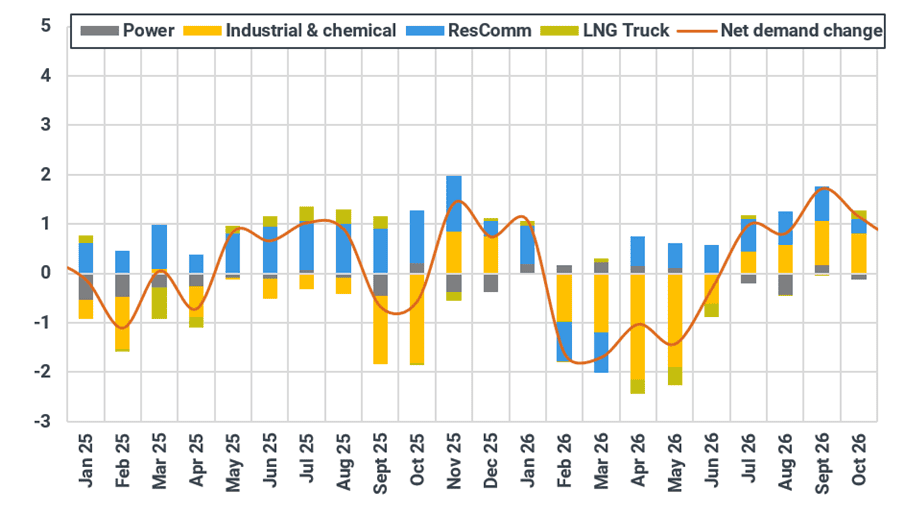
China’s LNG demand outlook has been revised lower under Kpler Insight’s prolonged conflict Hormuz scenario, with 2026 imports cut by 4.5 mt from the previous forecast. The adjustment is expected to come through delayed inventory rebuilding and weaker industrial gas demand, as sustained Asian spot LNG prices above $18/MMBtu undermine the economics of imported LNG. However, lower-than-expected Central Asian pipeline imports and a slower recovery in domestic gas production in Hainan and Shanxi are likely to tighten domestic gas supply in Q3 and early Q4. Combined with peak summer gas-for-power demand, this could sustain modest near-term LNG procurement, although stronger solar generation in August may cap further upside. As a result, while China remains the largest source of LNG demand curtailment in Northeast Asia until Middle Eastern supply begins to recover in Q1 2027, tighter domestic gas balances could still provide additional modest support to prompt prices.
Year-on-year changes in China’s monthly gas demand by sector (Bcm)
Source: NDRC, Kpler Insight
China implied LNG inventory forecast (LHS, %; RHS, mt)

Source: Kpler Insight
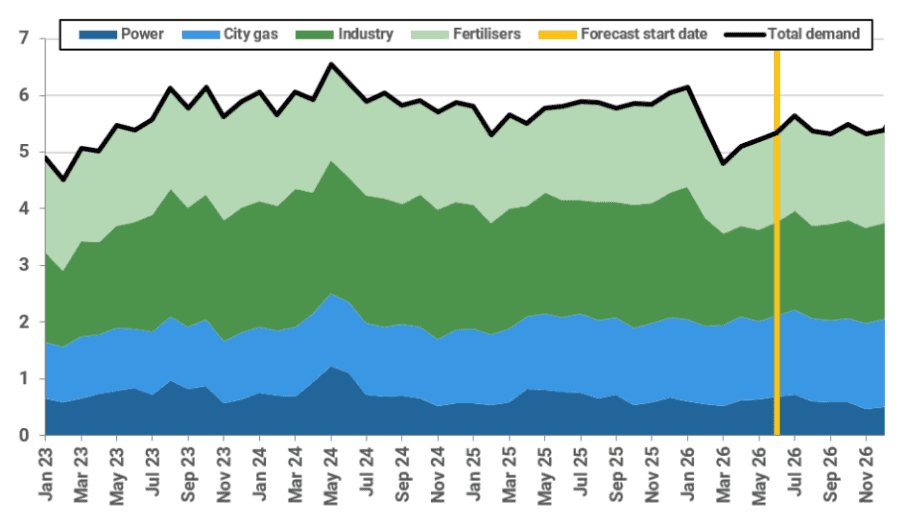
India's LNG demand outlook has been revised lower under Kpler Insight's prolonged conflict Hormuz scenario, with 2026 LNG imports reduced by 1.3 mt to 24.6 mt. With Asian spot LNG prices expected to remain above $18–20/MMBtu through the rest of 2026, LNG will become increasingly uncompetitive against alternative fuels. Price-sensitive industrial users and gas-fired power generation are expected to absorb most of the demand destruction, while city gas distribution and fertiliser demand remain comparatively resilient. Kpler Insight now forecasts India's total gas demand at 64.5 bcm in 2026, down 4.6 bcm y/y.
More broadly, South Asia remains the region most exposed to prolonged Middle East LNG supply disruptions. Pakistan and Bangladesh are expected to reduce LNG consumption through tighter gas allocations, lower power-sector demand, and incomplete replacement of disrupted Qatari cargoes.
India monthly gas demand forecast by sector (bcm)
Source: PPAC, Kpler Insight
US: Strong domestic gas production, stout storage inventories, to keep Henry Hub under $3.00/MMBtu
US Henry Hub front-month price settled at $2.93/MMBtu on 22 July, identical to the 15 July settlement. Despite a relatively light storage injection reported for the week ending 10 July, prices fell to $2.86/MMBtu last Thursday. Henry Hub reclaimed some lost ground on Friday, settling at $2.91/MMBtu, as lower prices spurred limited buying. However, a mixed temperature outlook and risks associated with the potential impacts of Tropical Storm Bertha saw prices hold near flat at $2.87/MMBtu on Monday and Tuesday. Wednesday saw a modest rally, with supportive weather model revisions showing scorching hot temperatures in the Southwest for the remainder of July.
Henry Hub prices are expected to remain rangebound between $2.85-3.00/MMBtu over the next 7 days, with strong domestic gas production, limited impacts from the incoming tropical storm, and profit-taking activities from traders limiting upside potential.
US domestic gas consumption by sector (bcf/d)

Source: EIA
National consumption averaged 81 Bcf/d, up 2 Bcf/d w/w as hot temperatures, coupled with weak wind output, increased the call on natural gas-fired power generation. Gas demand in the power sector once again crested 50 Bcf/d on 21 July, as the southern and western US experienced blistering heat. Above-average temperatures are expected to persist for much of the Lower 48 over the coming week, though cooler conditions in the Northeast and parts of the Midwest are expected to limit burns. Gas demand in the power sector is forecast to average between 45-50 Bcf/d over the next 7 days.
Tropical Storm Bertha is likely to cause delays in loadings from liquefaction facilities on the US Gulf, though feed gas deliveries are expected to be mostly unaffected.
Forecast of cooling degree days

Source: National Weather Service
Dry gas production averaged near 110 Bcf/d over the last week, fluctuating between 109 and 110 Bcf/d. Kpler Insight expects production to remain near current levels amid hot temperatures.
Forecast of natural gas volumes in underground storage (bcf)
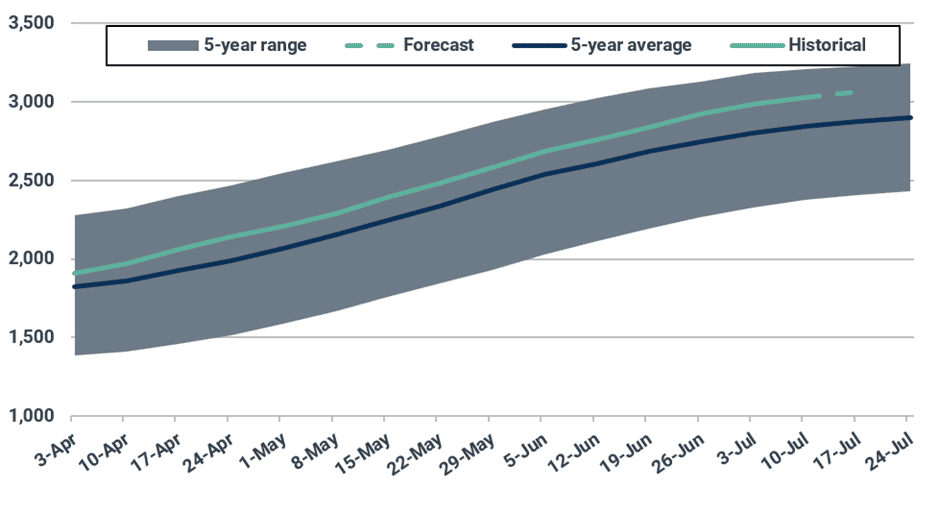
Source: EIA, Kpler Insight
The US injected 41 Bcf into underground storage for the week ending 10 July, matching market consensus. Inventories grew to 3,024 Bcf, though the surplus to the 5-year average fell from 6.6% to 6.4%. Another relatively light storage build is expected for the week ending 17 July, as lower wind generation supported increased gas demand in the power sector. Kpler Insight forecasts a net injection of 37 Bcf.
Global LNG Supply: Kpler Insight adjusts base case Hormuz view to ‘prolonged crisis’; Tropical Storm Bertha could slow USGC loadings this week
Global LNG exports dropped to a six-week low last week, falling 0.50 mt w/w to 7.21 mt driven by lower US (-0.17 mt w/w to 2.18 mt) and Qatari exports (-0.09 mt to 0.34 mt).
Kpler Insight expects global LNG supply to fall further this week as Tropical Storm Bertha slows loadings along the US Gulf Coast, while LNG exports from Qatar's Ras Laffan continue to decelerate and UAE shipments from Das Island have come to a standstill following the closure of the Strait of Hormuz. These losses are partially offset by higher Russian LNG supply, with Sakhalin 2 returning to full production after planned maintenance.
Global LNG exports (mt, 10-day moving average)

Source: Kpler
In the Middle East, amid escalating geopolitical tensions between the US and Iran, Kpler Insight has revised its base case view for the Strait of Hormuz from a de-escalation scenario to a prolonged crisis scenario, in which LNG transit remains severely constrained through the end of 2026 before gradually recovering during Q1 2027. As a result, global LNG exports have been revised down by 21 mt over July 2026–March 2027 against our previous de-escalation base case, leaving the global LNG market significantly tighter for longer.
Qatar LNG export forecast - prolonged crisis vs previous de-escalation base case (mt)
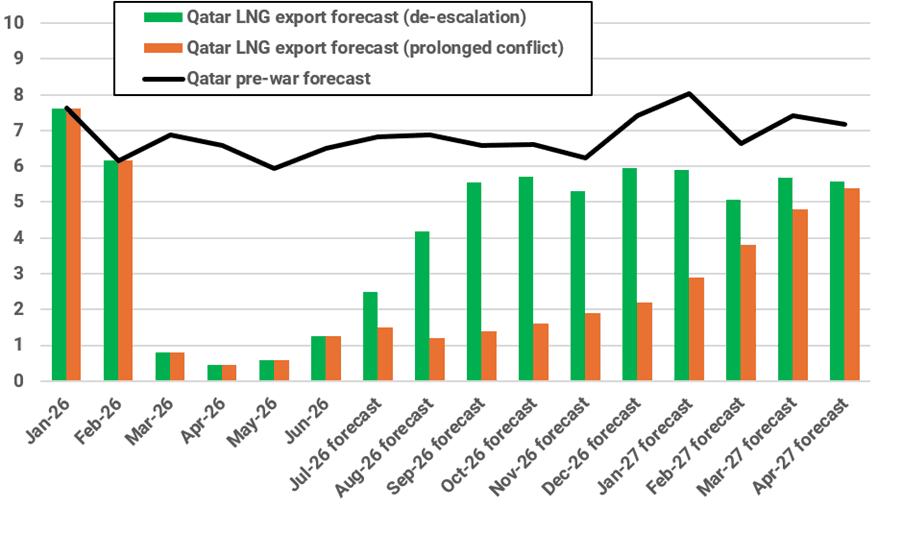
Source: Kpler Insight
Loadings out of Qatar’s 77 mtpa Ras Laffan plant are slowing, while UAE exports have ground to a halt. Last week, Ras Laffan loadings dropped to 4 cargoes, down from 6 the week prior. So far this week, 1 cargo – the Al Gharrafa - has loaded with another – the Al Shamal - at the facility currently. The latest thermal imagery shows three trains remain active - QatarGas Trains 6 and 7 and RasGas Train 7.
Meanwhile, Das Island has exhausted all ballast vessel capacity in the Gulf and thermal activity reveals the plant is winding down production, with only one of three trains online currently.
In the US, Tropical Storm Bertha has made landfall in Louisiana, raising the risk of loading delays at US Gulf Coast liquefaction plants. Bertha, the second named storm of the Atlantic hurricane season, came ashore on Wednesday in St. Bernard Parish, around 40 miles east of New Orleans, according to the National Hurricane Center (NHC). Sustained winds are forecast at 40 knots, with the potential to reach a maximum of 50 knots. At the time of publication, a number of ballast vessels were waiting offshore for the storm to pass before calling at US Gulf Coast LNG export terminals, indicating that loading delays are likely until the storm passes.
US Gulf Coast LNG vessel positions
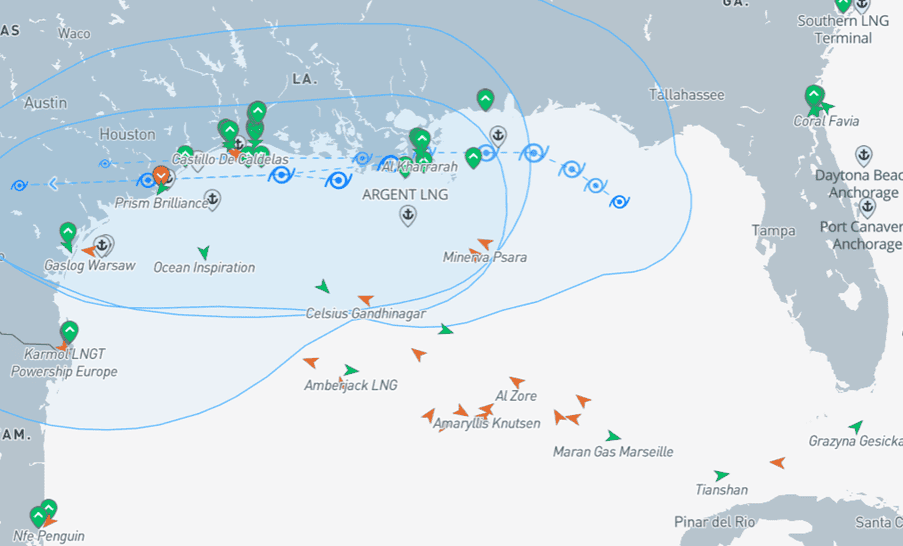
Source: Kpler. Screenshot from 23 July at 11am BST.
Feedgas deliveries into US liquefaction plants has trended between 16.23-16.53 bcf/d over the past week, with Freeport LNG remaining offline for planned maintenance at one train. Golden Pass feedgas volumes have remained steady at 0.31–0.33 Bcf/d over the past week, well below the level required to support a single 6 mtpa liquefaction train at full capacity, indicating the ramp-up continues to face challenges.
In Canada, exports from the 14 mtpa LNG Canada plant fell from three cargoes to two last week amid unplanned maintenance. Sources close to the project said there may be delays of one or two days as a result.
Elsewhere, Russia’s 10.8 mtpa Sakhalin 2 plant returned to exports on 18 July following planned maintenance, adding to Pacific Basin supply amidst the ongoing Hormuz crisis. According to Kpler data, the Grand Aniva arrived at Prigorodnoye on 17 July before loading and departing a day later.
LNG and natural gas S&D API
Kpler Insight has recently launched the LNG and natural gas supply and demand API, which includes full natural gas balances and forecasts for over 25 countries modelled on a bottom-up basis. To find out more, book your demo here.

See why the most successful traders and shipping experts use Kpler