


In a chokehold of chokepoints, who chokes first?
Bessent's “economic D-Day” arrives Monday, with Washington promising to sever Iran's remaining economic lifelines and force the regime into collapse. But who breaks first: Iran, the countries absorbing the cost of its isolation, or the chokehold itself as Iran and its partners build ways around it?
In a Chokehold of Chokepoints, Who Chokes First?
“It is a one-two punch. We have the blockade, and we are going to have the toughest sanctions in history. And I will tell you, this will work. It worked in Venezuela once we put up the blockade. It is working in Cuba right now. And it is going to work in Iran, and we are going to collapse this regime.”
— Treasury Secretary Scott Bessent, CNBC, August 20, 2026
Here we are, three days later, Bessent called the next phase an “economic D-Day”—“the single greatest financial offensive ever marshalled against an adversary,” designed to “sever every economic lifeline” sustaining Iran.
The One-Two Punch in Action
Bessent's description of Venezuela is worth unpacking. The United States imposed a blockade on sanctioned Venezuelan oil tankers on December 16, 2025, adding another layer of pressure to an economy already weakened by years of sanctions. Yet Venezuelan oil exports had surged immediately before the blockade and were still running above 600 kb/d in December.
Just 18 days later, U.S. forces captured President Nicolás Maduro and removed him from the country. His vice president, Delcy Rodríguez, assumed the presidency and has since governed in cooperation with Washington. The blockade increased pressure on Caracas, but it had hardly had time to economically isolate Venezuela before U.S. forces directly removed its president.
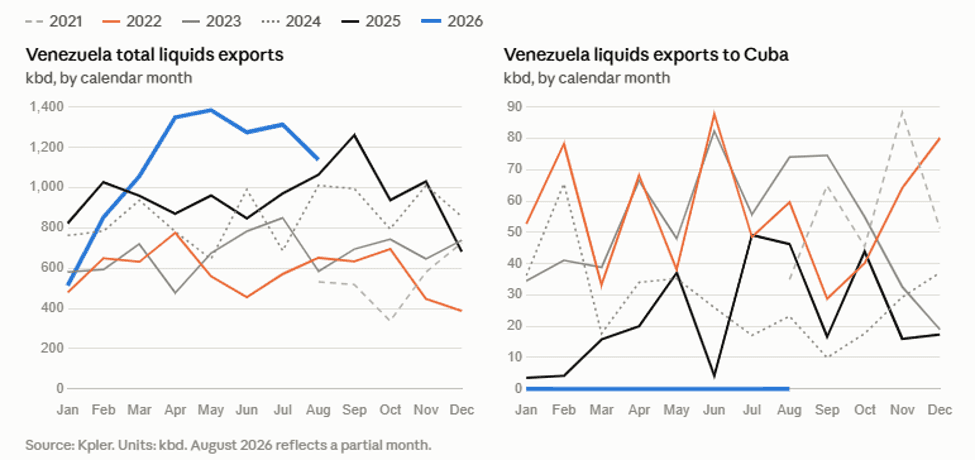
Cuba may be approaching something closer to the economic experiment Bessent describes. The United States has subjected Cuba to economic sanctions for more than six decades without forcing regime change. What is different in 2026 is the nature of the isolation. For much of that history, outside patrons continued to provide the island with energy, financing and trade. Today, Washington is trying to close those external lifelines as well.
Venezuelan oil shipments stopped after Maduro's capture, and Washington threatened tariffs against countries that tried to replace them. Cuba consumes roughly 110 kb/d of petroleum but produces only 30–40 kb/d domestically, leaving it heavily dependent on outside energy.
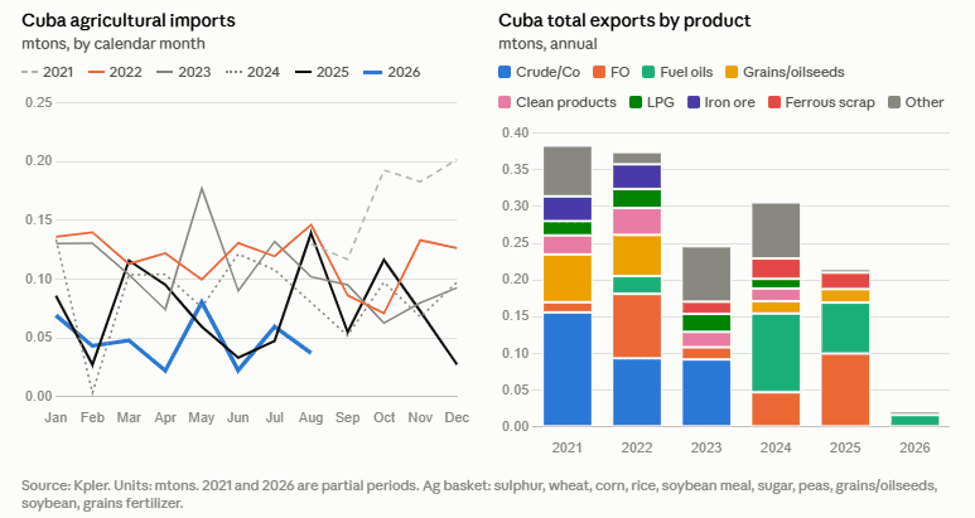
The squeeze now operates on both sides of Cuba's external accounts. Cuba imports far more than it exports and relies on medical services, tourism, remittances, mining and tobacco for the foreign currency needed to finance essential imports. Less fuel means less electricity, transportation, tourism and industrial production; weaker economic activity means fewer foreign-exchange earnings and still less ability to import. The contraction becomes self-reinforcing.
Yet there is an important difference between strangling an economy and strangling a regime. Cuba's limited domestic crude and refining capacity cannot sustain normal economic activity, but it appears to be sufficient to preserve critical infrastructure and fuel for the military and internal-security apparatus. Scarcity falls disproportionately on civilians while the government protects the institutions necessary for its survival.
That is the central weakness in economic strangulation as a strategy for regime change: the economy can run out of resources long before the regime does. Economic pressure can weaken a country, but regime change still requires that hardship translate into political action capable of overwhelming—or fracturing—the institutions protecting the government.
The Iranian One-Two Punch
Iran is considerably harder to isolate than Cuba. It shares land borders with seven countries, produces its own oil and natural gas, has a large industrial and agricultural economy, and has spent decades building commercial and financial routes around U.S. sanctions.
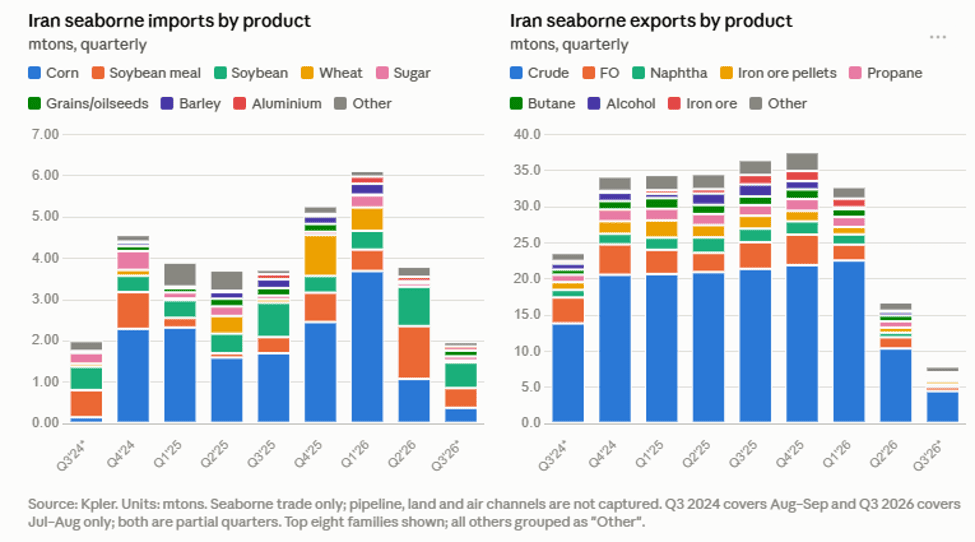
The U.S. naval blockade has already attacked Iran's largest external artery: seaborne trade. As those flows approach zero, the campaign moves inland. Iraq, Turkey, Afghanistan and Pakistan remain direct land outlets; pipelines continue moving Iranian gas; northern routes connect Iran to the Caucasus, Central Asia and Russia; and exchange houses, banks, gold and barter provide ways to move value outside conventional financial channels.
Closing those routes also exports the economic pain. Iraq risks deeper electricity shortages if Iranian gas disappears. Turkey can replace Iranian gas, but at a cost. Afghanistan receives nearly a third of its imports from Iran. Every remaining Iranian economic lifeline is also, to varying degrees, someone else's supply line.

See why the most successful traders and shipping experts use Kpler






