


Iron ore miners tracking: The Middle East conflict and CMRG restrictions continue to weigh on miners’ September quarter cost structures and output
High fuel costs and freight rates linked to the war in the Middle East pushed up mining and export costs for global iron ore miners in the June quarter but had only a very limited impact on their overall iron ore production or shipments. Main iron ore miner’s operational performance remained firm in the quarter. Looking ahead to the September quarter, China Mineral Resources Group (CMRG)’s disputes with miners such as FMG and Rio Tinto may introduce some additional uncertainty.

Rio Tinto – SP10 products in the sales mix reached a three and a half year low
Closely matching Kpler Insight's forecast of 85Mt, Rio Tinto reported 85.26Mt of Pilbara iron ore sales (100% basis) in Q2 2026, up 6.73% y/y. With production broadly flat from a year earlier, the stronger sales growth was likely supported by a drawdown of mine and port inventories accumulated in Q1, when cyclone-related disruptions constrained shipments.
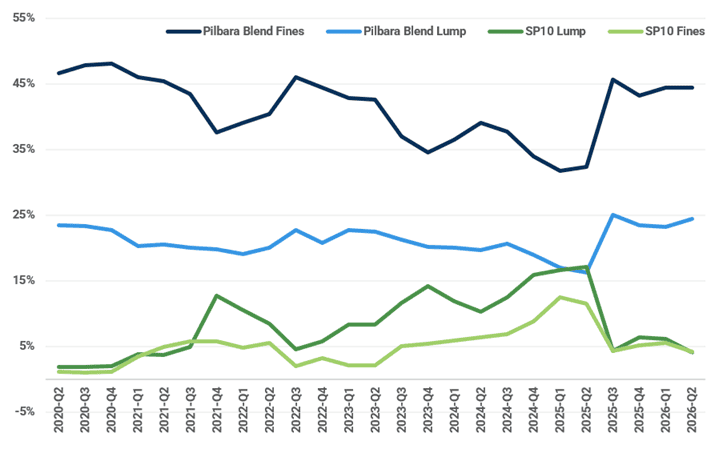
Rio Tinto's product mix also continued to shift following a year of implementing its revised Pilbara strategy. Since July 2025, the company has been consolidating SP10 and the previous Pilbara Blend specifications (61.6% Fe for fines and 62.2% Fe for lump) into a single offering with a lower iron content of 60.8% Fe for fines and 61.6% Fe for lump. Against this backdrop, SP10's share of Pilbara sales fell to 8.17% in Q2 2026, the lowest in three and a half years, while Pilbara Blend products accounted for 68.83%, their highest share since 2020.
Share of Pilbara Blend and SP10 products in Rio Tinto shipments mix (%)
Source: Rio Tinto, Kpler Insight
Looking ahead, 165.35-180.35Mt still needs to be sold in H2 2026 to meet the annual guidance of 323-338Mt. Commercial tensions with China remain a potential risk to H2 sales. Although CMRG has reportedly instructed some Chinese steel mills to suspend negotiations with Rio Tinto, there has been little evidence of an impact on shipments so far. Assuming exports remain largely unaffected through the remainder of August and September, we expect Rio Tinto to report 84.50Mt of Pilbara iron ore sales (100% basis) in Q3 2026.
At Simandou, construction of the SimFer mine and port were 77% and 85% complete, respectively, as of July, while 2.20Mt of high-grade ore was shipped during H1. Guinean authorities nevertheless appear keen to accelerate the ramp-up. At a meeting on 12 August between a senior Guinean official and the head of Rio Tinto's iron ore business, the government reiterated the need to accelerate production towards the project's 60Mtpa target.
Vale - Oman pellet plants resumed faster than expected
Slightly above Kpler Insight's forecast of 83.20Mt, Vale reported 84.26Mt of iron ore production (including third-party purchases) in Q2 2026, up 0.78% y/y. Growth was driven by the Southeastern System, where production increased by 3.30Mt y/y, led by the continued ramp-up at Capanema. This was sufficient to offset lower output from both the Northern and Southern Systems.
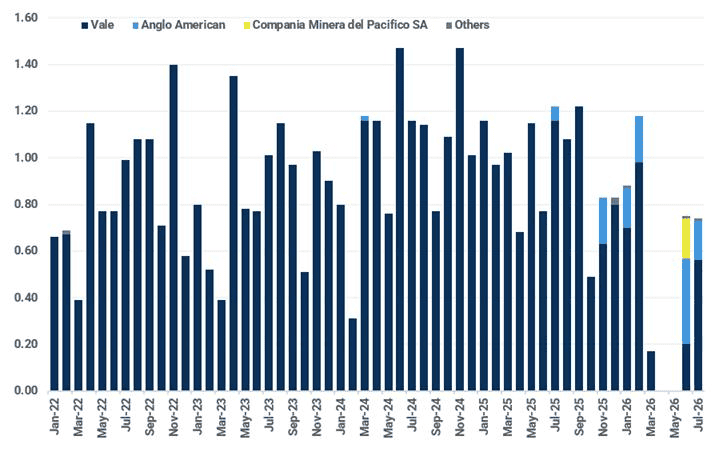
Vale also disclosed that its Oman pellet plants partially resumed operations in late June, earlier than its previous expectation of restart by the end of Q3. Kpler's seaborne flows are consistent with the recovery, with iron ore arrivals at Vale's Omani facilities reaching 0.75Mt in June and 0.74Mt in July. The timing of a full production recovery remains uncertain, although Vale continues to see strong Middle Eastern demand for direct-reduction pellets, particularly following the shutdown of the Bahrain pelletising plant.
Iron ore imports by Vale’s Sohar terminal, by seller (Mt)
Source: Kpler
Looking ahead, Vale needs to produce 181-191Mt to meet the full-year guidance of 335-345Mt. We expect Vale to report 94.50Mt of iron ore production (including third-party purchases) in Q3 2026, broadly unchanged from a year earlier. This would represent a marked slowdown from the 3.77% and 5.49% y/y growth recorded in Q3 2025 and Q3 2024, respectively. Softer iron ore prices amid subdued Chinese demand, combined with higher costs linked to oil prices and exchange-rate movements, have compressed margins and reduced the incentive to maximise incremental production and shipments.
BHP - Jimblebar recovery gains momentum
In line with Kpler Insight's forecast of 74Mt, BHP reported 74.84Mt of iron ore production (WAIO, 100% basis) in Q4 FY2026 ending June, down 3.41% y/y. Despite the prolonged dispute with CMRG through much of the year, full-year production edged 0.42% higher to a record 291.21Mt, demonstrating the resilience of BHP's Pilbara operations.
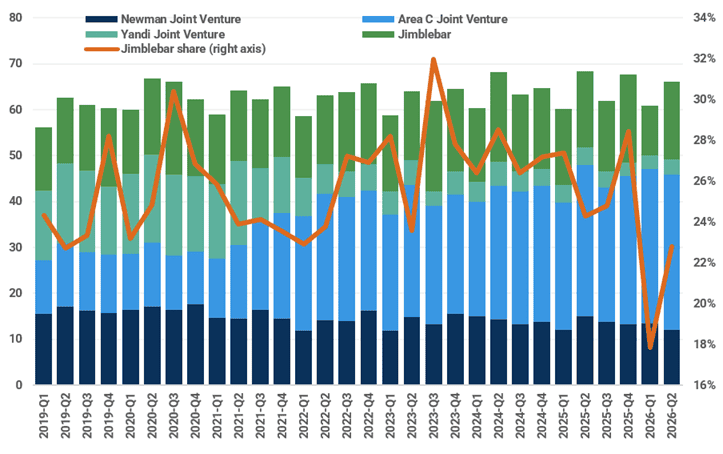
The recovery in Jimblebar accelerated following the conclusion of negotiations with CMRG in April. Jimblebar ore production rose to 17.06Mt in the June quarter, from 10.88Mt in the previous quarter, although its share of BHP's overall product mix remained below historical norms. Early indications suggest a further normalisation in the September quarter. Kpler data show that exports of Jimblebar Fines from Port Hedland surged to a 22-month high of 5.90Mt in July, accounting for almost a quarter of BHP's total shipments for the month.
BHP iron ore production (Mt)
Source: BHP, Kpler Insight
Looking ahead, BHP has raised its WAIO production guidance to 286–298Mt for FY2027, from 284–296Mt in FY2026. We expect the miner to report 72.30Mt of iron ore production (100% basis) in Q1 FY2027 ending September, with the continued recovery in Jimblebar helping to restore a more balanced product mix.
BHP is also investing to support its next phase of production growth. The company has approved a US$0.9 billion investment on a 100% basis in the Ministers North project, which will have a nameplate capacity of 20Mtpa and is expected to deliver first ore in FY2029. The project will form an important part of BHP's strategy to lift WAIO production capacity towards 305Mtpa over the medium term.
FMG - Tops 200Mt annual shipments for the first time, but CMRG dispute clouds FY2027 outlook
Closely in line with Kpler Insight's forecast of 52.40Mt, FMG reported 52.70Mt of iron ore shipments (100% basis) in Q4 FY2026 ending June, down 4.50% y/y.
The decline is notable given that the June quarter is typically FMG's strongest shipping period, with shipments having grown by an average of2.35% y/y growth over the previous five years. A high comparison base and softer Chinese demand for some lower-grade products contributed to the weakness. However, the emerging dispute with CMRG may also have begun to affect shipments towards the end of the quarter. Kpler data show that FMG's exports from Port Hedland in late June fell below the previous five-year average.
Despite the softer final quarter, FMG achieved a significant milestone in FY2026, with full-year shipments reaching a record 201.30Mt and exceeding 200Mt for the first time. The miner has set FY2027 shipment guidance at 197–207Mt, slightly above the FY2026 range of 195–205Mt.
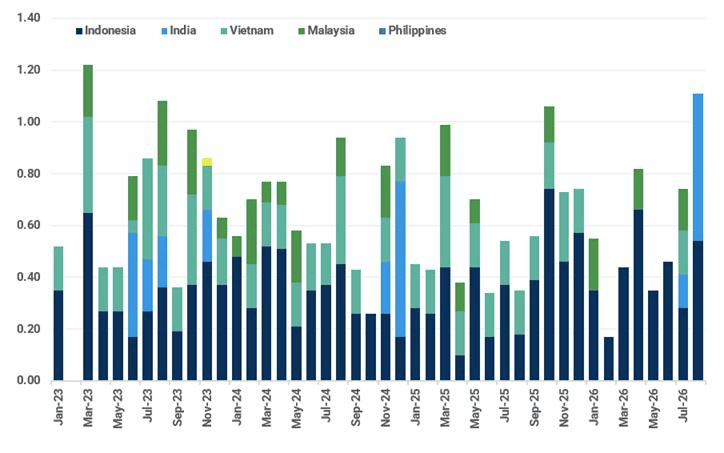
The CMRG dispute is becoming a more material downside risk in the September quarter. FMG shipments to China remained below the five-year average for a fourth consecutive week in the week ending 23 August. The miner has responded by diversifying sales towards Southeast Asia and India, with combined shipments to the two regions on track to reach a multi-year high in August. However, these markets are unlikely to fully compensate for weaker sales to China, which remains by far FMG's largest customer.
FMG iron ore exports to Southeast Asia and India are reaching a multi-year high in August (Mt)
Source: Kpler
Assuming that there won’t be a deal between CMRG and FMG before the end of September, we expect FMG toreport 47.70Mt of iron ore shipments (100% basis) for Q1 FY2027, down 4% y/y.

See why the most successful traders and shipping experts use Kpler






