

Record high freight as risk premiums meet tightening fundamentals
Tanker markets remain supported by geopolitical risk and tightening vessel availability. Dirty freight should stay elevated through Q4 as higher MEG loadings support VLCCs and spill into midsizes. Clean markets are also strengthening, with limited LR2 supply supporting rates and pushing cargoes toward MRs as Middle East exports recover into 2027.
Market & Trading Calls
VLCC
- Stay bullish through Q4 as higher MEG loadings, constrained GoO STS capacity, and persistent security risk keep freight elevated.
- Q4 VLCC ton-miles are revised 8.6% higher m/m; a sustained reduction in MEG risk is the main downside trigger.
Suezmax
- Suezmaxes supported near term as VLCC spillover, longer-haul WAF-to-East trades, and renewed European demand tighten tonnage.
- Q4 ton-miles are revised 5% higher m/m, although returning Yanbu barrels pose downside risk.
Aframax
- Atlantic Aframaxes supported by WTI flows to Europe and potential Black Sea cargo downsizing from Suezmaxes.
- Q4 ton-miles are revised 10% higher m/m, but Mediterranean fundamentals once again hinge on Red Sea barrels.
LR2
- Stay bullish as recovering Middle East exports meet restricted clean tonnage availability.
- LR2 demand rises 50% in 2027, while the $200k–300k/day Aframax earnings premium limits tonnage returning to clean trades.
MR
- Near term, Asia should soften on Golden Week and lower Chinese exports
- A record 245 MRs trading dirty constrains clean supply, while LR2 scarcity supports MR demand further ahead.
Forecast Dashboard
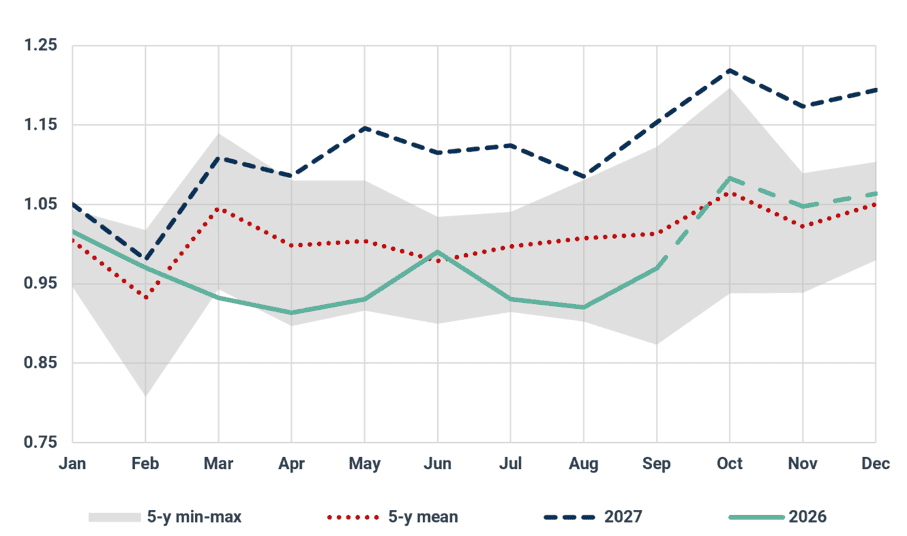
A month of rapid geopolitical changes has translated into significant revisions across our dirty tanker demand forecasts. Most of these can be traced back to a shift in our base case from a diplomatic resolution in the late first quarter of 2027, toward a managed normalisation of flows, following the observed ramp-up in Strait of Hormuz (SoH) transits over September. This has led to a 7.6% upward revision in the Q4 2026 ton-mile forecast versus our last publication, in line with a higher transits ceiling. Thanks to the very same change in our base case, however, ton-miles fail to witness a deal-induced spike in Q1 of 2027, leading to a 4% downward revision in H1 2027 demand. A downward revision has extended into H2 of 2027, as, in the absence of a concrete US-Iran deal, the restocking incentive is likely to be deferred further down the timeline.
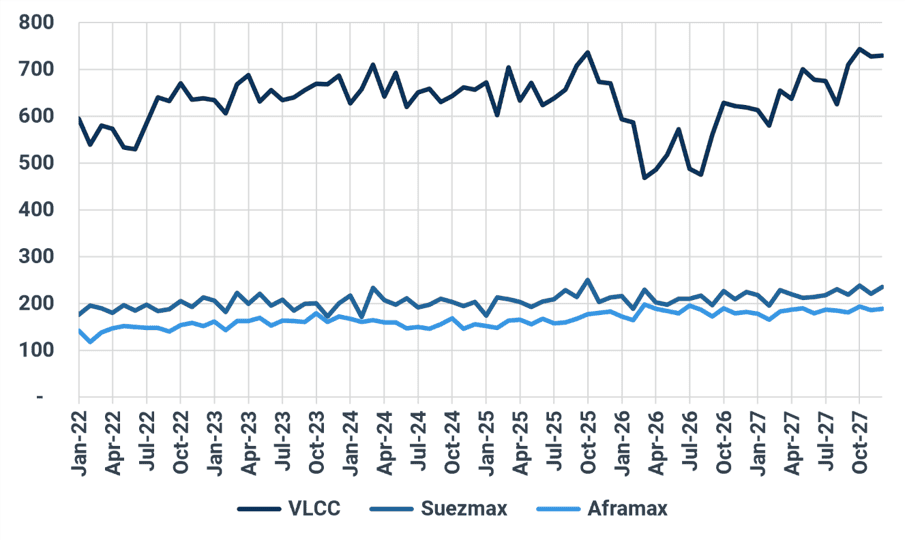
Focusing on the running quarter, the trajectory of VLCC ton-miles has been heavily defined by the observed reshuffling of Saudi Arabia’s crude barrels. As discussed below, following the September redirection of barrels towards the MEG, we expect the Producers to prioritise optionality by maintaining both export corridors. Higher MEG volumes should more than offset the more controlled Eastbound loadings from Red Sea ports in terms of laden demand. Q4 VLCC Ton-miles have been revised up m/m by 8.6%.
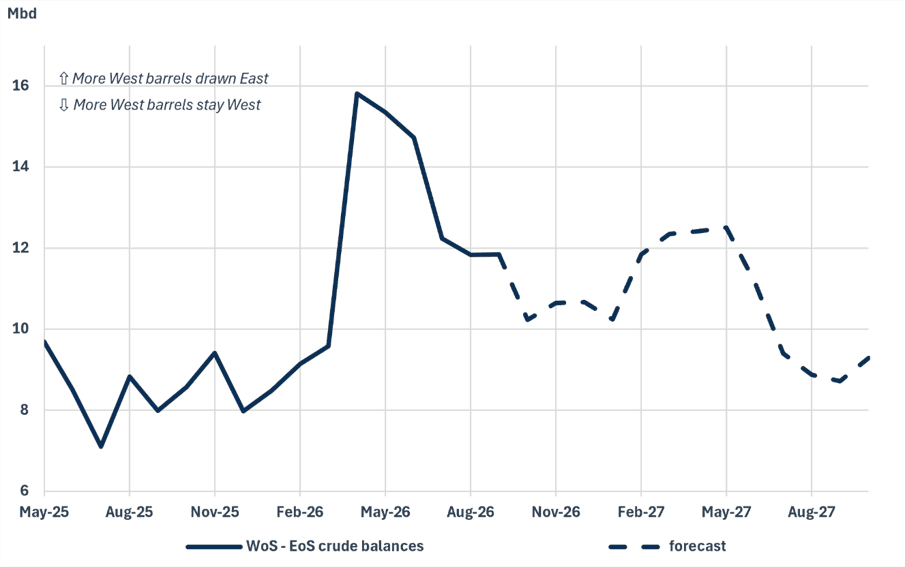
Gains have also been recorded across midsizes, primarily driven by a better-supplied EoS basin allowing more Atlantic barrels to trade with the WoS, as well as some GoO spilling into the segment. Q4 Ton-mile expectations have been revised up by 5% m/m for Suezmaxes and 10% for Aframaxes.
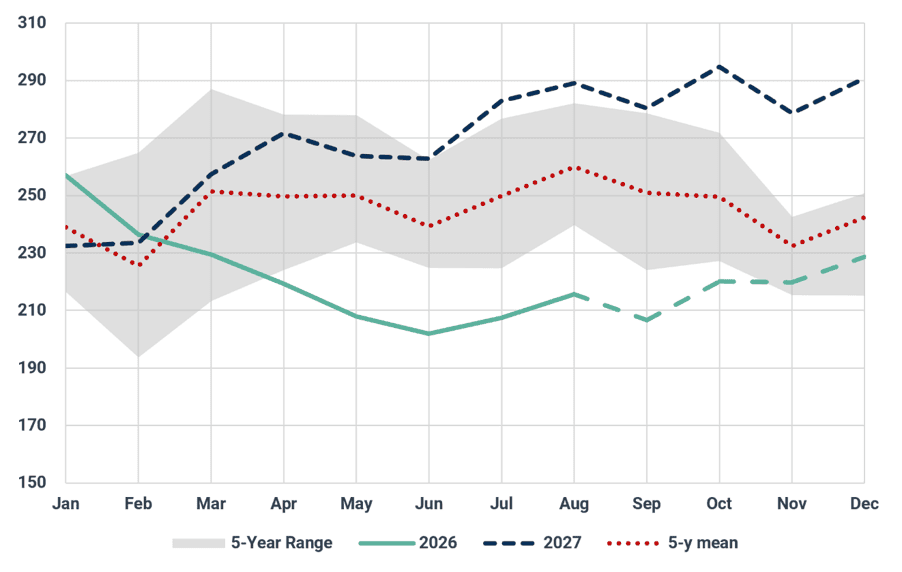
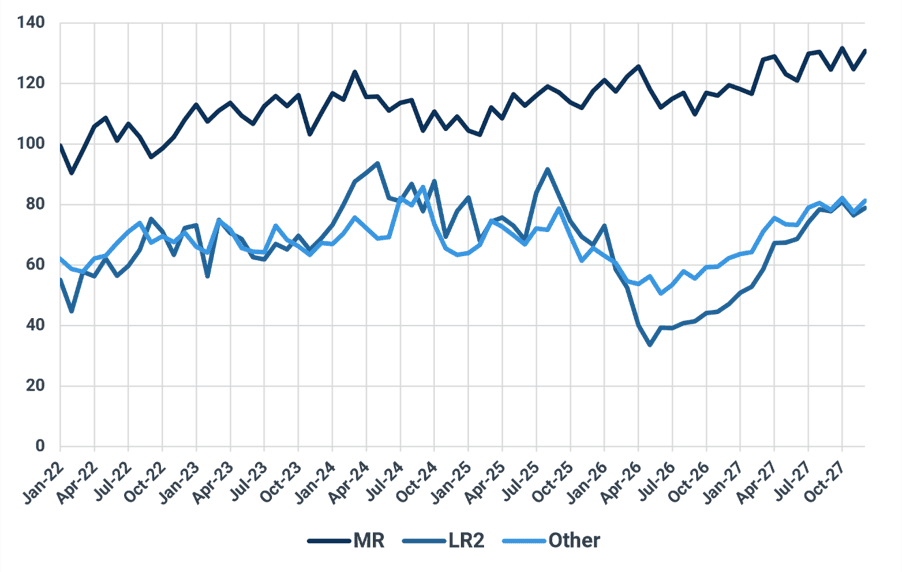
Clean tanker demand is forecast to rebuild steadily through the outlook. Ton-miles rise from around 223 Bn per month in Q4 2026 to around 288 Bn by Q4 2027. Full-year 2027 demand is forecast to be 22% above 2026 and around 5% above 2025, meaning the recovery more than reverses this year’s disruption.
The Middle East and India drive the recovery, accounting for roughly four-fifths of the increase as exports normalise and long-haul flows return.
- LR2s see the strongest rebound: Demand rises 50% in 2027, driven by a 74% increase in Middle East-origin ton-miles and 41% growth in Asia-Pacific. Despite this recovery, LR2 demand remains around 9% below 2025 levels.
- MR growth is more moderate: Demand increases 6%, led by the Middle East (+54%), while Western MR demand falls 6% following a strong 2026.
Asia-Pacific provides the more structural growth story. Total regional demand rises 16% in 2027, with Asia-Pacific MR demand ending the period around 21% above 2025 levels. West of Suez demand is broadly flat overall, as stronger LR2 demand offsets softer MR volumes. Growth is also back-loaded, with most of the increase arriving from Q2 2027 and demand peaking in the second half of the year.
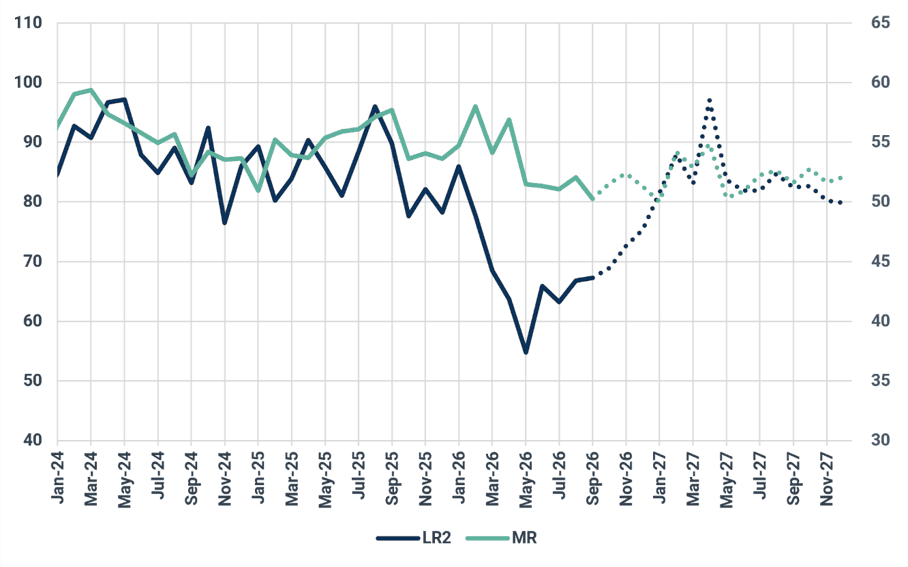
The changing demand picture has also shifted our productivity forecasts between clean segments. Rising Middle East exports are expected to meet a shortage of LR2s following months of clean-to-dirty switching and an expected sustained Aframax earnings premium. As a result:
- LR2 productivity is revised lower over the forecast period as vessel availability remains a constraint to demand growth.
- MR productivity is revised higher as the LR2 shortfall pushes more cargoes onto smaller vessels.
Dirty tanker demand outlook (Bn TM)
Source: Kpler
Dirty tanker demand outlook by segment (Bn TM)
Source: Kpler
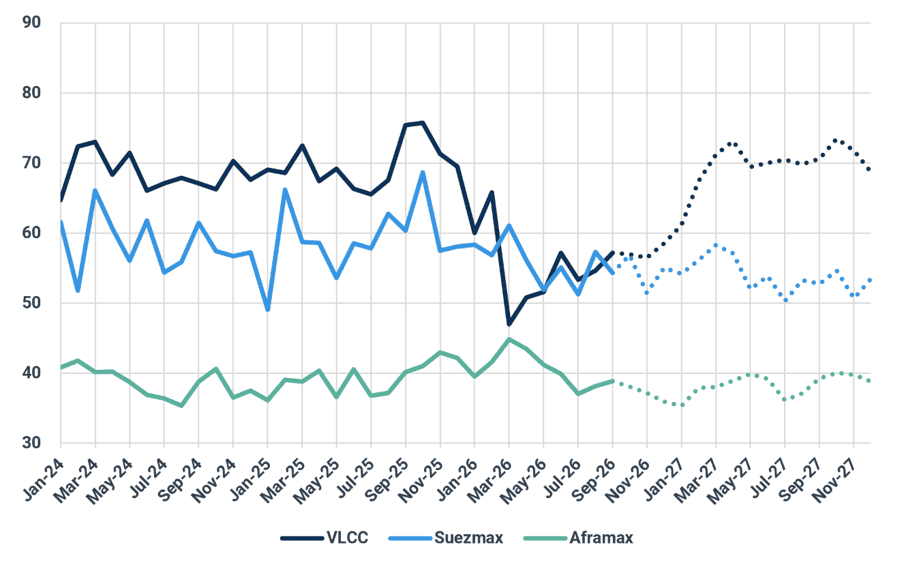
Dirty tanker productivity (ton-miles / DWT)
Source: Kpler
Clean tanker demand outlook (Bn TM)
Source: Kpler
Clean tanker demand outlook by segment (Bn TM)
Source: Kpler
Clean tanker productivity (ton-miles / DWT)
Source: Kpler
The Big Picture: September
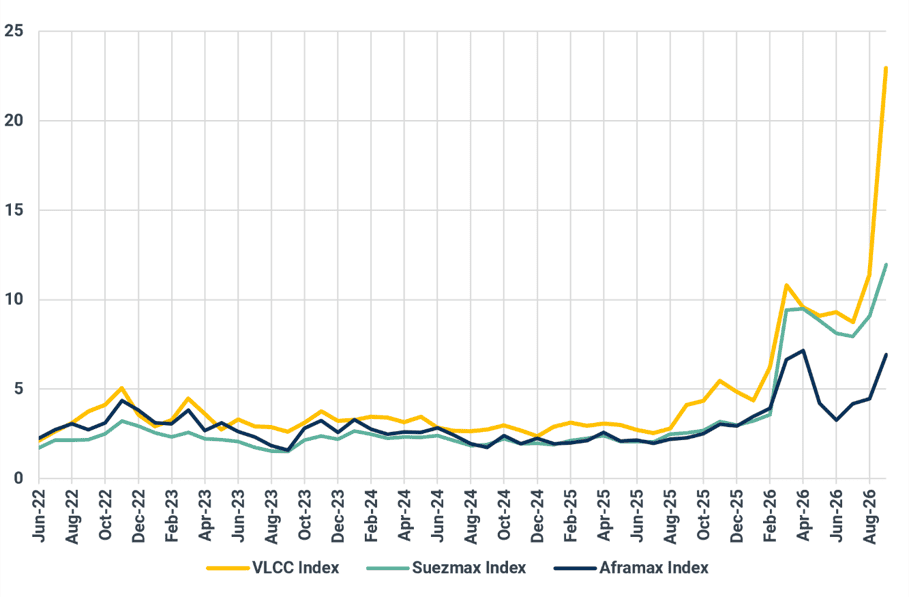
The September dirty tanker market was characterised by a pronounced shift in trading risk, as crude barrels were redirected away from lower-risk export corridors towards higher-risk areas. This redistribution of flows amplified the risk premium embedded in VLCC rates, pushing earnings further above levels justified by underlying fundamentals. The loss of Yanbu flows forced Saudi Arabia to redirect exports towards its Eastern ports and the Strait of Hormuz, creating a significant logistical challenge. The resulting increase in vessel demand exposed to MEG corridor not only supported higher risk premiums, but also encouraged regional producers to diversify their trading patterns.
Strength across the remainder of the dirty tanker market appears to have been driven largely by spillover effects. Rates have been pushed higher either to close earnings gaps with the MEG and Gulf of Oman (GoO), or as uncompetitive VLCC rates have encouraged cargoes to cascade into smaller vessel classes across traditional VLCC markets.
Looking ahead, our base case assumes that MEG volumes will continue to scale. As a result, a material correction in rates is likely to require a meaningful reduction in perceived risk around the MEG. With Iran becoming increasingly aggressive while losing influence over regional flows, we see limited downside risk to tanker rates through Q4, despite their significant premium to fundamentals.
September’s clean tanker market was shaped by three connected themes: recovering demand, tightening vessel supply and regional divergence among MRs.
First, clean tanker demand is recovering. Clean ton-miles are up around 12% since bottoming in June, in contrast with more modest growth dirty tanker demand since June, while cargo volumes are rebuilding in the Middle East and Asia-Pacific.
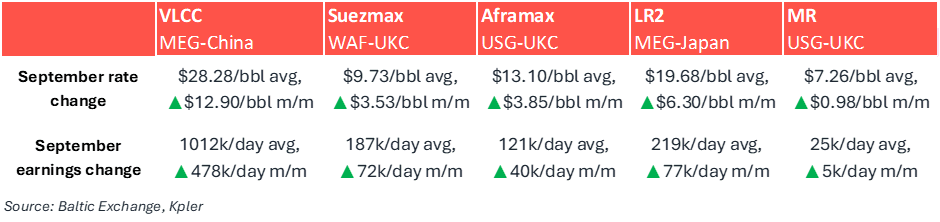
Second, record dirty earnings are tightening clean tonnage supply. Strong dirty returns are keeping coated Aframaxes and a growing number of MRs in dirty trades, reducing clean vessel availability just as demand improves. Together, these factors pushed MEG–Japan LR2 freight to a record monthly average of $19.68/bbl. Geopolitical risk still underpins freight, but fundamentals are now doing more of the work.
Third, MR markets are increasingly diverging by region. Asian rates strengthened on a rebound in regional exports, while the West continues to benefit from structural distillate tightness and strong US exports.
*Rates and earnings are monthly average based on sheets to be supplied*
Key dirty tanker rates ($/bbl)
Source: Kpler calculations based on Baltic Exchange and McQuilling data
Key clean tanker rates ($/bbl)
Source: Kpler calculations based on Baltic Exchange and McQuilling data
Sector Snapshots
VLCC
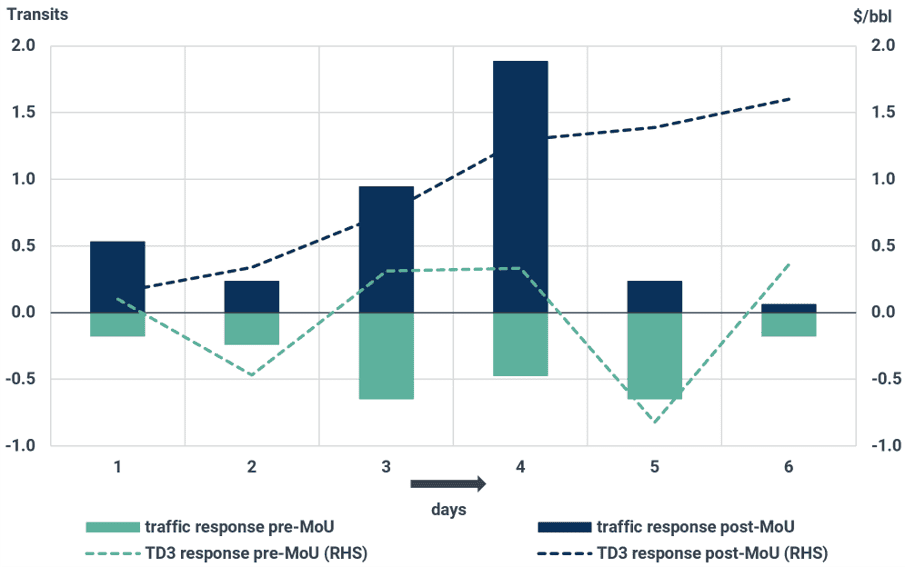
MEG-to-China VLCC rates rose to a record $28.28/bbl in September, a $12.90/bbl m/m increase, with earnings averaging $1.01m/day. As through most of the year, the latest freight boost remains a function of risk. Early September saw a spike in regional risk premia as the US adopted a tit-for-tat approach in Iranian attacks against commercial shipping in the MEG.
A mid-month attack against Saudi Arabia’s East-West pipeline saw the Kingdom pivot exports towards MEG ports, where loadings increased by 3.2 Mbd m/m to 4.1 Mbd in September, calling for an expansion of VLCC tonnage employed to high-risk MEG trades. With GoO STS capacity reaching its operational limits, additional barrels need to be shuttled further afield (WCI or Malaysia) or shipped on direct voyages, increasing round voyage times and resulting in higher tonnage demand for each additional barrel. The decoupling from fundamentals became evident as Saudi volume redirection from Yanbu and the COGH to MEG ports implies a 60% reduction in hauls to Asia.
Outlook:
The gradual ramp-up of Petroline’s flows is unlikely to see a sharp reduction in Saudi’s loadings in the MEG, also reflected by a third round of Arab cargoes offered to Asian refiners from the region and the expansion of operations into the Saudi-Kuwait Neutral Zone. Instead, under the continued threat of attacks, the Producer is likely to prioritize flexibility, keeping both export channels open. Our model sees a fair share of Yanbu volumes staying West, yet some flows to East via the COGH will persist, adding to the sector’s inefficiencies. Further scaling of MEG operations suggests limited scope for a correction in rates closer to fundamentals, especially as Iran has intensified attacks against vessels into October.
Higher MEG loadings coupled with a downward revision of Saudi OPSs will place a ceiling over the record West-to-East trades recorded across the year, also supported by a light US maintenance schedule. More Atlantic volumes should trade intra-regionally, until and unless Yanbu barrels return at scale, helping narrow the spread between VLCCs and midsizes in the basin.
Freight and transit response to Iranian vessel attacks (6 day-period following attacks)
Source: Kpler, Baltic Exchange, IMO
Suezmax
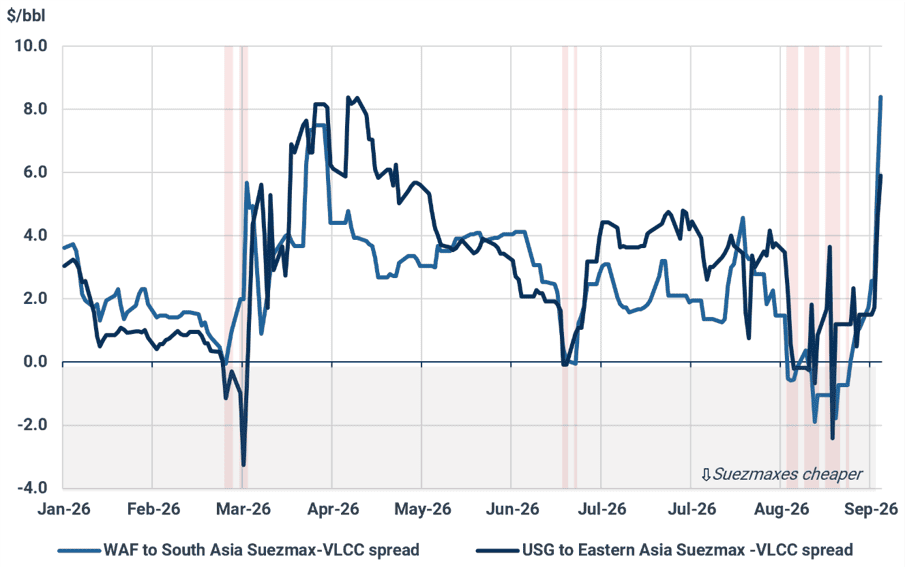
The VLCC rally had a knock-off effect on midsize assessments, most notably WAF Suezmaxes, where rates gained $3.53/bbl to $9.73/bbl in September, even as loadings traded broadly flat m/m at 2.2 Mbd. The disproportionate boost in VLCC rates made cargo splitting onto Suexmaxes more economical for eastern voyages. WAF to EoS Suezmax loadings rebounded to circa 520 kbd over the month, with long-hauls to Eastern Asia tracking the early conflict’s high of 130 kbd. This pivot should provide lasting support to the market, stretching vessel turnaround times, with WAF–East Asia voyages roughly twice that of WAF–UKC. Conversely, northbound WAF voyages declined over the month, but this was offset by higher Suezmax loadings from LatAm, driven by transatlantic flows from Guyana and increased Suezmax utilization on trans-Caribbean short-hauls.
The strength in WAF is contrasted with a correcting MED market, where Black Sea-to-MED rates shed $0.89/bbl m/m to $6.15/bbl in September. While CPC Kazakhstan loadings recovered to 1.5 Mbd in September, the loss of Yanbu barrels saw MED Suezmax cargo lists shorten. Black Sea assessments nosedived in the first decade of the month, as military aggression in the region came to a temporary halt but quickly recovered after regional commercial shipping was once more targeted. Regional risk premia persist, underscored by the mid-month expansion of the Black Sea listed area to cover the wider Black Sea.
Outlook:
Early October has seen the dirty tanker rally’s momentum shift into Suezmaxes, with WAF rates doubling from September’s close. The strength appears driven by increased Suezmax utilization on EoS trades and renewed European demand following the loss of Yanbu volumes, ahead of the refinery maintenance easing post mid-October. However, downside risks remain significant, with eastern trades no longer economically viable and an expected return of Yanbu barrels likely to shift European trades toward shorter-haul MED voyages at the expense of longer-hauls. Nonetheless, tonnage tied up on long-haul eastern voyages, continued VLCC spillover support, Black Sea risk, and higher Suezmax utilization in GoO trades should help limit downside.
Suezmax-VLCC freight spread across key loading regions ($/bbl)
Source: Kpler via Argus Media
Aframax
The decoupling between rates and cargoes persists as we move down to Aframaxes, where USG-to-UKC (TD25) rates gained $3.85/bbl to $13.10/bbl m/m in September, amidst a 300 kbd m/m decline in loadings. A clear geopolitical driver lies behind the rates’ trajectory across the month. Cross-Atlantic Aframax rates traded sideways in the month’s first decade, on the back of rising European maintenance and higher sourcing of Red Sea Saudi volumes. This improved access to regional crudes ended in the month’s second decade, when the attack on the East–West pipeline led Aramco to cancel September–November cargoes, forcing the Continent to scramble for Atlantic replacements. The disruption has proven sustained with benchmark rates extending gains into the third decade of the month, even as the VLCC rally lost momentum.
The cross-MED Aframax market broadly followed a similar trendline, with a drop in cargo lists, following August’s record loadings, lending support to assessments early in the month. The key difference, however, lies in a steeper contraction of regional cargo lists (-400 kbd m/m), following the loss of Sumed-routed barrels and Libya’s programme revised lower on domestic conflicts.
Outlook:
While the constructive momentum in the dirty complex has extended across Aframaxes, demand indicators appear more supportive in the USG, where WTI continues to clear into Europe despite record-high freight costs. MED fundamentals, however, appear to be weakening, with the return of Yanbu barrels increasingly looking like a prerequisite for fundamental support to the market. In the meantime, the recent rally in Suezmax rates has increased the incentive to shift Black Sea trades onto Aframaxes, although this move would need to be sustained for longer before translating into actual cargo downsizing. Such a shift could provide additional support to Aframaxes in the region while taking some momentum out of Suezmaxes. While dirty earnings continue to outperform clean one, clean fundamentals are also improving, as discussed below, providing further support to the broader LR/Aframax complex further down the forecast.
WoS – EoS crude balances
Source: Kpler
LR
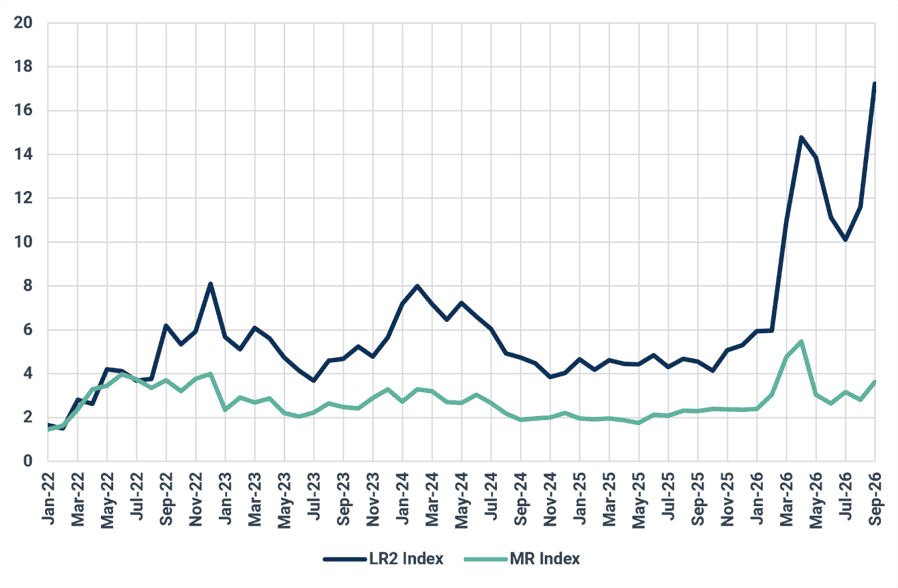
MEG–Japan LR2 rates (TC1) reached a record monthly average of $19.68/bbl in September, up $6.30/bbl m/m, before ending the month at a record $23/bbl. While geopolitical risk remains a factor, higher dirty tanker rates and stronger clean cargo demand have become more prominent drivers. Strength was not limited to the Middle East, with West Coast India and Mediterranean rates also rising.
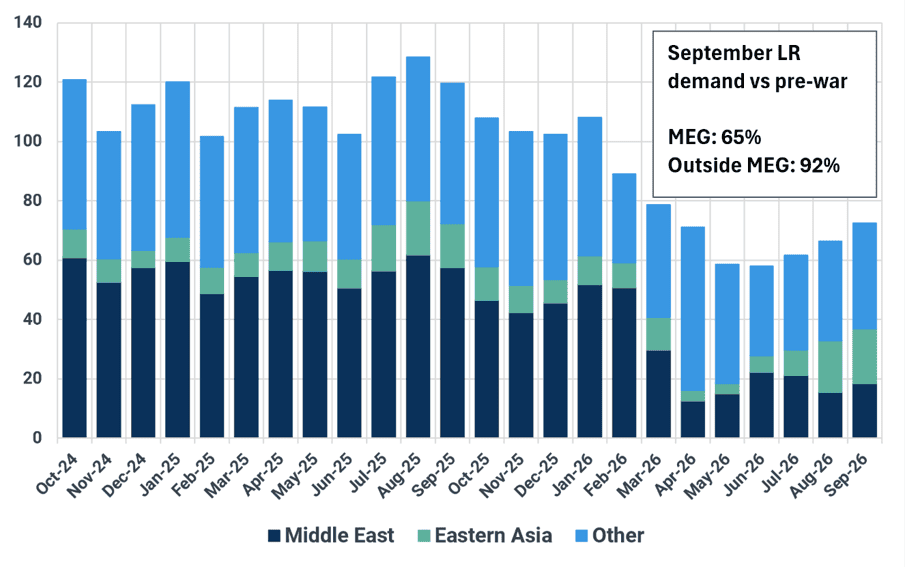
Stronger Middle East and Asian exports tightened LR2 supply. Middle East clean exports rose above 3 Mbd early in September, with LR2 and LR1 loadings reaching 2.1 Mbd. Asia-Pacific exports climbed to 660 kbd, the highest since February, reducing ballasters returning to the Middle East. Loaded LR2s consequently rose above 100 for the first time since April.
LR2 ton-miles reached 81.8 Bn, a six-month high, driven mainly by Eastern Asian flows. Despite higher LR2 earnings, Aframaxes remain at a substantial premium, keeping coated tonnage in dirty trades and clean supply tight.
Outlook:
Rates should hold near current highs in the short term, supported by rising Middle East and Asian flows and low fleet supply. Middle East clean exports should increase over the coming month, albeit subject to ongoing regional setbacks. In Asia, exports will slow near term as refiners face lower domestic product stocks and feedstock limitations.
The main downside risks are a correction in Atlantic dirty rates that sends coated tonnage back to clean, or a faster recovery in Gulf product exports. However, the bullish dirty market looks set to persist, keeping the clean LR market elevated.
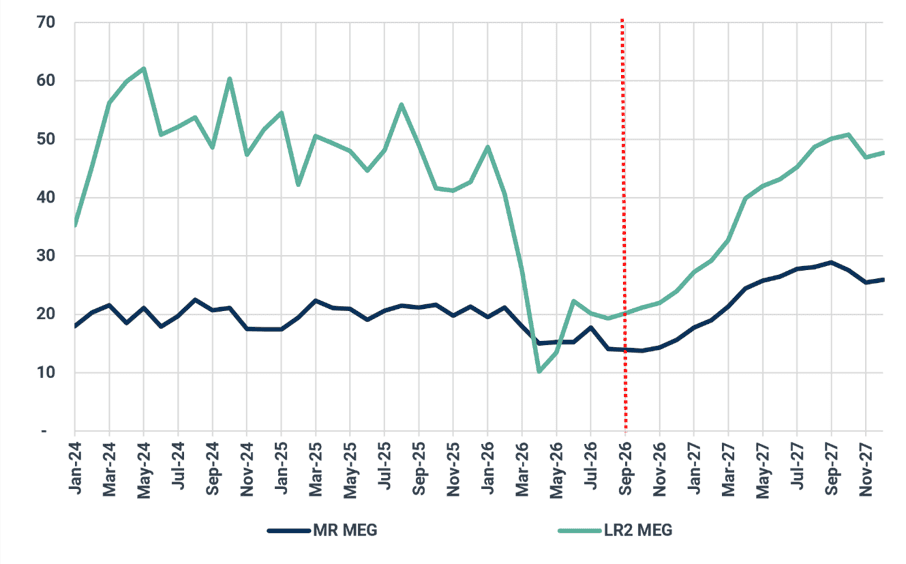
Looking further ahead, continued growth in Middle East exports will tighten LR2 supply into 2027. Rates could spike given limited clean tonnage, but with Aframax earnings $200k–300k above LR2s, LR earnings are unlikely to overtake Aframaxes without a dirty-market collapse. This should drive demand towards alternative tonnage, most likely MRs, supporting the clean segment through 1Q27.
Clean LR ton-miles (Bn)
Source: Kpler
MR
MR markets firmed in both the East and West in September. Korea–Singapore (TC11) climbed $1.91/bbl to $4.74/bbl, its largest monthly increase this year and a third consecutive monthly rise. Asia-Pacific MR exports increased 200 kbd m/m to 2.9 Mbd, returning MR demand to pre-war levels for the first time since February.
Western markets strengthened sharply towards month-end. USG–UKC (TC14) rose $0.98/bbl m/m to $7.26/bbl amid severe transatlantic distillate tightness. US diesel exports reached 1.3 Mbd, the highest September on record, while ton-miles increased 52% y/y as more barrels moved to Morocco and Turkey. Russia’s extension of its gasoil export ban into October provided further support.
UKC–USAC rates recovered to $2.48/bbl, supported by depleted US gasoline stocks and record NWE-to-Med flows of 1 Mbd, driven partly by Libyan demand.
MR supply remains tighter than fleet growth suggests.The clean-trading fleet has held around 1,480 vessels for two months, down from over 1,500 in May despite 62 deliveries over four months. Meanwhile, MRs trading dirty reached a record 245, attracted by strong dirty earnings.
Outlook:
Asian rates should weaken slightly over the coming month. Golden Week and lower Chinese exports, linked to domestic stock thresholds, will weigh on demand. Crude feedstock availability should become less of a constraint through Q4 as Middle East crude flows rise.
In the West, a US diesel export ban remains the key downside risk, although this looks increasingly unlikely.
MR supply in the East increased over the past month as vessels responded to the widening regional earnings spread. However, the recent USG rally has narrowed that differential. The incentive for further repositioning has therefore diminished, which should keep the West-East tonnage split relatively stable.
Further ahead, we expect MR rates to firm. Demand is projected to to steadily rise and supply growth will be tempered by an increase in MR usage on LR routes.
Middle East clean ton-miles forecast (MR & LR2)
Source: Kpler

See why the most successful traders and shipping experts use Kpler






