

The expanding geography of risk
The Houthis' attacks on Saudi Arabia represents more than another escalation. It signals that the geography of the conflict is expanding from the Strait of Hormuz to the Red Sea. As new participants enter the war, governments must consider not only how much additional crude and refined product supply is at risk, but which strategic corridor or country becomes vulnerable next.
The Expanding Geography of Risk
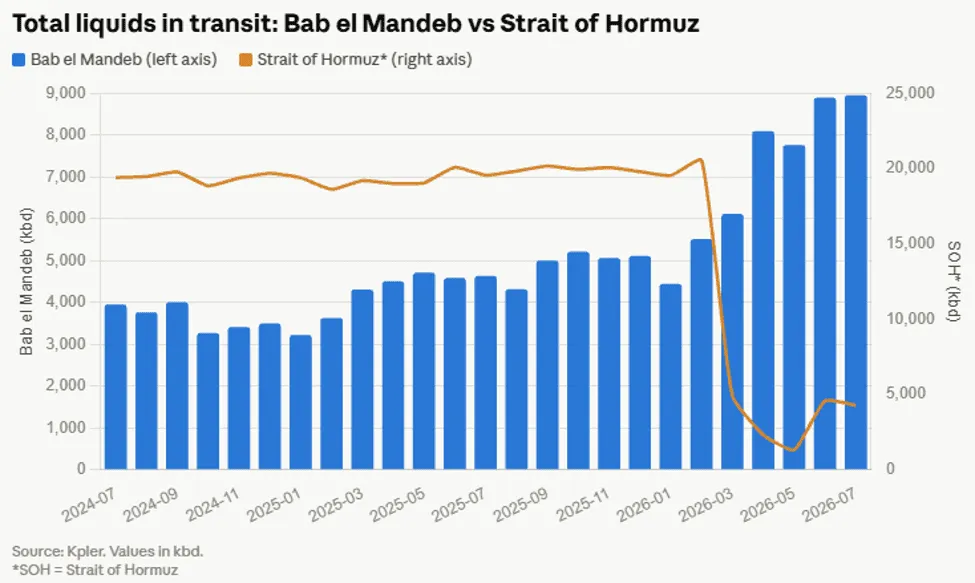
For much of the conflict between the United States and Iran, one development stood out. Despite repeated military exchanges between Iran and the US, the disruption of commercial shipping through the Strait of Hormuz, and escalating tensions across the region, the Houthis largely remained on the sidelines. Their restraint preserved one of the Middle East's most important alternative energy corridors and kept the Bab el-Mandeb strait outside the conflict.
This appears to be changing.
Following reported Saudi strikes against Houthi targets, the Houthis launched missiles and drones toward Saudi Arabia, raising the possibility that the Red Sea is becoming the second major maritime front in the war. If the unofficial truce between Saudi Arabia and the Houthis has broken down, the implications extend well beyond Yemen.
The Houthis' re-entry into the conflict raises three increasingly important questions.
The first question is urgent. How much additional crude and refined product supply is now at risk?
The second is strategic. Who joins Iran next?
The third may ultimately prove the most consequential: at what point does protecting national interests become incompatible with remaining outside the conflict?
Saudi Arabia's Alternative Route
For more than a decade, Saudi Arabia prepared for exactly the scenario unfolding in the Strait of Hormuz.
The East-West Pipeline and expanded export infrastructure at Yanbu were designed to ensure the Kingdom could continue exporting crude even if the Strait became contested. Over time, Yanbu also developed into a major refining and product export hub, transforming the Red Sea from an alternative route into a central pillar of Saudi Arabia's energy security.

See why the most successful traders and shipping experts use Kpler