The strategic timing of China's crude purchases
China's years of investment in energy security have given Beijing the strategic flexibility to delay crude purchases, transforming the timing of its demand into a potential instrument of economic statecraft rather than simply a response to market conditions. By monitoring inventories, refinery runs, and the commercial behavior of state-owned oil companies, the note outlines a framework for identifying when China may re-enter the crude market—and what that decision could signal about its broader geopolitical objectives.
The Strategic Timing of China's Crude Purchases
Take a step back from the conflict in the Middle East and it becomes clear that this is no longer simply a regional war. It is unfolding within the broader strategic competition between the United States and China, where energy security has become another instrument of geopolitical power.
For years, China strengthened its energy security by building strategic crude inventories while purchasing discounted barrels from sanctioned producers such as Iran, Russia and Venezuela. Those investments are now paying off. Rather than responding to the Strait of Hormuz disruption like most major consuming countries, Beijing has largely remained on the sidelines, using its energy security buffer to delay a return to the crude market.
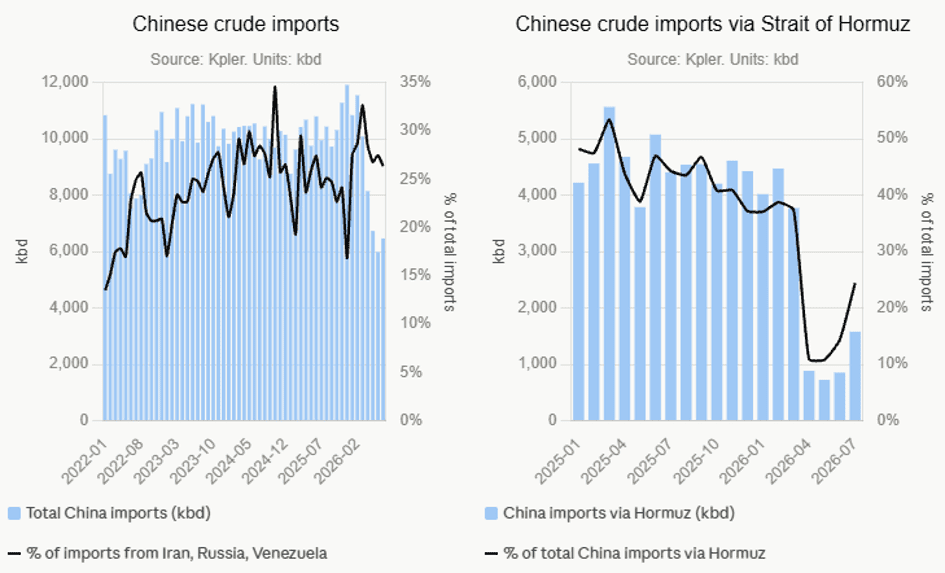
That flexibility, however, is finite. At some point China will need to resume large-scale purchases. The timing of Beijing's return may reflect more than commercial fundamentals. It could also signal that Beijing is prepared to play a more active diplomatic role in the region.
For Gulf producers, renewed Chinese buying would provide more than additional demand. It could also create an opportunity for Beijing to leverage its relationships with both Arab producers and Iran, much as it did during the 2023 Saudi-Iran rapprochement. If Beijing decides the time is right to re-engage diplomatically, its renewed procurement of crude may become one of the earliest observable signs of that shift. Beijing, however, provides little transparency into its energy strategy, leaving markets to infer its intentions from a combination of commercial data and geopolitical developments.
The Value of Strategic Flexibility
The Strait of Hormuz conflict showed what years of investment in energy security had ultimately bought Beijing: time.
Rather than competing aggressively for increasingly scarce barrels, Beijing reduced refinery runs, drew on accumulated inventories and sharply curtailed crude imports. Since March, combined term and spot purchases have averaged around 6 mbd, compared with more than 10 mbd before the conflict. Although state-owned and independent refiners briefly returned to the spot market after oil prices retreated toward $70/bbl in June, total purchases have remained well below pre-conflict levels.
The charts below illustrate the scale of that adjustment. Refinery throughput declined sharply, but crude imports fell even further. Rather than reflecting a collapse in domestic consumption, the divergence suggests Beijing deliberately substituted inventory for imports, allowing it to remain on the sidelines while other buyers competed for tighter global supplies.
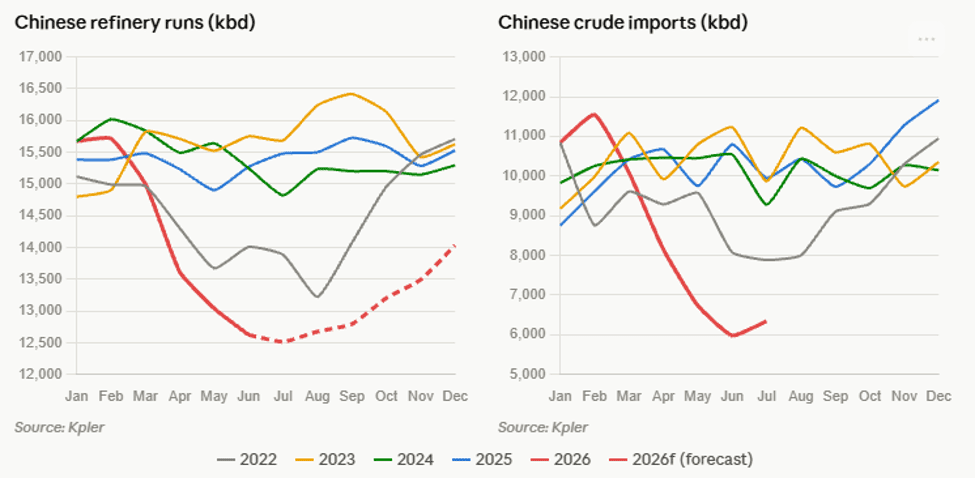
China's growing market influence stems from the timing of its demand. As the world's largest crude importer, its decision to delay or accelerate purchases can alter market balances, price expectations and competition among producers. Yet Beijing offers little guidance on how it intends to use that influence, leaving markets to infer changes in strategy from commercial data.
Interpreting that strategy is complicated by China's limited transparency. Beijing discloses neither the size of its strategic petroleum reserve nor the inventory level it considers necessary for energy security. Rather than attempting to estimate an unknowable target, the more useful question is how much strategic discretion China's measured inventories continue to provide.
The days cover framework provides one way to approach that question. Rather than attempting to identify a precise buying trigger, it estimates how long China's measured onshore inventories can sustain different combinations of crude imports and refinery throughput. The framework does not predict Beijing's decision. Instead, it narrows the range of plausible outcomes by showing how China's procurement flexibility evolves under different market conditions.
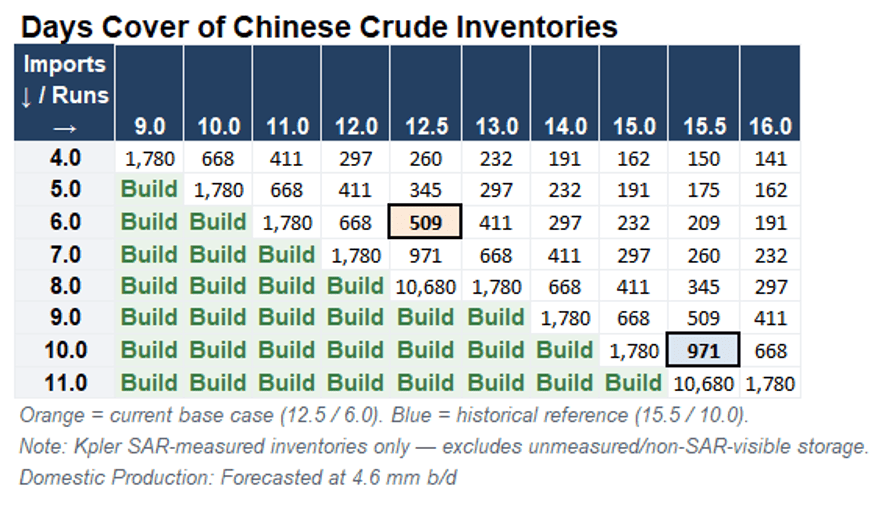
Kpler's forecast assumes refinery throughput gradually recovers from approximately 12.6 mmb/d in July to around 14.0 mmb/d by early 2027. If imports fail to recover alongside those higher refinery runs, China's measured inventory buffer would decline much more rapidly, reducing days cover to below 300 days. This illustrates how quickly the reserves created by China's energy security strategy could narrow if domestic demand strengthens before procurement does.
Commercial Behavior
While Beijing provides little transparency into its energy strategy, changes in commercial buying patterns often provide the earliest observable indications that its buying strategy is evolving.
Market participants have long monitored the purchasing activity of China's state-owned oil companies—including PetroChina, Sinopec, CNOOC, Sinochem and Zhenhua Oil—for clues about Beijing's procurement posture. These firms have played a central role in previous rounds of strategic stock building, making their commercial activity one of the market's most closely watched indicators.
Their purchasing decisions, however, should not be interpreted as direct expressions of government policy. Many are publicly listed commercial enterprises whose trading activity reflects a combination of profitability, sanctions compliance, risk management and national energy security objectives. Rather than revealing Beijing's intentions outright, they offer incremental signals that become more meaningful when viewed collectively.
Recent activity by Sinopec's trading subsidiary, Unipec, illustrates the point. During the current period of subdued imports, Unipec resold several West African cargoes, reduced Saudi crude nominations to almost zero for four consecutive months and remained largely absent from the spot market despite a sharp correction in oil prices. None of these decisions, viewed in isolation, explains Beijing's broader strategy. A sustained reversal in those procurement patterns would likely provide one of the earliest commercial signals that Beijing has decided the time is approaching to resume larger-scale crude purchases.
The Economic Statecraft of Energy Security
Traditionally, energy has been viewed as a source of leverage for those who control supply. China's evolving energy security strategy suggests that influence can also accrue to those who control the timing of demand. By building sufficient strategic flexibility, Beijing is no longer compelled to enter the market whenever supplies tighten or prices rise. Instead, it can decide when the participation of the world's largest crude importer best serves broader national objectives.
That shift has implications well beyond the oil market. Beijing can use the time to decide whether to delay purchases, accelerate them, or align them with broader diplomatic, economic or geopolitical objectives. That flexibility creates opportunities to support strategic partners, strengthen China's negotiating position with producers, or simply allow market pressures to build before re-entering the market.
This reflects a broader evolution in the purpose of energy security. Historically, strategic inventories were designed to protect economies from supply disruptions and reduce vulnerability to energy coercion. China's approach increasingly suggests that energy security can also create geopolitical influence by expanding the strategic choices available to policymakers.
As China's energy security strategy matures, crude procurement has the potential to become another instrument of economic statecraft. The significance of China's buying decisions increasingly extends beyond their impact on oil markets to the broader diplomatic, economic and geopolitical objectives they support.
Bringing the Indicators Together
No single indicator will reveal when Beijing decides to increase crude purchases. Inventory levels, refinery runs and commercial buying patterns each provide part of the picture. Together, they offer a framework for identifying when China's strategy may be changing. Understanding what Beijing hopes to accomplish when it does will ultimately prove the more important challenge.

See why the most successful traders and shipping experts use Kpler