


US SPR draws accelerate as domestic pull drains export barrels
With SPR releases picking back up and medium sour exports sliding even as imports hold firm, net US crude exports have collapsed to near zero, underscoring how much of the barrel — SPR and commercial alike — is now being absorbed by the domestic market rather than sold abroad.
Market & Trading calls:
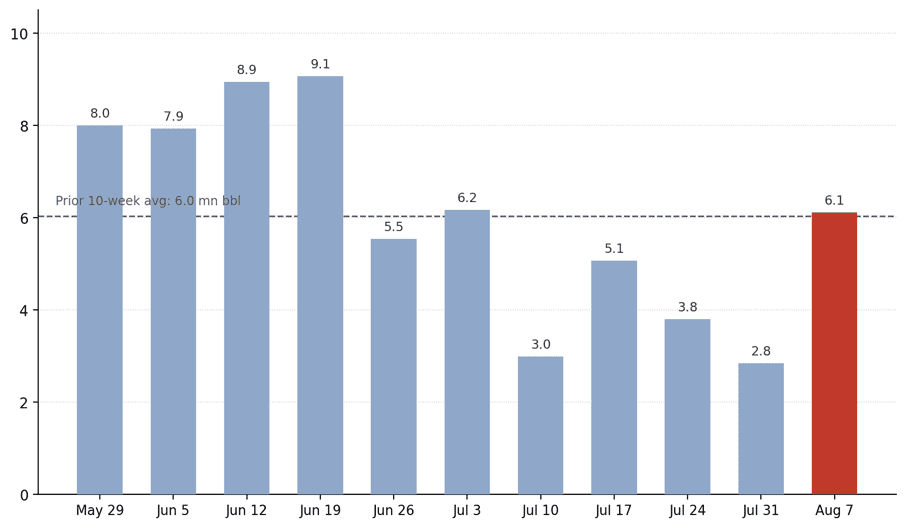
- US SPR draws have accelerated, easing by 6.1 Mbbls to a fresh multi-decade low of 298.7 Mbbls last week.
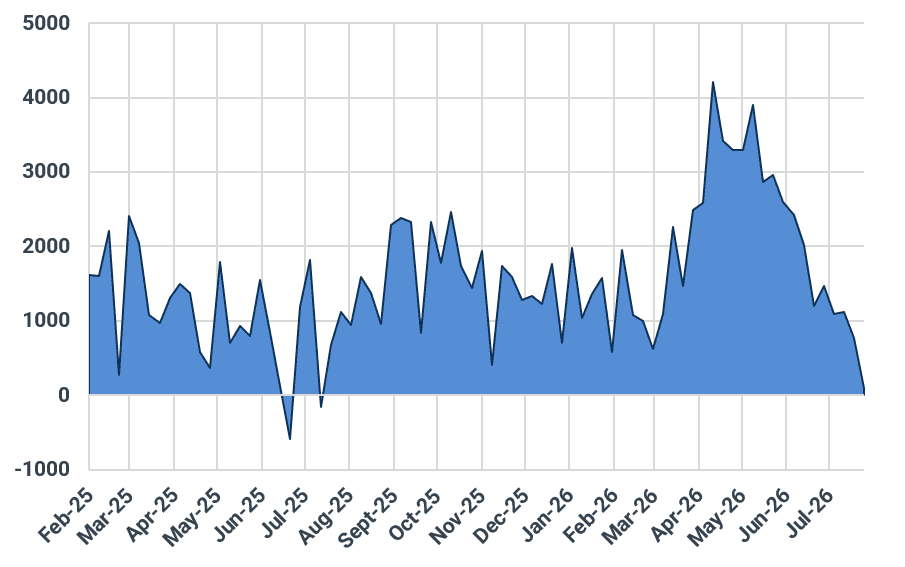
- US seaborne net exports have fallen to near zero in early August — likely noise from one week, but confirms domestic-absorption trend.
- Weekly seaborne crude exports hit a 1-year low in early August while imports remained steady and elevated above average levels at 2.8 Mbd last week.
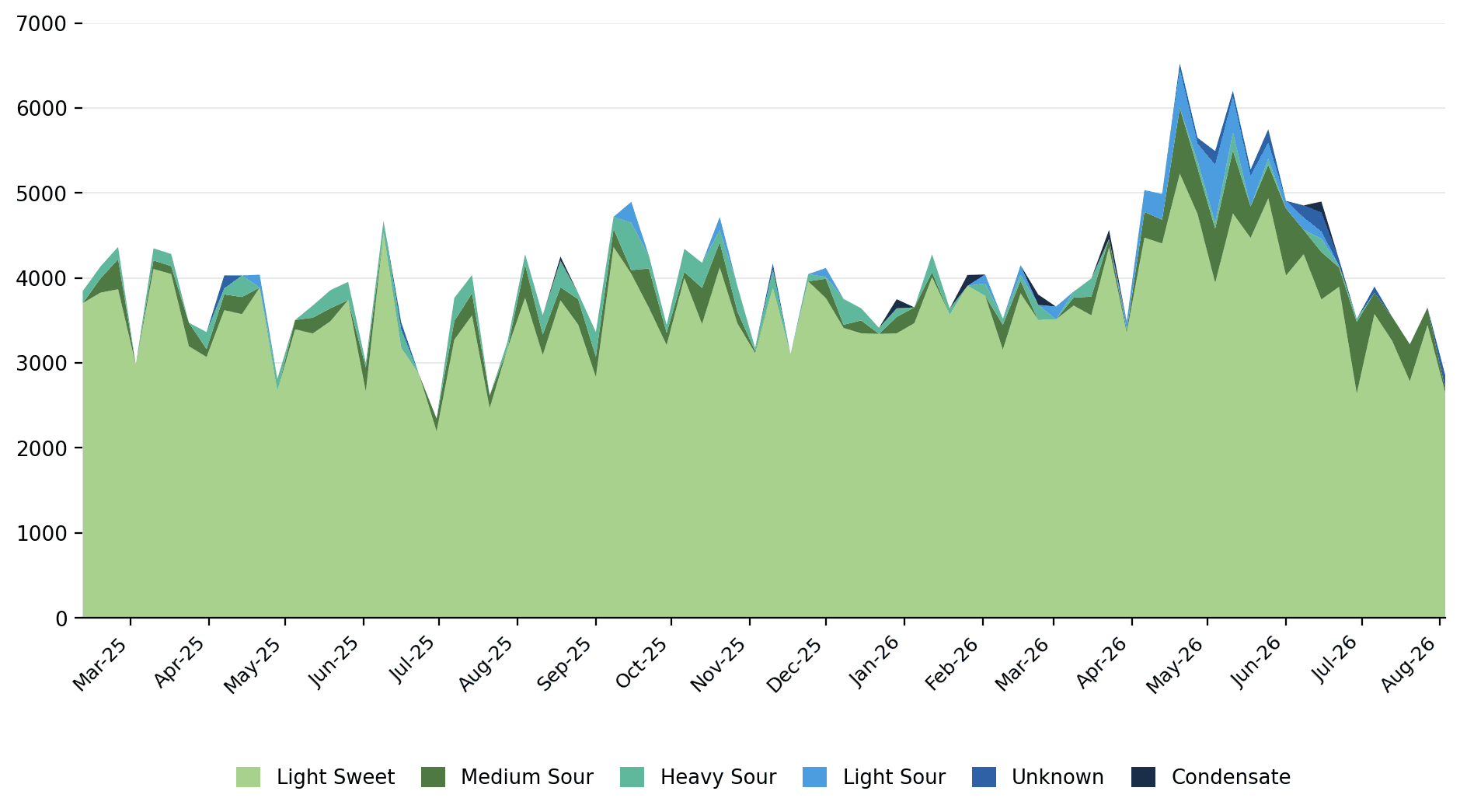
- More heavier barrels are staying domestically — seaborne medium density crude exports averaged 160 kbd in late July, even hitting nil in early August, down from >300 kbd the weeks prior.
- High refinery runs and tighter product stocks are set to keep domestic runs supported as US primary distillation offline capacity is set to average between 500-800 kbd below year-ago levels over the next two months.
Weekly releases from the US Strategic Petroleum Reserve (SPR) accelerated last week, with inventories falling by 6.1 Mbbls in the week to 7 August, pushing the reserve below 300 Mbbls for the first time since 1983 and down to 298.7 Mbbls — a fresh 40-plus-year low.
The latest draw marks an acceleration from the previous four weeks, when releases had slowed to between 2.8 Mbbls and 5.1 Mbbls, and it sits close to the roughly 6.0 Mbbls average of the preceding ten weeks (see below chart).
The drawdown remains, however, below the 8-9 Mbbls weekly draws seen through much of May and June, when the reserve was being run down at its fastest pace since the drawdown began.
US SPR weekly stocks changes, Mbbls
Source: EIA
The renewed pace of drawdowns suggests a change in how the reserve is actually being used. In the early stages of the Iran-US war, SPR barrels also played an important role in helping cushion buyers overseas as Gulf supply came under pressure.
That role has since faded amid an uptick in US crude demand and a weakening pull from abroad: exports of US medium sour crude — including cargoes drawn from the SPR — have fallen sharply, averaging just 160 kbd in the week beginning 26 July, down from roughly 300-400 kbd in the two weeks prior.
These barrels have increasingly stayed in the domestic market rather than being shipped overseas, though the recent uptick in SPR releases suggests US medium sour crude exports could rebound in the weeks ahead. Nevertheless, higher volumes out of the Mideast Gulf have helped temporary meet demand in Asia and Europe, keeping demand for US barrels marginally pressured.
That shift became more pronounced in the week beginning 3 August, when no medium sour crude export volumes were recorded at all — suggesting the most recent SPR barrels are being absorbed entirely into the domestic system to meet strong refinery demand and high refinery margins.
US crude and condensate exports by quality, kbd
Source: Kpler
Notably, weekly US crude exports have fallen to 2.8 Mbd for the week beginning 3 August — the lowest reading since July 2025. With US crude imports holding elevated over the same period, averaging almost 2.8 Mbd, net exports fell to almost nil (see chart below). The rise in seaborne crude exports will help relieve pressure on tighter domestic inventories, with recent Cushing stocks already showing a continuation of recent builds.
US seaborne net exports, kbd
Source: Kpler
While US refinery runs are easing as the maintenance season gets under way, throughput remains historically high, averaging ~17 Mbd in August, down from around 17.2 Mbd in July, before falling further to 16.4 Mbd in September.
The decline in throughput in the weeks ahead comes on the back of higher US offline primary distillation capacity, which is set to rise to only 350 kbd in September and 500 kbd in October (IRR).
Nevertheless, offline capacity is set to remain some 500 kbd and 800 kbd below year-ago levels, respectively, over these months as refiners defer much of this year's turnaround work into the first quarter of next year to capture currently strong refining margins.
Tighter US product inventories and product cracks, with US gasoline cracks currently at ~35/bbl versus >$70/bbl for USLD and Jet/Kero, are painting an optimistic picture for refinery margins into year-end, a backdrop that should keep domestic demand for crude barrels — including those coming out of the SPR — well supported. This will also keep crude markets tighter, supporting domestic M1/M2 spreads.

See why the most successful traders and shipping experts use Kpler






