
China’s road fuel demand displacement reaches 1.3 Mbd in 2026 as high prices accelerates technology shift
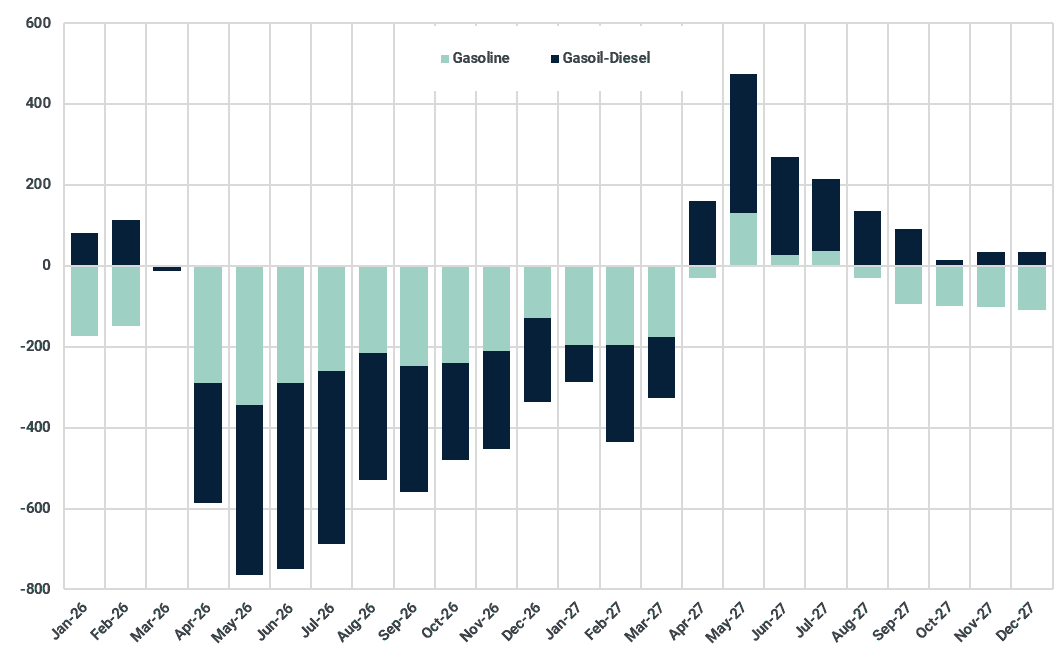
China’s road-fuel demand downturn is becoming increasingly structural as elevated prices accelerate the shift toward electric passenger cars and alternative-powertrain trucks this year. Gasoline and diesel demand are set to fall by around 440 kbd in 2026 while technology-driven displacement reaches 1.3 Mbd, raising the risk that much of this year’s demand loss will persist even as prices normalize.
Key takeaways:
- Technology is amplifying the price-driven demand shock: EVs and alternative-powertrain trucks are estimated to displace around 650 kbd of gasoline and 680 kbd of diesel demand in 2026, showing how high prices are accelerating the decoupling of China’s road transport from oil demand.
- Gasoline losses are proving sticky: Demand is expected to fall 210 kbd in 2026 as high prices reinforce the economics and utilization of an expanding EV fleet. Even as prices normalize, gasoline demand is forecast to decline by another 70 kbd in 2027, suggesting little of this year’s loss returns.
- Freight is growing, diesel is not: Road freight turnover increased around 3% y/y during January-July, yet diesel demand is projected to fall 230 kbd in 2026 as LNG and electric trucks reduce fuel intensity. A modest 64 kbd recovery in 2027 therefore recoups less than a third of this year’s decline.
In the first part of our China demand update, we looked at how the US–Iran war disrupted what had been the main pillar of China’s 2026 oil demand growth, i.e. petrochemical feedstocks. Yet even as LPG and naphtha demand took a substantial hit, resilient ethane consumption provided an important counterweight. The road transport fuel side of the barrel has no such cushion. Gasoline and diesel demand are collectively expected to fall by around 440 kbd in 2026, accounting for half of China’s total liquids demand decline.
More importantly, the conflict landed on a transport-fuel market already undergoing a structural transition. The surge in oil prices has compounded rather than created the weakness, reinforcing the impact of electrification on road-fuel demand. Rapid EV penetration continues to displace gasoline, while electrification is increasingly extending to commercial vehicles and challenging diesel demand. In total, this technology shift is estimated to displace 1.3 Mbd of road fuel demand this year due to high utilization. The key question remains how much of the 2026 decline reflects an acceleration of China’s structural shift away from oil-based mobility even if prices normalize next year.
China road transport fuel demand y/y change (kbd)
Source: Kpler
Price shock compounding China’s EV shift, deepening structural gasoline decline
China’s gasoline demand is projected to decline by around 210 kbd in 2026, a much steeper contraction than the modest decline we forecast at the beginning of the year. The deterioration reflects a combination of weaker passenger-car demand, rapidly rising EV penetration and, since the US–Iran war, substantially higher retail gasoline prices. While electrification was already pushing gasoline demand toward structural decline, this year’s price shock has accelerated the transition, further widening the running-cost advantage of electric vehicles.
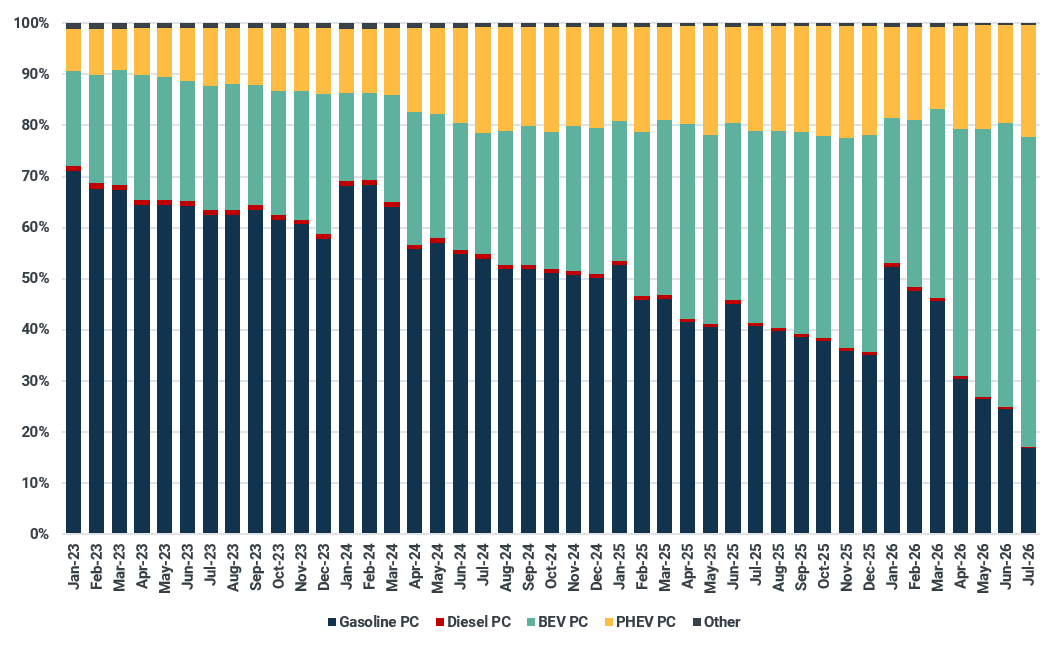
The year initially appeared less favorable for EVs. New-energy vehicles (NEVs), including battery electric vehicles and plug-in hybrids, accounted for more than half of passenger-car sales in 2025, but penetration dropped below 50% at the beginning of the year as the broader auto market weakened and government support became less generous (China Taxation Administration). From January, qualifying NEVs moved from a full vehicle-purchase-tax exemption to a 50% reduction, effectively introducing a 5% purchase tax and halving the maximum tax benefit to RMB 15,000 per passenger vehicle. The change contributed to a weak start to the year, with NEV retail sales falling alongside the broader passenger-car market.
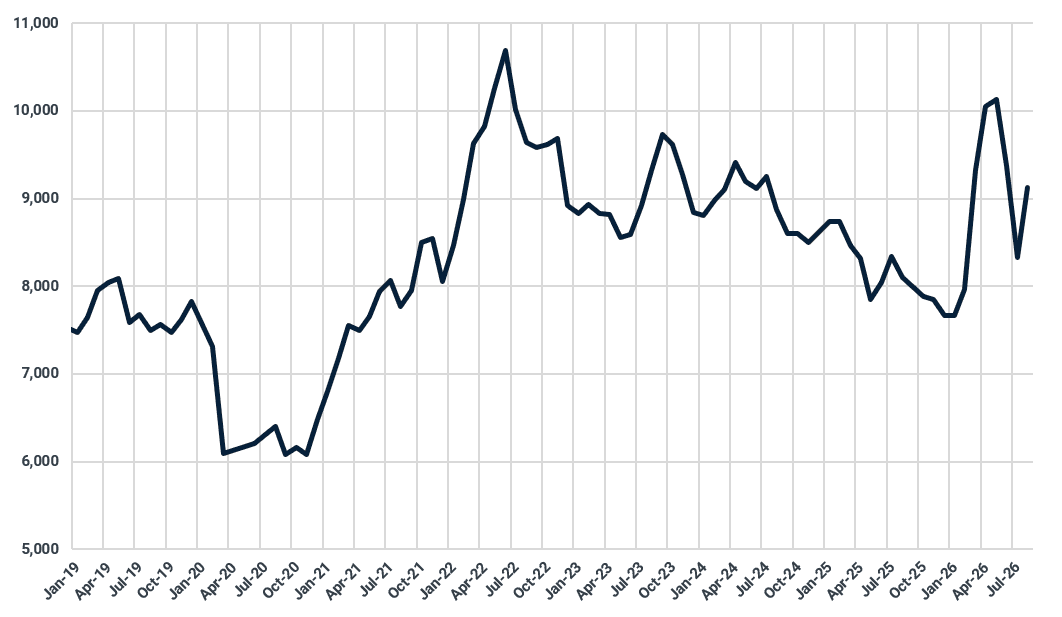
Yet the picture shifted sharply in Q2. Gasoline retail prices jumped around 21% between the beginning of the year and April and averaged roughly 22% above year-ago levels during Q2 (EastMoney), reinforcing the relative economics of electric driving just as consumers were becoming more cautious about discretionary spending amid heightened macro risks and uncertainty. Gasoline demand consequently fell around 8% y/y in Q2. Our model shows that gasoline demand bottomed out by the end of Q2 and found modest support during the summer driving season. Importantly, the shift toward EVs has occurred despite weak vehicle sales overall. Passenger NEV retail sales were down around 12% y/y during January–July, but conventional gasoline-car sales contracted much faster at 42%. As a result, NEV penetration climbed from below 46% in January to around 83% by July, averaging 64% during January-July (CAAM).
China gasoline prices (Renminbi/ton)
Source: EastMoney
China Monthly Car Sales by Powertrain share (%)
Source: Kpler based on China Association of Automobile Manufacturers
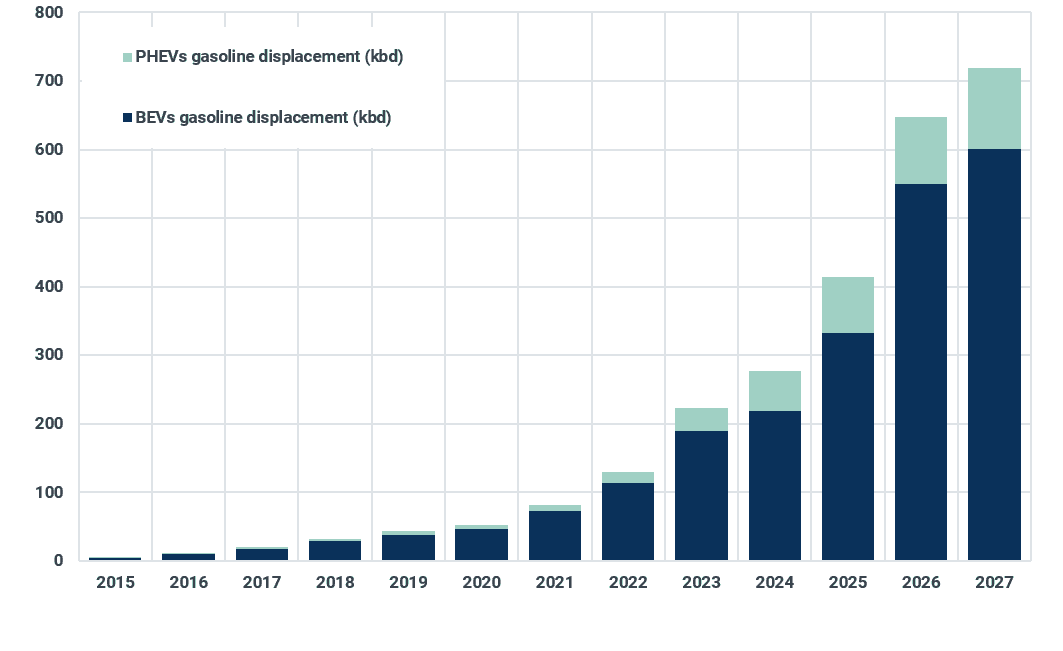
By the end of 2025, EVs accounted for 15% of China’s passenger-car fleet, and we estimate the share will approach 20% by the end of this year. As the stock of electric vehicles expands, their impact on gasoline consumption increasingly depends not only on fleet penetration but also on utilization. Elevated gasoline prices appear to be encouraging households that own both EV and ICE vehicles to favor the electric car for more journeys, increasing the effective displacement per EV. We estimate electrification will displace around 640 kbd of gasoline demand on average in 2026.
Gasoline displacement by passenger electric vehicles in China (kbd)
Source: Kpler
There has been little relief from fuel prices. After briefly easing in July, gasoline retail prices rose again in August and, although around 10% below their May peak, remain elevated. Tight gasoline balances through September and relatively thin balances through year-end should keep prices supportive, continuing to weigh on consumption even as the initial supply shock fades.
We see little scope for those volumes to return next year. Even if gasoline prices normalize, the EV fleet accumulated during the past several years remains on the road with a higher utilization rate. We therefore expect gasoline demand to fall by a further 70 kbd in 2027, with displacement from electrification estimated at 650 kbd while reaching 720 kbd next year when EVs are forecast to account for 22% of the passenger car stock. The 2026 price shock has not created China’s gasoline decline, but it appears to have brought forward a structural erosion that was underway.
Diesel demand bruised by high prices and changing truck fleet
China’s gasoil/diesel demand is projected to decline by around 230 kbd in 2026, with the steepest losses concentrated in Q2 and Q3. What makes this year’s contraction particularly striking is that it cannot be explained by weaker freight activity at all.
Official data show road freight turnover increased by around 3% y/y on average during the first seven months of the year (China National Bureau of Statistics). Simply put, China is moving more freight while consuming less diesel. The divergence points to a broader decline in diesel intensity of road freight. Elevated fuel prices and weaker construction and industrial demand have weighed on consumption, while the growing penetration of LNG and electric heavy-duty (HDV) vehicles mean an increasing share of freight activity is being performed without diesel. In other words, freight activity is becoming progressively decoupled from diesel demand as the truck fleet diversifies.

See why the most successful traders and shipping experts use Kpler