Demand headwinds weigh on dry bulk commodities
Iron ore prices nudged higher but look set to soften again as demand falls in China and Japan, even as Hancock Iron Ore ramps up its new McPhee Creek mine. Coal markets are holding steady, with China's peak season off to a slow, rain-delayed start and Turkey returning to the market as hydro output fades. In grains, China's soft demand continues for US agricultural goods, as underwhelming soybean sales and the absence of corn or wheat purchases test confidence in previous commitments. Aluminium extends its recent slide despite an undersupplied market, and dry bulk freight sentiment diverges, with Capesize and Panamax earnings firming while Supramax and Handysize rates lag.
Iron Ore & Steel: A brief bounce, capped by weak demand and slipping freight rates
- Iron ore prices edged slightly higher over the past week, with the most traded iron ore price benchmarks rising 0.7% w/w. The DCE contract, September 2026 closed at 740 yuan/t on 2 July and the SGX 61% Fe August contract was trading at $98.25/t at the time of writing. Iron ore futures jumped briefly as CMRG reported restrictions on imports of FMG’s Super Special Fines and Fortune Fines, before paring some gains later. We expect this to have little effect on prolonged pricing. It echoes a similar move against BHP last year, when China continued to import BHP products during the company’s pricing dispute with CMRG. We expect prices to remain subdued over the next few weeks as demand from China (structural slowdown) and Japan (summer maintenance shutdowns) fall. India is entering a seasonal lull for crude steel output, but the monsoon typically lifts iron ore if mining and haulage activities are disrupted.
- Global seaborne iron ore exports rose 3% w/w to reach 34.19Mt in the week ending 28 June, but volumes remained 4% lower y/y and below the five-year average of 35.07Mt.
- Australian shipments stood at 18.25Mt, down 10% y/y, as exports to China and Japan weakened.
- Brazil iron ore shipments, by contrast, surged 8% y/y to 9.13Mt as miners ramped up volumes during the final week of the month to meet quarterly guidance targets.
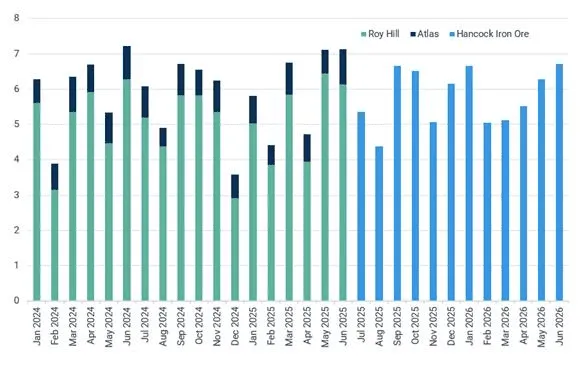
- Hancock Iron Ore has produced first iron ore at McPhee Creek, its newest Pilbara mine in Western Australia. Using the satellite orebody model, McPhee Creek will haul primary crushed ore to Roy Hill (Hancock's flagship operation) for further processing and blending.
- Effective July 2025, Roy Hill and Atlas Iron merged into a single brand, Hancock Iron Ore, giving a combined nameplate capacity of ~72Mtpa across four operating mines: Roy Hill and the former Atlas trio - Mount Webber, Sanjiv Ridge, and Miralga Creek. Hancock also holds a 50% stake in Hope Downs, a joint venture with Rio Tinto.
- Hancock shipped 61.3Mt of iron ore in 2025 from Roy Hill via the Stanley Point installation, largely bound for China and the JKT region, plus a further 8.8Mt from Utah Point (the Atlas mines), all bound for China.
- With Roy Hill's shipments softening and the Mt Webber orebody ageing, Hancock has designed McPhee Creek's 8-9.5Mtpa output to backfill Roy Hill's processing capacity rather than add a wholly separate export stream. This comes as higher-grade West African supply increasingly contests the competitive floor under Australian ore.
Hancock iron ore exports ramp-up in June 2026 (Mt)
Source: Kpler
- On the demand side, Chinese seaborne iron ore imports rose a 8% y/y to 27.06Mt in the week ending 28 June despite the broader demand lull.
- Shipments from FMG and Rio Tinto rose 27% y/y and 19% y/y respectively, while BHP and Vale saw a drops of 22-24% y/y.
- Iron ore inventories at Chinese ports fell slightly on modest increase in hot metal output, but buying interest continues to remain weak.

See why the most successful traders and shipping experts use Kpler
Request a demo