

Dirty freight stabilises as the market seeks a new equilibrium
Dirty tanker rates rebounded across midsize segments this week, led by surging USG Aframax demand, while MEG VLCCs traded sideways amid looser regional tonnage. Conversely, clean product markets weakened across Western and Asian MR routes due to rising gasoline inventories and cooling regional buying, though LR2 rates firmed slightly on stronger Northeast Asian petrochemical margins.
Market & Trading Calls
MEG–China (TD3C): Slightly Bullish | VLCC rates levelled off at $29.62/bbl this week and are forecast to remain rangebound. Looser Gulf tonnage balances and lower Saudi loadings keep upward pressure capped.
USG–China (TD22): Bullish | VLCC rates recouped losses, gaining $0.35/bbl to $17.43/bbl, and should remain supported. Tight tonnage and high GoO earnings continue to slow vessel replenishment in the region.
WAF–UKC (TD20): Bullish | Suezmax rates jumped $0.60/bbl to $8.46/bbl and are expected to climb further. Strong VLCC and Aframax markets are pushing more cargoes onto Suezmaxes across the Atlantic.
USG–UKC (TD25): Bullish | Aframax rates doubled to $17.51/bbl on record loadings and tight tonnage. However, increasing competition from larger Suezmaxes on transatlantic routes will likely temper further gains.
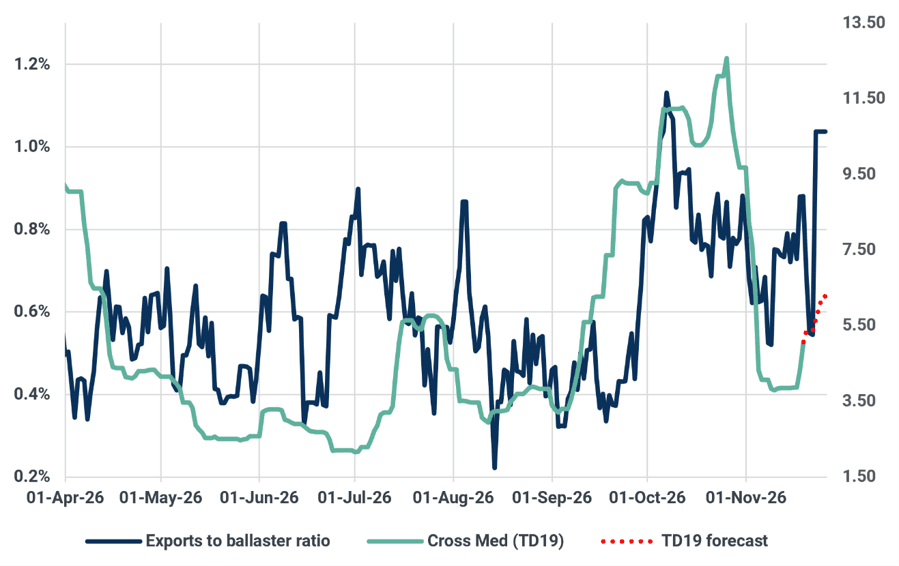
Cross Med (TD19): Bullish | Aframax rates rose $1.22/bbl to $5.07/bbl and should sustain upward momentum. Record Red Sea/SUMED flows and firming Kirkuk-Ceyhan pipeline exports will lengthen regional cargo lists.
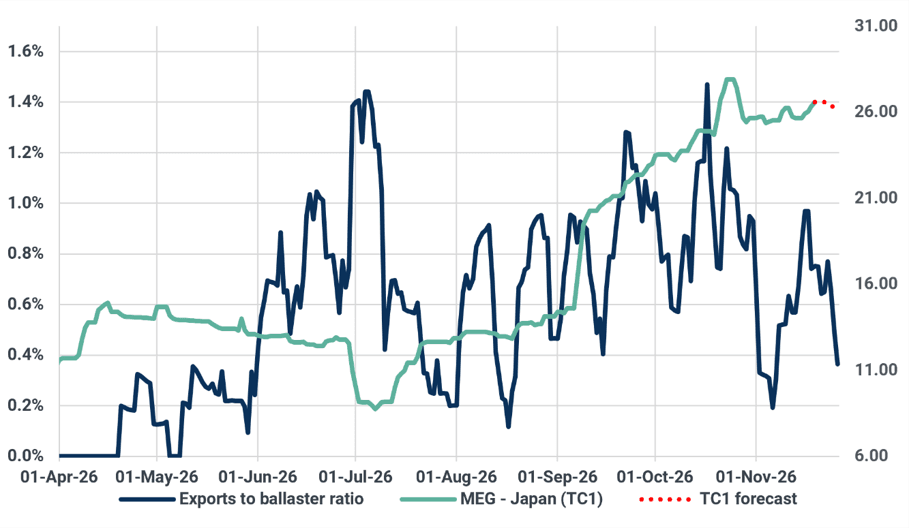
MEG–Japan (TC1): Bearish | LR2 rates rose $0.83/bbl to $26.58/bbl but are expected to dip slightly next week. Weaker Asian LR demand offsets rising Northeast Asian cracker margins and Gulf security risks.
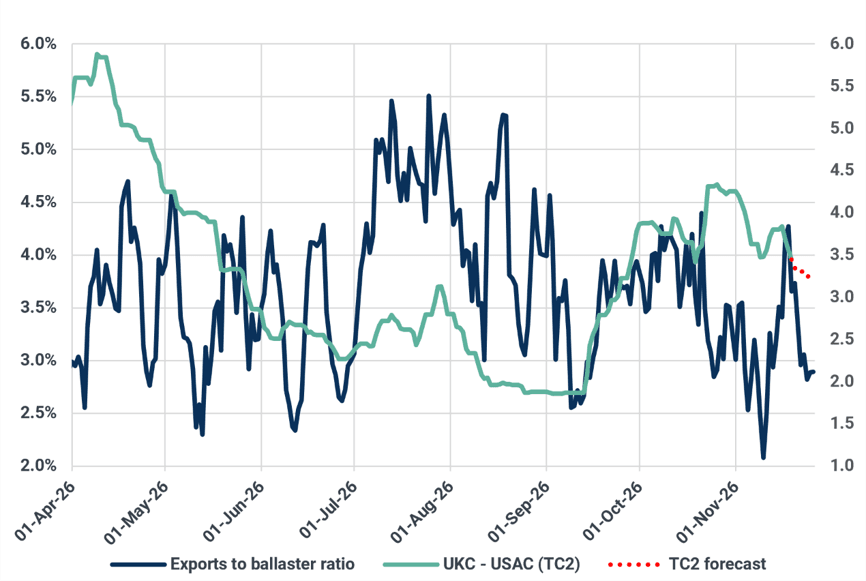
UKC–USAC (TC2): Bearish | MR rates fell $0.27/bbl to $3.44/bbl and should drift lower next week. Rising US and European gasoline inventories continue to dampen transatlantic import demand.
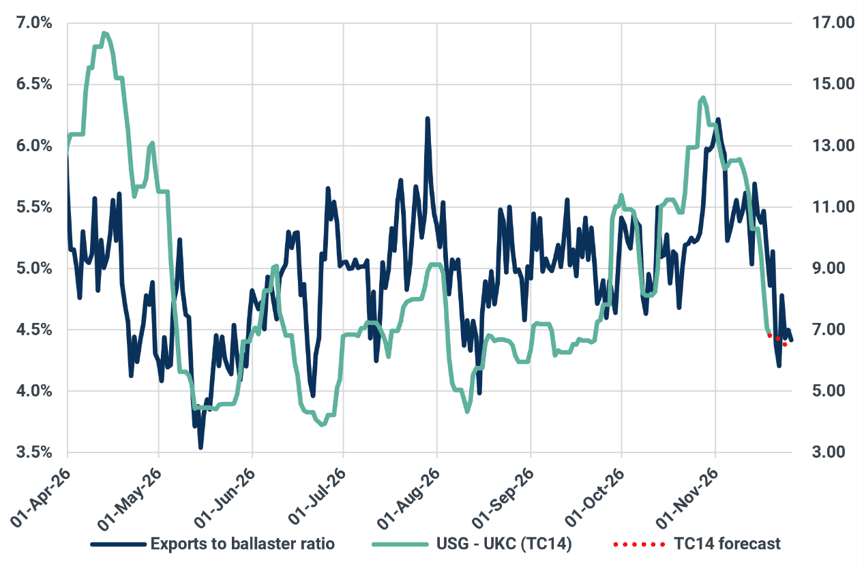
USG–UKC (TC14): Bearish | MR rates plunged 40% to $6.81/bbl, though losses should slow next week. Tightening Russian supply and reopening transatlantic arbitrage will eventually boost US Gulf diesel pull.
Korea–Singapore (TC11): Bullish | MR rates dropped $1.28/bbl to $4.19/bbl but should level off and rise slightly. Low Chinese domestic diesel stocks argue against an expected flood of December export cargoes.
VLCC
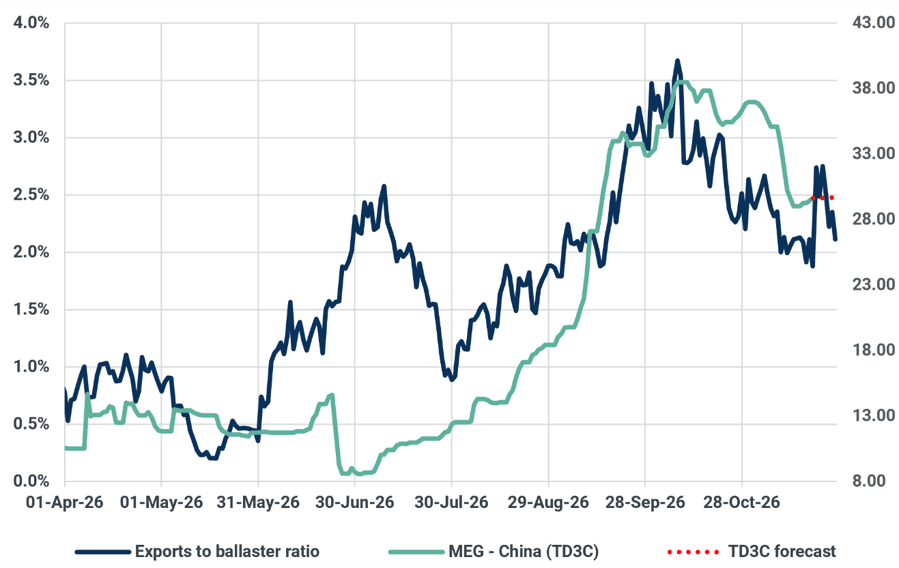
MEG – China (TD3C)
MEG to China VLCC rates levelled off over the reporting period, ending the week with a $0.04/bbl gain to $29.62/bbl. On the one hand, early November’s geopolitical optimism continues to dissipate, as highlighted by the ongoing targeting of commercial shipping in the MEG, as well as Houthi forces regaining control over the Red Sea coast of Yemen, followed by the announcement of yet another (unconfirmed) attack on Saudi Arabia’s Petroline.
Inside the MEG, VLCC supply and demand balances have shown signs of stabilisation. Loadings have averaged 7.8 Mbd thus far in the month, with the largest m/m declines coming from Saudi Arabia. For comparison, at an estimated size of 103 vessels and an average round-trip duration of 24 days, the MEG shuttle VLCC fleet’s export capacity is estimated at approximately 8.3 Mbd per month, bringing MEG loadings below tonnage operating in the region for the first time since July. The future of this trend remains key, with Yanbu-to-East VLCC rates nearly 50% below MEG-to-East levels, potentially encouraging Saudi crude exports to Asia to shift towards lower-risk Red Sea ports, provided no further sabotage occurs. With current freight levels, largely reflecting this looser tonnage balance environment, the TD3c forecast remains rangebound.
Broadly in line with MEG, GoO-to-China rates also traded sideways over the past week, shedding $0.03/bbl to $7.88/bbl. Regional rates continue to be pressured by VLCC employment in the EoS market, stabilising at 76% of the total fleet since mid-October. GoO loadings have also trended lower in November, with a drop in Meg loadings likely to eventually translate into reduced GoO StS in the medium term.
VLCC MEG tonnage balance ratio (%) (10MA) vs TD3C ($/bbl)
Source: Baltic Exchange, Kpler
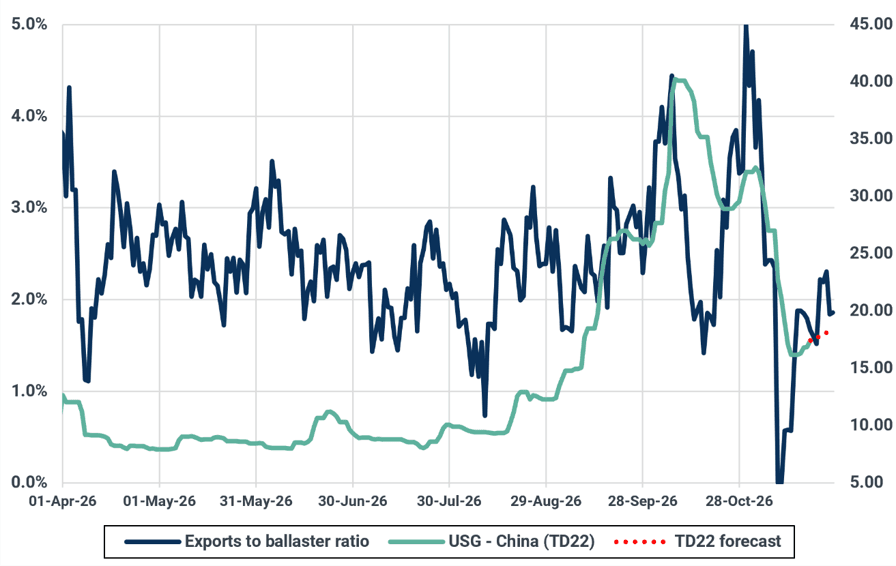
USG – China (TD22)
USG to China VLCC rates recouped some of the early November’s losses, gaining $0.35/bbl to 17.43/bbl. On top of VLCCs practically exiting USG loadings thus far in November, wider West-East trades have come under pressure, currently tracking a low of 3 Mbd. The Brazil-to-East route remains the only consistently viable arbitrage, while WAF and WTI Midland-to-East opportunities have been circumstantial, with no sustained economic incentive to support continued flows.
As such, support hinges on the supply side, where the small concentration of tonnage has seen the number of ballasters decrease. At the same time, GoO earnings continue to trade at a premium of circa $50k/day, decelerating the replenishment of tonnage in the region. We expect this trend to continue supporting USG VLCC rates until the earnings spread further narrows to incentivise more tonnage in the region. In the meantime, lack of VLCC tonnage is likely to pivot any West-East flows to midsizes, which thus far in November hold a market share of 52% of total flows.
VLCC US Gulf tonnage balance ratio (%) (10MA) vs TD22 ($/bbl)
Source: Baltic Exchange, Kpler
Suezmax
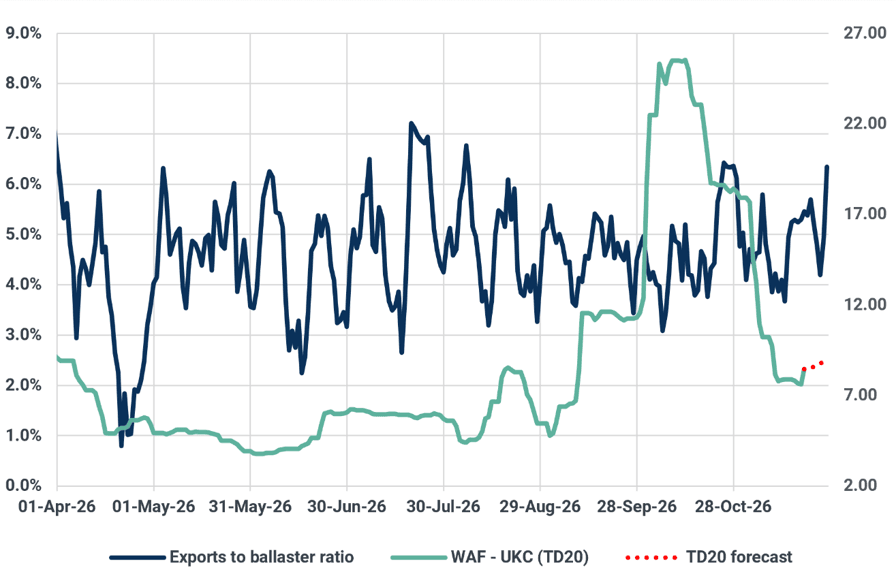
WAF – UKC (TD20)
In line with our last week’s predictions, the rebound in the dirty rates accelerates as we move down to midsizes. In WAF, benchmark Suezmax rates to UKC increased by $0.60/bbl w/w, settling at $8.46/bbl. WAF remains the main region where strength in VLCCs is filtering down to Suezmaxes, primarily as Eastbound WAF cargoes shift to the more economical smaller vessels, with average VLCC-Suezmax rate spreads trading at parity so far in November.
However, more recently we see Suezmaxes also benefiting from bottom-up support. Strong Aframax fundamentals, discussed below, have started pricing Suezmaxes into traditionally Aframax routes. Transatlantic USG-to-NWE trades have merged as the most evident example, where the $/bbl cost of Aframaxes currently dictates a premium of $9.30/bbl compared to Suezmaxes. As a result, going forward we expect Aframaxes to gradually lose their monopoly over intra-Atlantic trades, promoting Suezmax utilisation across the basin and thus rates.
Suezmax WAF tonnage balance ratio (%) (10MA) vs TD20 ($/bbl)
Source: Baltic Exchange, Kpler
Aframax
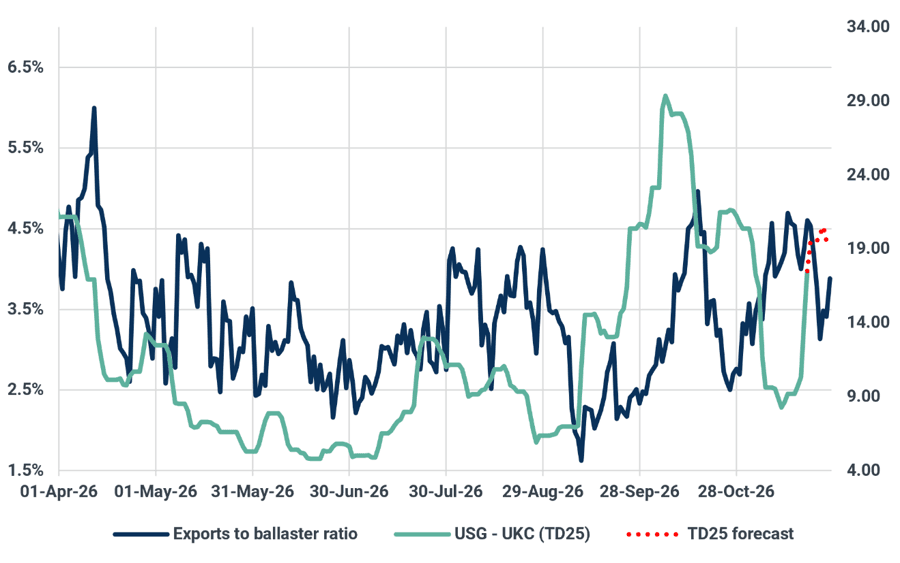
USG – UKC (TD25)
USG to UKC Aframax rates led gains across the dirty segment over the past week, doubling in value to $17.51/bbl. As discussed in our last publication, the observed correction in TD25 rates largely contrasted with a fundamentally supported market, better reflecting the ripples of a weakening VLCC structure across the dirty complex. Indeed, with the exit of larger assets from the USG, Aframax loadings track a record 2.6 Mbd so far in November, even as the region’s overall loadings are trending lower. The recent decline in WTI, driven by inventory builds, alongside a relatively resilient Brent benchmark supported by the ongoing war premiums, has further allowed freight to move higher. High utilisation levels continue to bring tonnage availability down, further supporting assessments. However, we expect increasing penetration of larger assets in the transatlantic trades to start biting into the rates’ rally over the forecast.
Aframax US Gulf tonnage balance ratio (%) (10MA) vs TD25 ($/bbl)
Source: Baltic Exchange, Kpler
Cross Med (TD19)
Cross-MED Aframax rates also strengthened, although gains lagged significantly behind their transatlantic counterparts, rising by $1.22/bbl w/w to $5.07/bbl. While this increase partly reflects spillover strength from the Atlantic market, the route also benefits from firm underlying fundamentals. Red Sea and SUMED flows to Europe are currently running at a record 1.3 Mbd, with Aframaxes capturing the largest share at approximately 0.7 Mbd. Although Ceyhan loadings may have eased in November due to lower Kirkuk flows, some Iraqi volumes have been redirected to Syria, where SOMO has loaded its first Basrah cargo for trucking to Banias under an agreement signed in October. Looking ahead, Iraqi loadings at Ceyhan could soon exceed 500 kbd following SOMO's resumption of flows through the Kirkuk-Ceyhan pipeline this week, lengthening regional cargo lists. Against this backdrop, we expect freight rates to sustain their upward momentum over the forecast period.
Aframax Med tonnage balance ratio (%) (10MA) vs TD19 ($/bbl)
Source: Baltic Exchange, Kpler
LR2
MEG – Japan (TC1)
MEG to Japan LR2 rates rose $0.83/bbl w/w to $26.58/bbl from $25.75/bbl, climbing steadily after a low of $25.66/bbl on 13 November. Rates have held up despite total Hormuz clearance of clean products falling this month.
Asian pull is building with Northeast Asian steam-cracking margins at their highest since May 2023, and South Korean buyers will need further swing cargoes for end-December and early-January delivery as cracker turnarounds finish. Mediterranean naphtha also remains open to Asia on paper as clean freight softens. Offsetting this is weaker LR demand in Asia which have absorbed the bulk of the decline in regional flows, primarily from South Korea. An increase in West to East will add support to the wider LR market.
Vessel attacks in the Gulf remain high, which is likely adding to the export weakness this month. Any easing of vessel attacks would let Middle Eastern naphtha and diesel exports recover towards pre-war levels, reducing the need for Western swing barrels. We expect rates to hold around current levels next week, dropping slightly.
LR2 MEG tonnage balance ratio (%) (10MA) vs TC1 ($/bbl) .
Source: Baltic Exchange, Kpler
MR
UKC – USAC (TC2)
UKC to USAC MR rates fell $0.27/bbl w/w to $3.44/bbl from $3.71/bbl, reversing from a week high of $3.84/bbl on 16 November. The weakness reflects softening US demand for European gasoline. EIA data showed US gasoline stocks building by 5.2 mb in the week to 13 November, taking inventories 3% above the five-year average and to their highest since April, while diesel and jet stocks also rose.
Northwest Europe gasoline exports are slowing, and falling retail prices have eased the urgency for the US to import. Europe is itself lengthening: ARA gasoline stocks are building rapidly, refinery maintenance is winding down, and export demand is weakening.
West Africa offers some support, with flows rising in the last couple of weeks. Dangote exports are set to recover once partial RFCC maintenance wraps up this week, but this is unlikely to offset lost transatlantic demand. We expect rates to drift lower next week, finding support only if West African pull strengthens.
MR UKC tonnage balance ratio (%) (10MA) vs TC2 ($/bbl)
Source: Baltic Exchange, Kpler
USG – UKC (TC14)
USG to UKC MR rates dropped $4.61/bbl w/w to $6.81/bbl, a 40% decline from the $11.43/bbl open, with assessments falling in every session. The correction extends the slide across the Atlantic clean complex as LR freight in the West continues to soften and US product exports ease.
Diesel fundamentals are firmer than the rate suggests. Repeated Ukrainian strikes on the Ust-Luga, Omsk, Volgograd, Ilsky and Salavat refineries are tightening Russian supply, and Russian exports are unlikely to meaningfully exceed 1 Mt next month, which should push Mediterranean and Latin American buyers back toward US Gulf Coast barrels.
US diesel and jet exports are already up almost 60% y/y since March, the transatlantic diesel arbitrage into Europe has only just reopened, and record-low PADD 1 diesel stocks keep domestic demand for Gulf Coast supply firm. We expect the sharp decline to slow next week, with diesel pull limiting further losses.
MR US Gulf tonnage balance ratio (%) (10MA) vs TC14 ($/bbl)
Source: Baltic Exchange, Kpler
Korea – Singapore (TC11)
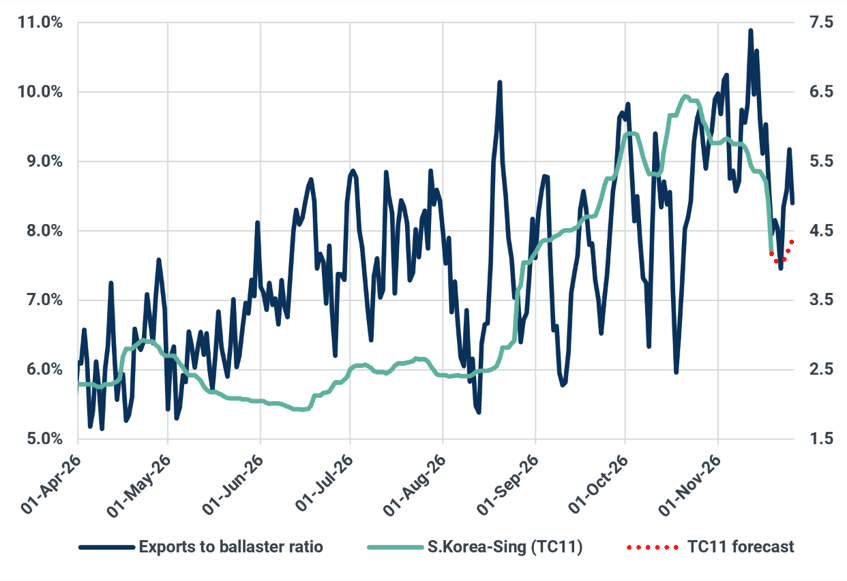
South Korea to Singapore MR rates fell $1.28/bbl w/w to $4.19/bbl from $5.47/bbl, with the decline accelerating on 19 November as the benchmark shed $0.71/bbl in a single session. Regional demand has cooled. Indonesian buying is expected to slow after a couple of strong weekly readings as stockpiling needs are met, while Chinese exports are tracking slightly lower m/m compared with expectations of higher planned allocations for November, which we believe will be deferred into December. Attention has turned to China's December export programme. Refiners hold around 12 Mt of unused product export quota, and speculation that they will rush to use it has weighed on regional gasoil sentiment. However, reaching the 89% utilisation seen in 2024 and 2025 would take only about 7 Mt, and low domestic diesel stocks argue against a flood of cargoes. On the supply side, the ballast MR count has jumped this month following a shift in tonnage from West to East. We expect rates to level off next week before rising slightly as the market reaches a new balance.
MR Eastern Asia tonnage balance ratio (%) (10MA) vs TC11 ($/bbl)
Source: Baltic Exchange, Kpler

See why the most successful traders and shipping experts use Kpler