September 3, 2025
Iron ore and coal markets watch production curbs linked to China’s Victory Day parade
Iron Ore & Steel: Beijing’s new steel blueprint sparks more questions than answers
- Global seaborne iron ore exports totalled 32.30 Mt in the week ending 24 August, pulling back from the previous week’s 13-month high and falling below the five-year seasonal average of 33.70 Mt. BHP’s exports from Nelson Point slumped by more than half w/w to just 1.29 Mt, their lowest since February, amid what appears to be maintenance works. Conversely, FMG saw shipments from Anderson Point rise to a four-week high of 3.84 Mt, signalling the end of its seasonal maintenance.
- On the demand side, Chinese seaborne iron ore imports declined to 22.80 Mt last week, continuing to retreat from early August’s weather backlog-driven peak of over 28 Mt. Meanwhile, daily average crude steel output by CISA member mills rose 6.10% y/y to 2.12 Mt during the 10 days from 11 to 20 August, aiming to frontload output ahead of stricter environmental curbs linked to the 3 September Victory Day parade.
- Beijing’s policy stance added to market intrigue following the release of a planning document titled Work Plan for Stabilising Growth in the Steel Industry 2025–2026 on 28 August. Jointly drafted by five ministries, the plan targets annual growth of 4% in the steel industry’s value-added, improved supply-demand alignment, and structural optimisation. While it references long-standing production cut policies, it stops short of specifying reduction targets or introducing new curbs. Following the disclosure of the document, the DCE iron ore price increased by 1.74% on 28 August, while the SHFE rebar and HRC only edged up by 0.55% and 0.78%, respectively. The larger increase in iron ore prices may be a reaction to signs of hesitation in Beijing about imposing steel production cuts.
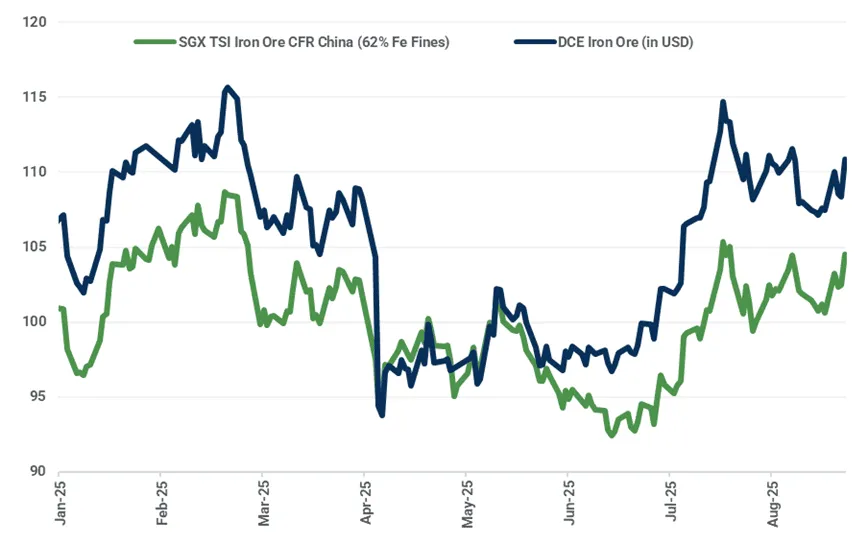
- Iron ore prices continued their sentiment-driven rally last week, mirroring similar gains in July. Optimism was fuelled by several factors: the temporary halt of Rio Tinto’s operations at Simandou in Guinea following a fatality, hopes of increased Chinese steel production after the military parade, and a policy document for the Chinese steel industry that left room for positive interpretations rather than signalling production constraints. Nevertheless, market fundamentals remain anchored in oversupply, and these developments are unlikely to alter the near-term balance significantly. The most-traded iron ore contract on DCE, January 2026, rose 2.33% w/w to a two-week high of 790.50 yuan/t (110.86/t) on 28 August. On the SGX, the TSI 62% Fe second-month contract increased by 3.29% w/w to $104.50/t at the time of writing.
Daily DCE and SGX iron ore prices ($/t)
Source: SGX, DCE, Kpler Insight

See why the most successful traders and shipping experts use Kpler
Request a demo
Gain clarity on dry bulk flows, rates & fundamentals to navigate market shifts precisely
Request access