Middle Eastern oil supply recovery could surprise
Renewed Israeli attacks have postponed the formal signing of the US-Iran MoU. As the back and forth continues, we are focusing on the potential timeline and volumes of a Middle Eastern crude and condensate supply return.
Key takeaways:
- The supply comeback could be faster and larger than expected — Iran, Kuwait, the UAE, Iraq and Qatar all show upside surprise potential.
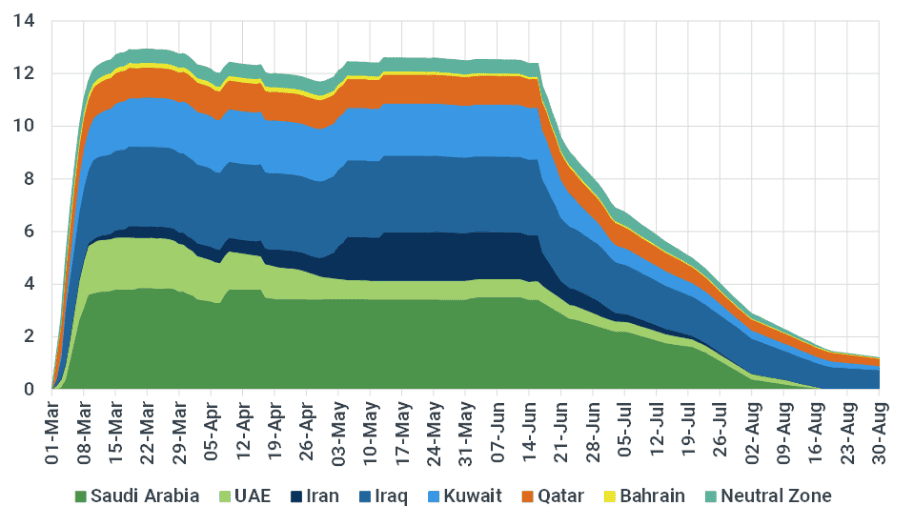
- Most Middle Eastern oil producers would return in weeks rather than months. Our current base case forecast a recovery to pre-war crude and condensate supply of close to 27 Mbd in September (vs 16 Mbd in June).
- Gulf countries' flexibility to ramp up is supported by regional onshore storage (excl. Iran) filled at only around 50%.
As noted in our previous reports, Israeli strikes were identified as a significant downside risk to the US–Iran deal; that risk has now materialised. While news emerged yesterday that the US had lifted its naval blockade on Iranian transits, the Israeli military carried out strikes against Hezbollah across southern Lebanon overnight. Switzerland's Foreign Ministry announced on Friday morning that US–Iran talks have been "postponed," offering no further explanation.
Kpler cargo tracking data show that Strait of Hormuz traffic remains severely constrained; however, a gradual restoration of Iran's crude export logistics may now follow the lifting of the US naval blockade. Kpler has observed more laden Iranian-linked vessels departing Iranian waters with active AIS — notably VLCCs Deep Sea, Hedy, Snow, Starla, and Happiness I, all of which have reappeared on AIS after extended periods of limited visibility. Ballast Iranian tankers are also transiting the Strait with AIS switched on, marking a notable shift from the largely static positioning that characterised many Iranian-linked vessels in recent weeks.
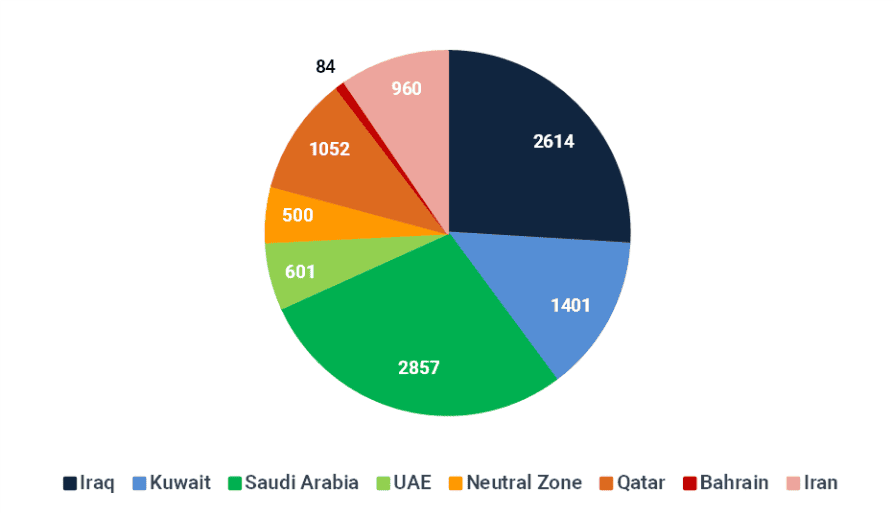
As of 19 June, we estimate that at least 10 Mbd of Middle Eastern crude and condensate production remains shut in, resulting in cumulative production losses exceeding 1.2 billion barrels.
10 Mbd: Middle Eastern crude and condensate supply outages, Mbd
Source: Kpler
Middle Eastern supply outage forecast by country, Mbd
Source: Kpler

See why the most successful traders and shipping experts use Kpler