The jet tightness is not easy to overcome
Jet fuel markets remain structurally tight, with limited ability to increase supply despite strong yield switching incentives and high refinery runs in the Atlantic basin. Constraints stem from low inherent yields, limited yield-switching flexibility, and stringent specifications requiring full-chain traceability, all of which limit the pool of on-spec molecules. As a result, jet balances are set to remain tight as the underlying constraint remains structural; the system can only produce, certify, and deliver incremental barrels at a measured pace.
Jet fuel continues to command outsized attention across global product markets as the Strait of Hormuz (SoH) disruption cuts Europe’s access to its primary supply region (ME), with cracks remaining firm as supply from other sources persistently disappoints despite Atlantic Basin refiners running at near-maximum utilisation and actively optimising yields. The tightness is not purely cyclical. It is structurally embedded across the value chain, spanning crude chemistry, refinery configuration, stringent product specifications, and a highly controlled, inflexible logistics system.
At its core, jet fuel is inherently constrained within the crude barrel. The kerosene cut represents a relatively small fraction of total yields, sitting behind gasoline and gasoil across most refinery configurations. Even in complex refineries, where operators actively optimise product slates, gasoil captures the largest share of incremental upgrading due to both configuration bias and market flexibility. Hence, while refiners do respond to stronger jet margins, the ability to shift yields remains structurally capped by crude slate, unit configuration, and, most critically, product specifications.
Specification is the single most binding constraint in the jet market. Unlike gasoline and gasoil, jet operates within a narrow quality envelope, particularly around freeze point, cloud point, aromatics, and thermal stability. This directly limits how much of the kerosene-range and swing cuts (between 150–270°C) can be upgraded into on-spec material. Blending flexibility is minimal, too. Even small deviations or contamination can push volumes off spec, with limited scope for reprocessing or downgrading. As a result, increasing jet output is not simply a matter of redirecting streams but of ensuring that incremental barrels consistently meet all aviation-grade parameters.
Jet Yield (%)
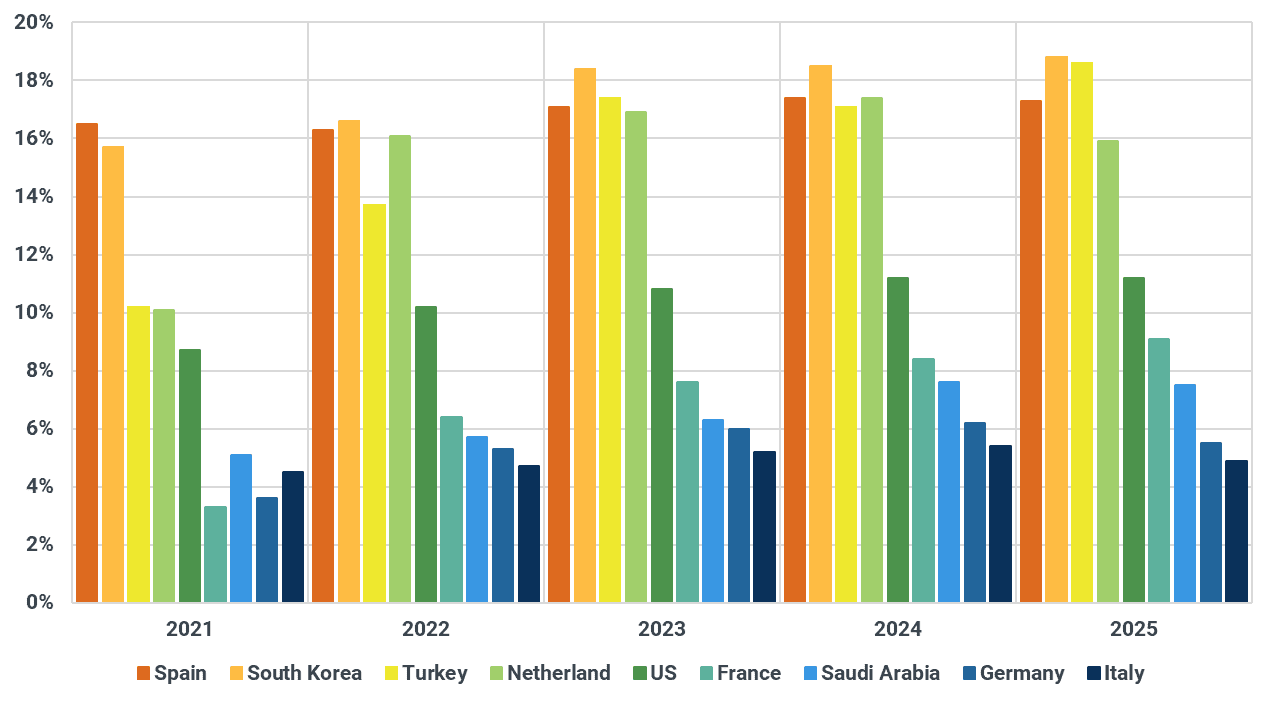
Source: Kpler

See why the most successful traders and shipping experts use Kpler