The price of the US AI boom
AI capex is lifting US growth, but demand for capital is pushing yields higher, squeezing housing and the federal budget.
Summary
- Growth Running Hot: US quarterly headline real growth averaged +2.4% annualized in H1, and our nowcast shows it accelerating to +2.8% in Q3. Unemployment remains low at 4.2%, and prime-age employment is near a two-decades high. AI capex is the engine, with business equipment and IP investment up by a quarterly average pace of +13.4% annualized in H1, roughly double the 2010s average. Data center spending, in inflation adjusted terms, was up +64% y/y in August.
- Capital Costs Climbing: The 10y has risen a full percentage point over the past year to 5%, and the 2y is up 1.24pp to 4.69%. AI and government demand for capital, plus energy-driven inflation from the Iran war are pushing yields higher and widening the gap between sectors that can absorb higher rates and those that can’t.
- Housing Takes a Hit: Residential investment fell by a quarterly average -2.4% annualized in H1 and is on pace for another -1% q/q annualized decline in Q3. Mortgage rates at 7.4%, up from 6% in February, have added about $460 a month to a $500k home loan, while prices have barely budged off post-Covid highs.
- Interest Costs Swell: Net interest reached $1.1tn in FY2026, or 3.4% of GDP, exceeding defense spending by $135bn. With the H1 deficit at 4.8% of GDP versus a roughly 3% non-recession average, higher borrowing and higher yields are feeding on each other.
- Summary Takeaway: The AI capex boom is powering the US economy forward, but it comes at the cost of other rate sensitive sectors of the US economy, such as housing. The US government must also contend with elevated deficits, which drive up demand for debt, thus driving up yields, which raise the cost of additional deficit financing.
Market Analysis
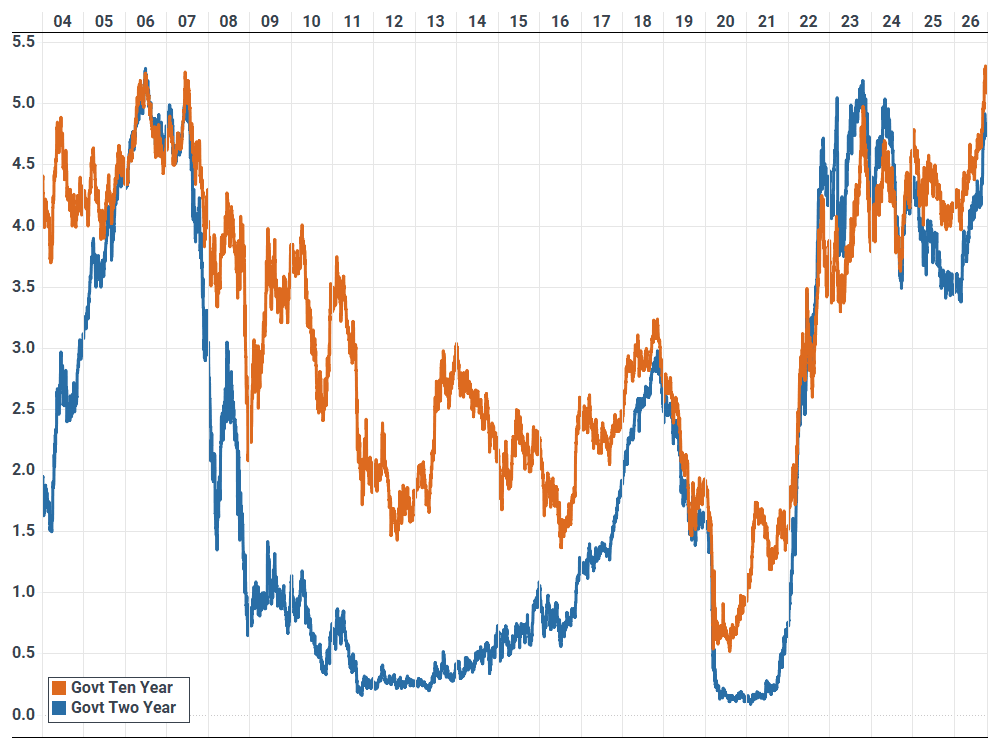
The cost of capital in the United States has risen considerably over the past year. As of October 22, the US 10y government bond yield was trading near 5%, up by a full percentage point over the past year. The US 2y yield has lifted even more, up 1.24 percentage points to trade at a current level of 4.69%. The uplift in yields reflects several factors, including rising AI and government demand for capital, and an energy-induced inflation shock resulting from the war in Iran. Rising interest rates are exposing sharp divergences across the US economy.
Daily Nominal US Government Bond Yields (%)
Source: Fed
Top line US growth looks healthy. Through the first half of 2026, average quarterly annualized headline real growth finished at +2.4%. Our GDP nowcast also points to accelerating economic activity in H2, with output growth set to accelerate to +2.8% q/q annualized in Q3, and +2.5% q/q annualized in Q4. The headline rate of unemployment, currently holding at 4.2%, remains below the cycle high 4.5% seen in November of last year, and there is little evidence of labor market weakness, albeit wage growth remains an area of concern. The prime age employment to population ratio is holding at 80.7%, near the top end of the two decade range. A large majority of prime age workers have a job.
Much of what is driving healthy top line growth is persistent AI capital expenditures, which are bleeding into household consumption resilience. Through H1, combined average quarterly inflation-adjusted expenditures on business equipment and intellectual property (IP) surged by +13.4% annualized. To put this in context, average business equipment + IP investment growth averaged +6.4% annualized between 2010 and 2019. The surge looks likely to continue with strong durable goods orders and business equipment production continuing into Q3. Based on our nowcast, business equipment investment is set for another +12.2% q/q annualized increase in Q3.
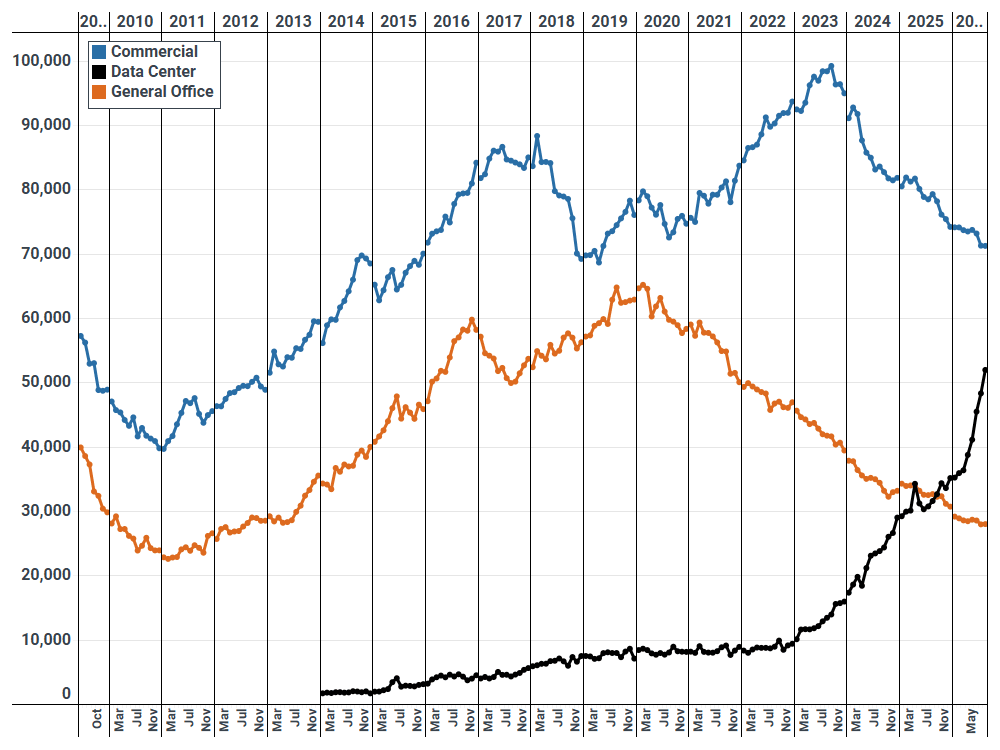
AI-related infrastructure spending is also rising rapidly. Inflation-adjusted private sector expenditures on data centers finished August up by an eye-watering +64% y/y, with spending growth accelerating from a +20% rate of expansion to start the year. Inflation-adjusted power related construction expenditures were also up nearly +4% y/y in August with a noticeable step up in May. Spending on power infrastructure can be volatile, but it is likely that growth will continue.
Monthly Inflation-Adjusted Construction Expenditures by Type (USD mn)
Source: Census; data deflated using BLS PPI New Nonresidential Building Construction
However, the AI capex buildout and its associated demand for capital are having negative knock-on effects across other parts of the US economy. The US housing market sits at the top of the list. In H1, inflation-adjusted residential fixed investment averaged a quarterly decline of -2.4% annualized. In August, inflation-adjusted residential construction expenditures were down nearly -10% y/y, and total housing starts finished lower -7.4% y/y in September. Total residential investment is on pace to decline by at least -1% q/q annualized in Q3.
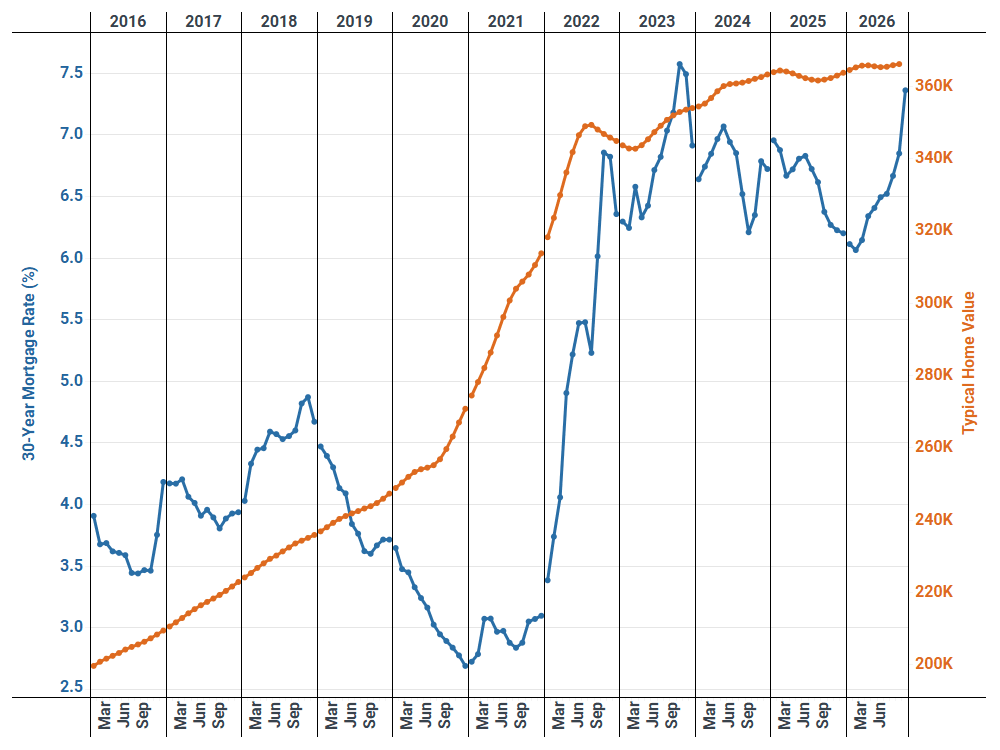
The cost to purchase a home on credit has increased dramatically since late February. At present, a 30 year fixed rate mortgage rate is 7.4%, up from 6% in February. On the purchase of a $500,000 home, and assuming no downpayment, the difference in the mortgage payment today and eight months ago is roughly $460/month, or $167,000 over the lifetime of the loan. Unfortunately for buyers, US home values have yet to undergo much decline, in part because owners locked into low-rate mortgages are reluctant to cut prices. According to Zillow, average American home values have flatlined over the past two years and yet are still up 51% against 2019 levels.
Monthly Average US 30 Year Fixed Rate Mortgage (%, left) Against Zillow Measured Typical Home Value (USD)
Source: Freddie Mac, Zillow
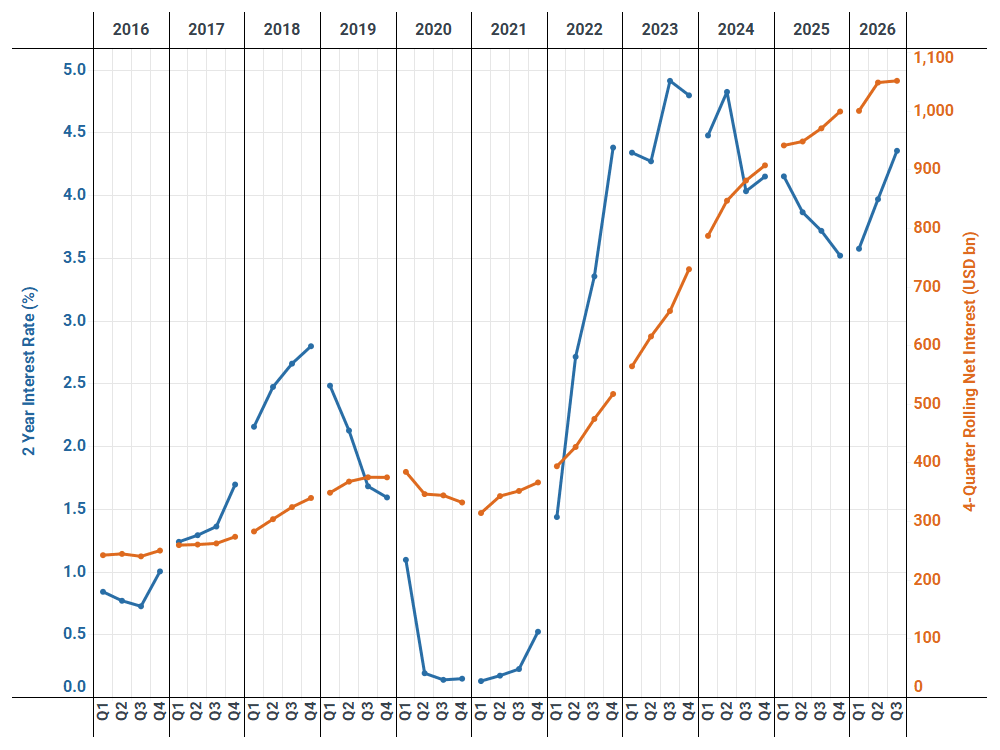
Higher yields also impact the US government budget. Elevated deficits are a circular problem in that they drive up demand for debt, thus driving up yields, which raises the cost of additional deficit financing. According to the US Treasury, FY2026 interest payments were $1.1tn (3.4% of GDP), outpacing defense spending by $135bn. Consider that in FY2019, before the pandemic, net interest payments were $375bn (1.8% of GDP). The combination of aggressive fiscal stimulus through Covid, structurally higher deficits post-Covid, and higher interest rates is playing an increasingly outsized role in the federal budget. Through the first half of 2026, the US government deficit was 4.8% of nominal GDP, pacing well ahead of a historical (non-recession) average of roughly 3%.
Quarterly US Average 2 Year Nominal Interest Rate (%, left) and 4-Quarter Rolling Net Interest (USD bn, right)
Source: Fed, Treasury
In summary, the AI capex boom is powering the US economy forward and will quite possibly raise America’s steady state growth rate in the future. However, AI investment is also lifting interest rates and thus, comes at the cost of other rate sensitive sectors of the US economy, namely housing, general office, and commercial property development. The US government must also contend with elevated deficits, which drive up demand for debt, thus driving up yields, which raise the cost of additional deficit financing. The Fed faces a difficult decision path ahead as they navigate this dual reality.

See why the most successful traders and shipping experts use Kpler