Venezuelan revival and sweet crude expansion reshape LatAm flows
The Latin American crude supply landscape is undergoing a structural expansion, driven by Venezuela's post-sanctions reactivation, Guyana's steady offshore production ramp-up, and big bets on Argentina's shale play. The continent is set to add significant volume to Atlantic Basin supply, at a time when reliable flows are paramount.
Key Takeaways
- Venezuelan production recovery: Venezuelan output is approaching 1.3 mbd in August, targeting 1.4 mbd by year-end, supported by a fiscal take reduction from 83% to 20–35% and major foreign corporate re-entry (SLB, Hunt Oil, Chevron, Eni). However, structural power grid deficits remain the primary bottleneck.
- Guyanese export milestones: Guyana's exports are on track to breach the 1 mbd mark by year-end, with July's exports hitting a new all-time high.
- Argentina shale investment: Established shale players and technology giants alike are eyeing operators in the Vaca Muerta shale formation.
Venezuelan crude and condensate output is currently hovering near 1.3 mbd, up approximately 450 kbd compared to December levels, with state producer Petróleos de Venezuela (PDVSA) targeting 1.4 mbd by year-end.
A sweeping fiscal overhaul that reduced government take on crude projects from 83% to 20–35% has triggered a wave of corporate re-engagement. Chevron's JV output has risen 15% over six months to 280 kbd, while majors and service providers including SLB, Hunt Oil, BP, Eni, Halliburton, Maurel & Prom, and the Oil and Natural Gas Corporation (ONGC) are sealing new operational and framework agreements.
This recovery is directly plugging supply gaps in the market. July exports hit near all-time highs, with sales to Asia rebounding amid escalating tensions in the Middle East. Flows to the US remain high as well, with the US exporting around 100 kbd of naphtha to Venezuela to support diluent needs, reinforcing the upward supply trajectory.
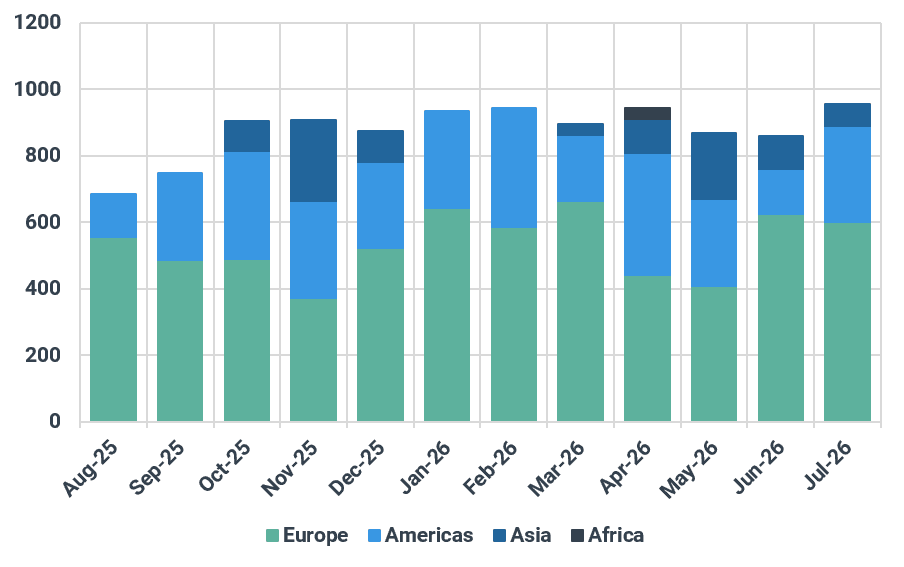
Simultaneously, Guyana continues its upward production trajectory. July exports reached an all-time high, and the rapid production growth suggests that the 1 mbd mark could be breached later this year, as the 250 kbd Uaru project ramps up in Q4. At the same time, Guyanese crudes have started featuring more prominently in Asian refiners' slates since the start of the war, perhaps marking a structural shift.
Guyana crude oil exports by destination continent, kbd
Source: Kpler

See why the most successful traders and shipping experts use Kpler