
War Endurance Model Update: Jet Inventories draw gradually then suddenly
Global jet fuel markets have exhausted their primary buffer, with jet fuel on water no longer able to offset the loss of Middle Eastern and Chinese supply as refinery runs begin to fall. As the system shifts to drawing down inventories, the adjustment moves from price to availability, setting the stage for rapid tightening and demand rationing.
Key Points
- Jet fuel on water has been the buffer—and it is now largely exhausted, removing the system’s most flexible source of supply.
- The market is structurally short, with ~700 kb/d of Middle Eastern and Chinese supply removed and refinery runs now declining, tightening balances further.
- Europe’s ~50 days of cover is not a cushion, but a steady-state level that will erode quickly as inventories begin to draw toward operational minimums.
- The adjustment is shifting from price to availability, with inventories now doing the work and setting up demand rationing and flight disruptions as the next phase.
Ernest Hemingway once wrote that bankruptcy happens “gradually, then suddenly.” That is how markets adjust as well, and it is exactly what is now unfolding in refined products.
The product market has been cushioned by oil on water, a floating supply pool of cargoes at sea that has acted as a temporary bridge to importing regions. That bridge is now exhausted. While this note could address many products, I want to start with jet fuel. It is the most visible, the most immediate, and the one most likely to disrupt behavior, particularly summer travel.
The head of the IEA warned last week that Europe has “maybe six weeks or so” of remaining jet fuel supplies, with possible flight cancellations “soon” if flows remain disrupted. We have already seen the first cancellations. Let’s fact check Birol.
When this war started (50 days ago) we built a War Endurance Model (WEM), and it identified Europe, Australia and New Zealand, smaller Asian economies, and Africa as the regions most vulnerable to jet fuel disruption. Oil on water has bought those regions some time but the"then suddenly" moment has now arrived.
Just so we’re all on the same page:
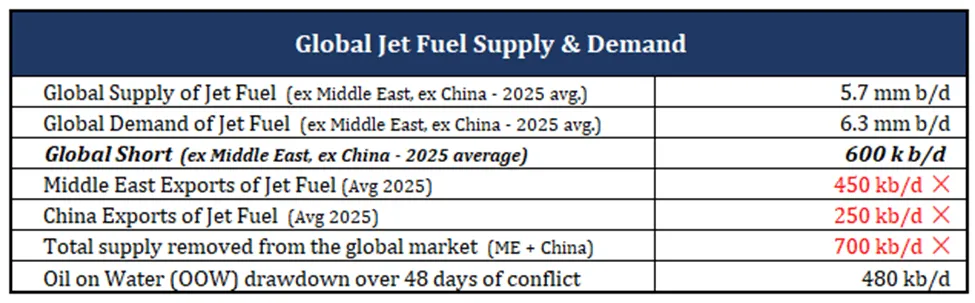
Kpler S&D Model, Kpler Cargo Tracking
The global supply picture outside the Middle East and China is structurally short. Non-ME, non-China production runs at roughly 5.7 million barrels per day against demand of 6.3 million barrels per day. That 600k b/d structural deficit was historically filled by two suppliers: Middle East Gulf exports of approximately 450k b/d, and Chinese exports of approximately 250k b/d. Both are now effectively zero. The Strait of Hormuz closure has eliminated the Middle East Gulf. China has imposed an export ban. Together, 700k b/d of supply has been removed from the global market in a matter of weeks.
Jet fuel on water absorbed the initial shock. Over the 48 days since the war began, OOW has drawn down at roughly 480k b/d, nearly matching the supply gap, but missed covering it fully by approximately 220k b/d. That shortfall has already pulled roughly 10 million barrels from land-based inventories globally, excluding China and the Middle East. The floating bridge has now been largely crossed.
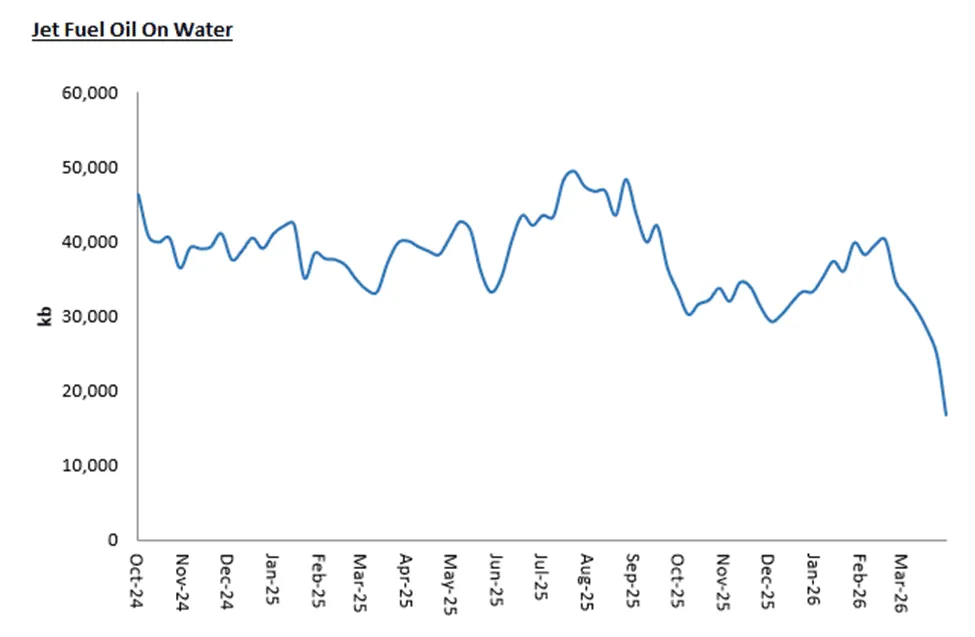
Kpler Jet/Kero Commodities on Water

See why the most successful traders and shipping experts use Kpler