
What’s been sinking Panamax earnings?
Lower demand and increased competition from relatively cheaper Capesizes are driving a decline in the Panamax dry bulk carrier market. However, this divergence from wider market trends cannot continue over the medium term. We expect a rebalancing over the coming month.
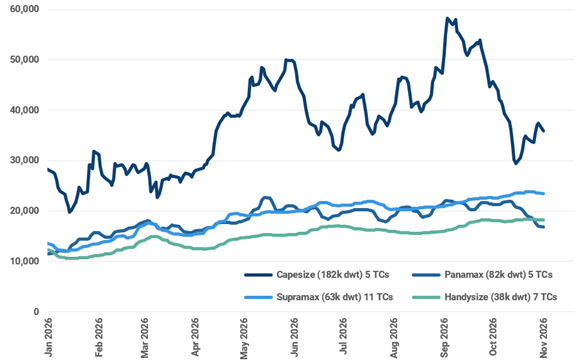
Panamaxes are an outlier among dry bulk carrier markets. Driven by an Atlantic downturn, average earnings remain on the slide and are down by a net $5,021/day from their recent peak of $21,888/day (12 October) to $16,867/day on 2 November. By contrast, the Capesize 5 TCs have found a floor and edged higher, while Supramax and Handysize markets have not seen the same scale of declines.
Panamax earnings are being hit by a loss of demand in key markets and increased competition for the remaining cargoes from both Capesizes and Supramaxes.
Dry bulk carrier average earnings: Panamaxes diverge from the rest of the market ($/day)
Source: Baltic Exchange
Capesize competition
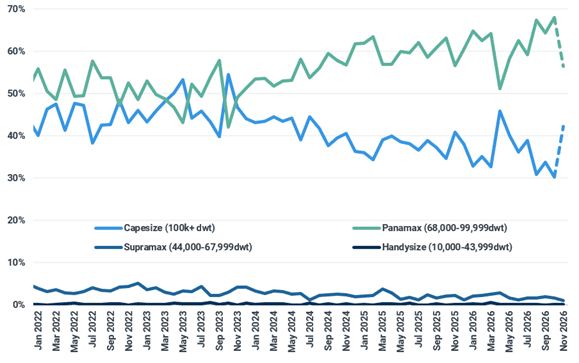
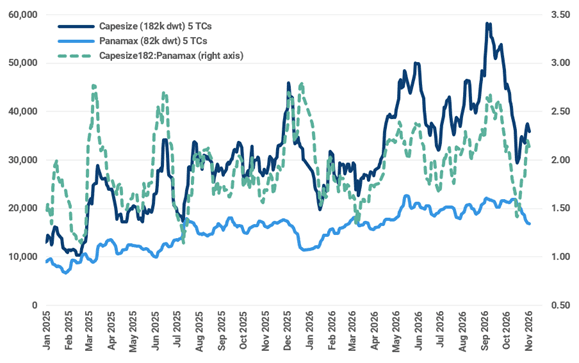
A consistent trend since late 2023 has been an increased Panamax share of Australian coal exports compared to recent historical norms. With the Capesize:Panamax average earnings ratio blowing out to average an exceptional 2.47 in September, the Capesize (dry bulk carriers of 100k+dwt) share of Australian coal exports slumped to just 30% (9.36Mt) in October. Panamaxes (dry bulk carriers of 68,000-99,999dwt) took 68%, the highest proportion since at least 2016.
Following the dive in the Capesize market, the average earnings ratio plunged to a trough of 1.41 on 16 October. Subsequent Panamax declines mean it has since climbed back to 2.13 however, lineup data show Capes taking close to 40% of Australia’s coal exports booked to date.
The upward march in bunker prices, as tensions in the Middle East remain high and fuel oil supplies tight, has also made the larger vessels more competitive. The price of 0.5% VLSFO has climbed from $841/t on 1 October to above $1,000/t at the time of publication. On average, Capes consume less bunker fuel per ton of cargo moved compared to Panamaxes.
Australian coal exports by vessel type: Panamax loadings set to dip in November (%)
*November data preliminary based on Kpler analysis of lineups, fixtures, and other loading data
Source: Kpler Insight
Capesize:Panamax average earnings ratio: Cape earnings decline caused the ratio to sink ($/day)
Source: Baltic Exchange, Kpler Insight
Demand for vessels is also lower
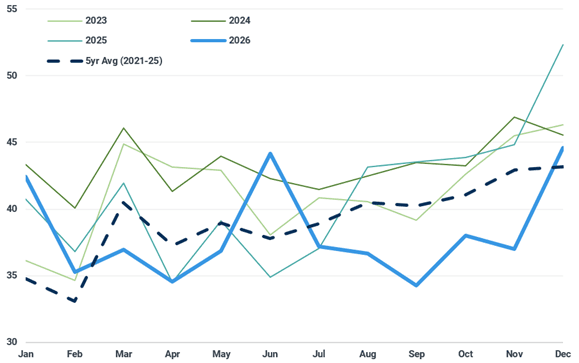
Underperforming Indonesian coal exports have taken demand out of the Panamax market. Exports fell by 8.17Mt y/y in October to 40.39Mt, a fourth consecutive month of annual declines, and are expected to struggle through the final months of the calendar year. Panamaxes carry close to 68% of Indonesian coal exports, rising to 72% in October.
At the same time, the collapse in Russian coal exports from the Black Sea has also cut demand for coal-carrying Panamaxes. Exports in the three months to October were below 200kt. Shipments in the same three months of 2025 totalled 5.40Mt, of which just under 60% was carried by Panamaxes.
Colombia and South Africa are leading the way in replacing these lost tons, shipping to Turkey and India, respectively, among other destinations. However, these include a higher proportion of Capesize cargoes. While the tons of coal are coming to the seaborne market, the vessels carrying them are different.
Indonesian thermal coal exports: actual and forecast (Mt)
Source: Kpler Insight
The divergence displayed by the Panamax market cannot continue indefinitely. A rebalancing will take place.
With Capesizes moving higher and more demand for the larger vessels in both the Atlantic and Pacific, there will be a floor for Panamaxes. Fundamental demand is there to support Capesizes, and this will lift Panamaxes as a re-stretching of the Capesize:Panamax earnings ratio encourages stem splitting onto the smaller ships. FFA contracts for November and December 2026 are pricing the Capesize:Panamax average earnings ratio at near 2.26 and 2.24 for November and December, respectively.
With Supramaxes, we expect Panamax declines to pull earnings for the smaller ships lower until Panamaxes find a floor. However, a restart of shipping in the Black Sea through a deal between Russia and Ukraine would provide a demand boost that could lift demand across sub-Capesize markets.
However, this outlook could be derailed by a ramp-up of fighting in the Middle East that causes bunker prices to spike and shifts demand in favour of larger ships.

See why the most successful traders and shipping experts use Kpler