Why hasn’t the clean tanker market corrected (yet)?
Atlantic dirty tanker rates have returned to pre-conflict levels under pressure from tonnage migration, while clean rates remain elevated due to continued clean-to-dirty switching and reduced tonnage in the West of Suez. The drop in dirty earnings has widened the premium for clean vessels, limiting further expansion of the dirty LR2 pool. Meanwhile, tighter Atlantic CPP balances could curb exports to the East, with the clean market likely to correct more gradually due to slower underlying dynamics.
Market and Trading Calls:
- Atlantic dirty tanker benchmarks reverted to pre-conflict levels over April, pressured by tonnage migration.
- Clean rates, however, remain elevated due to further clean-to-dirty-switching as well as a net negative tonnage migration into the WoS
- The correction in dirty benchmarks has pushed clean earnings to a premium to dirty ones, placing a lid over further increases in the dirty LR2 pool.
- Tighter Atlantic CPP balances are likely to see exports to EoS settle lower going forward.
- The clean tanker market is headed for a correction, but slower market dynamics suggest a more gradual easing in rates.
As the de facto closure of the Strait of Hormuz (SoH) pivoted Ton-Mile growth to the Atlantic basin for both the dirty and clean markets, the first fortnight of April saw the dirty (ex. MEG) tanker market correct from the post-conflict highs, partly as the arrival of VLCC ballasters from the East, put pressure on USG assessments, with the weakness eventually cascading to mid-sizes. A similar correction has yet to emerge in the clean sector, particularly in the Atlantic basin, as East of Suez (EoS, excluding MEG) markets were not significantly supported by the conflict to begin with; elevated feedstock costs and the loss of MEG CPP volumes have instead led to reduced refinery runs and the implementation of export controls.
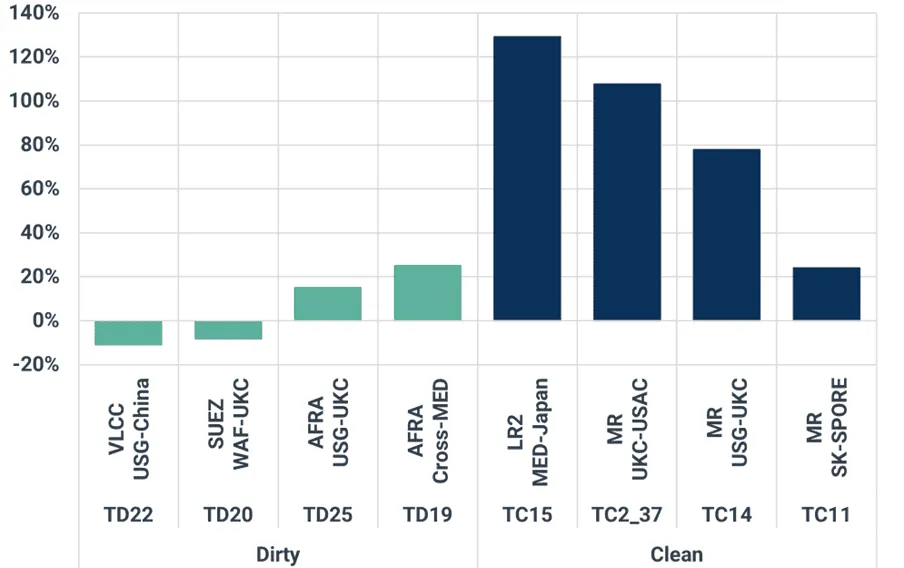
As of the time of writing, VLCC and Suezmax benchmarks have dropped below the pre-conflict levels, leaving the last signs of strength with Aframaxes, whereas LR2 assessments continue to trade circa 130% above pre-conflict levels, a figure that slips to 90% for transatlantic MRs.
Change in key (excl. MEG) tanker assessments (present vs pre-Iran war)
Source: Baltic Exchange, Kpler
Partially offsetting the pressure from the loss of MEG volumes and the knock-on impact on CPP exports across the rest of the EoS market, the clean tanker sector has been supported on the demand side by a surge in Atlantic trade with the East. This mainly features US to APAC, with special reference to Oceania, as well as Europe to Southern/Eastern Africa and Asia flows. While this mirrors an increased pull of Atlantic crude volumes from EoS refiners, a similar tonnage-relocation-driven correction has not yet been observed in LR2s and MRs, as has been the case for VLCCs.
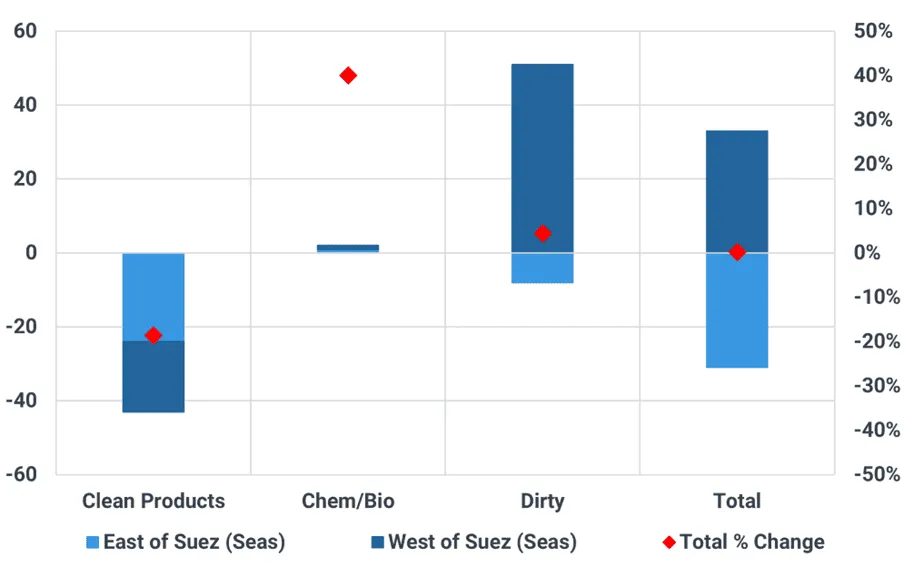
Starting with LR2s, unlike VLCCs, where the loss of MEG barrels naturally pushed tonnage toward the Atlantic, the most attractive option for LR2s, dictated by earnings economics, has been a shift into dirty trades in the Atlantic. In the first month of the conflict, the spread between dirty and clean earnings in the basin averaged $80k/day, exceeding the previous record set before the Russian crude price cap was enforced in 2022. This has triggered further clean-to-dirty switching. Comparing the current employment of the LR2 fleet across basins and products with that before the war, it becomes clear that clean tonnage supply has declined in both EoS and WoS, tightening supply and sustaining clean LR2 freight rates.
Change in Aframax/LR2 employment across basins and commodities (present vs pre-Iran war)
Source: Kpler
When repeating the above depiction in the case of MRs, however, we reach very different conclusions. While the clean MR pool has increased, seemingly driven by an exodus of tonnage from the Chem/Bio trades, the impact is geographically skewed. Most of these vessels, as of the time of writing, remain in the EoS , with the WoS market actually seeing a decline in tonnage. This appears somewhat counterintuitive, given the large migration waves recorded since the onset of the Iran war.

See why the most successful traders and shipping experts use Kpler