Will China help reopen Hormuz?
The long-awaited visit of U.S. President Donald Trump to Beijing to meet Chinese President Xi Jinping took place on Thursday. According to the U.S. State Department, both sides agreed that tolls should not be imposed on vessels transiting the Strait of Hormuz. However, it remains unclear how far China is willing to use its leverage over Iran to help reopen the waterway.
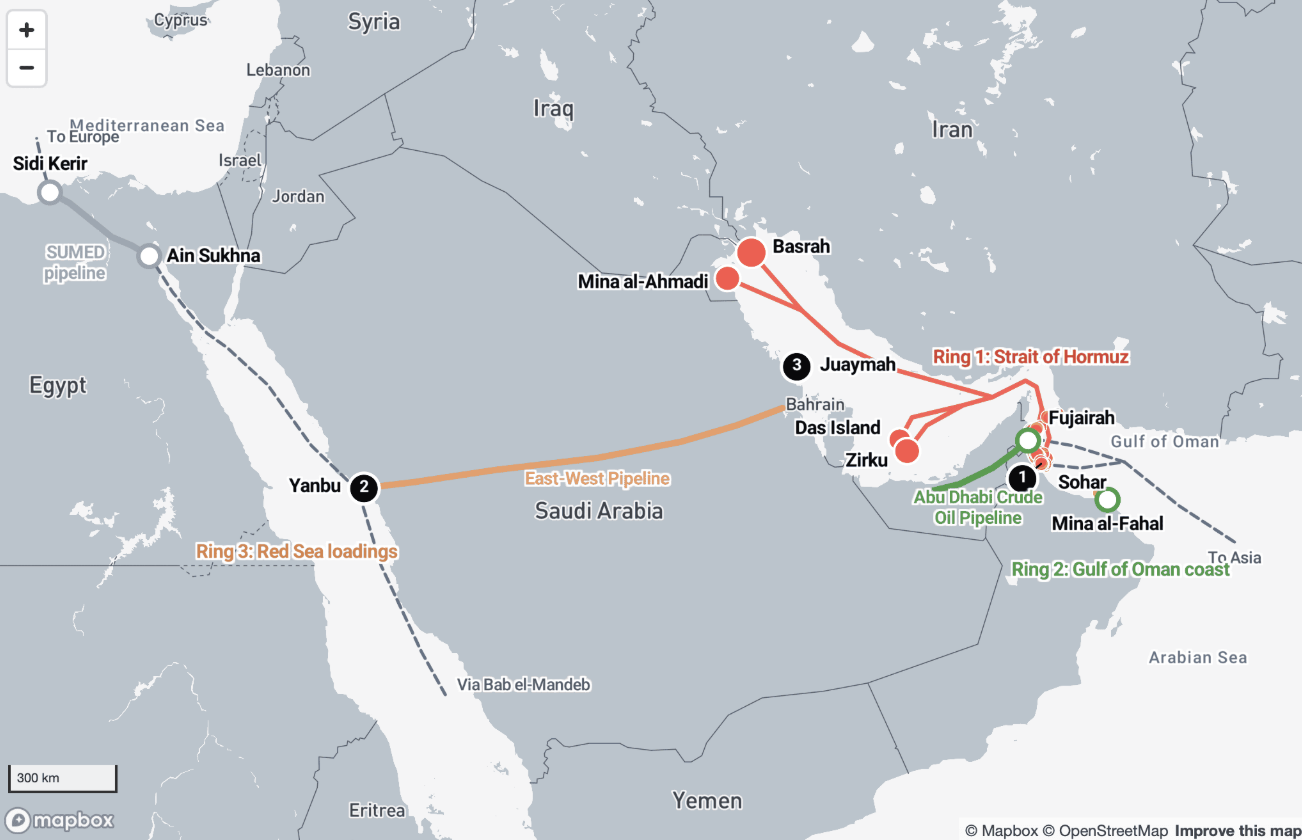
Vessel traffic through Hormuz began falling sharply shortly after the war started on 28 February. Crossings through the strait remain in the single digits, while supply disruptions from the region have already exceeded 800 million barrels and are expected to rise further if the stalemate continues.
Despite China’s heavy reliance on the strait—through which roughly 40% of its oil imports pass—Beijing appears to be pursuing a strategy of deliberate patience, allowing Washington to become increasingly entangled in a costly and open-ended confrontation with Iran. What initially appeared to be a decisive show of force has, due to poor forward planning, evolved into a stagnant and prolonged conflict. The Strait of Hormuz remains restricted by Iran, while the threat of further escalation continues to loom over the region. Despite the grand rhetoric, it is becoming increasingly clear that Trump wants to see both an end to the conflict and the reopening of Hormuz.
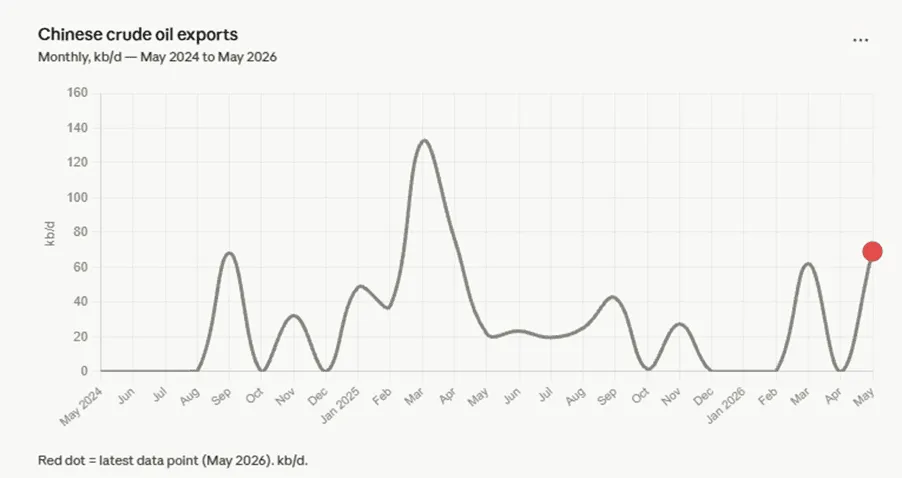
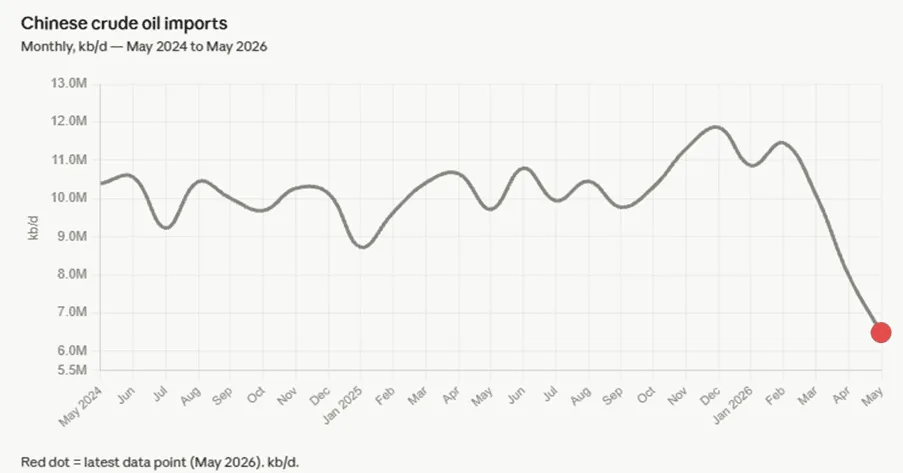
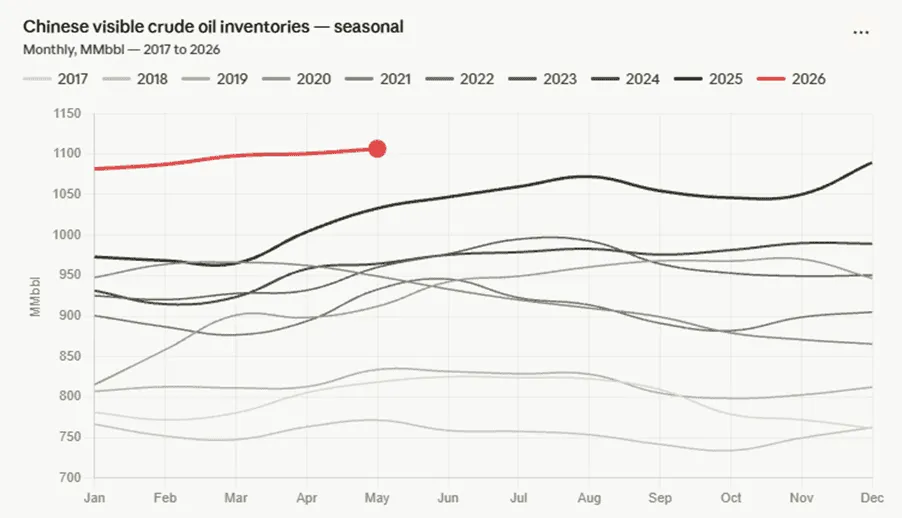
China can afford to wait. Visible oil inventories in China exceed 1.1 billion barrels and, according to recent data, continue to build. In fact, China appears so confident in their position that they’ve been willing to export crude oil—and reportedly even reexport barrels that would normally have been retained for domestic imports—while simultaneously reducing import volumes. Despite this, Chinese inventory levels have not shown meaningful declines.
Nevertheless, Beijing also has reasons to want the conflict resolved. Earlier this year, Trump’s intervention in Venezuela and tighter control over Venezuelan oil exports cut off discounted, sanctioned barrels flowing to China. As a result, safeguarding supplies from Iran has become increasingly important for Beijing. Moreover, China’s economy — heavily dependent on export demand — would hardly benefit from a prolonged closure of the strait, which could trigger broader global economic weakness. Our base case scenario at the moment assumes an improved rate of traffic from the strait by August.
During Trump’s visit, Xi reportedly stated that China would not supply Iran with military equipment. It remains unclear whether Xi raised Washington’s plans to supply military equipment to Taiwan, an issue many had expected him to address. However, Secretary of State Marco Rubio said U.S. policy toward Taiwan remains “unchanged” following Trump’s meeting with Xi while also warning that it would be “a terrible mistake” for China to take Taiwan by force.
One of Trump’s key objectives during the visit was reportedly to persuade China to purchase more U.S. crude instead of Iranian oil. However, such a shift appears unlikely. Beijing has repeatedly disregarded U.S. sanctions restrictions, with China’s independent “teapot” refineries continuing to buy the lion’s share of Iranian crude exports.
In what appears to be a gesture of support from Tehran toward Beijing, Iran said it had begun allowing some Chinese vessels to transit through the Strait of Hormuz following an understanding over Iranian management protocols for the waterway, according to the semi-official Fars news agency, citing an informed source.
Meanwhile, the NITC-controlled VLCC Huge, carrying an estimated 2 million barrels of Iranian crude, has resurfaced in satellite imagery near the Vietnamese coast after disappearing from AIS coverage earlier this month. The vessel was last seen on AIS on 3 May while transiting the Lombok Strait before going dark again. Fresh satellite imagery captured on 13 May shows the Huge moving northward past Vietnam, strongly suggesting the tanker is continuing toward China.

See why the most successful traders and shipping experts use Kpler