
Europe’s rising Russian risk
Europe raised its guard against Russia this weekend: Macron convened France’s political and intelligence leadership over an intensifying Russian hybrid threat, while NATO’s military chiefs met in Copenhagen amid growing drone, sabotage and infrastructure risks. As that confrontation moves further into the Baltic, the Danish Straits are becoming a critical chokepoint to watch.
Europe’s Rising Russian Risk
For most of the past four years, Europe’s Russian security problem was centered in Ukraine. Last week, the conversation changed when French President Emmanuel Macron gathered France’s political and intelligence leadership for a high-level security briefing and warned that Russia’s hybrid threat against Europe had “intensified.” The concern is increasingly about what Russia is doing beyond Ukraine and how Europe should respond.
The warning comes only weeks after CIA Director John Ratcliffe made a rare trip to Moscow, where he reportedly warned Russian intelligence officials against attacking NATO territory amid U.S. intelligence assessments that Moscow could seek to test the alliance.
That risk is complicated by the nature of the activity now causing concern. Drones, sabotage, cyberattacks and interference with critical infrastructure operate in the gray zone between peace and armed conflict.
NATO’s deterrence architecture was built around armed attack. These newer forms of aggression often fall below that threshold, where attribution can be difficult and the appropriate response less clear.
Europe is now having to define what constitutes an attack in this new environment. Germany formally attributed to Russia an attempted attack involving an explosives-laden drone found near a Ukrainian cargo aircraft at Germany’s Leipzig/Halle Airport and classified it as a “hybrid attack,” even while stressing that Germany is not at war. European Commission President Ursula von der Leyen called the incident a “new escalation on European soil.” European defense and intelligence officials warn that the lack of meaningful consequences is allowing Russia to keep testing the boundary below NATO’s Article 5 threshold. Russia denies responsibility.
Leipzig is one incident in a much broader pattern. Between Russia’s invasion of Ukraine in February 2022 and February 2026, researchers recorded 151 hostile Russian operations across Europe. Separately, 144 drone sightings across a dozen European countries were reported between August 2024 and February 2026.
The Danish Strait Chokepoint
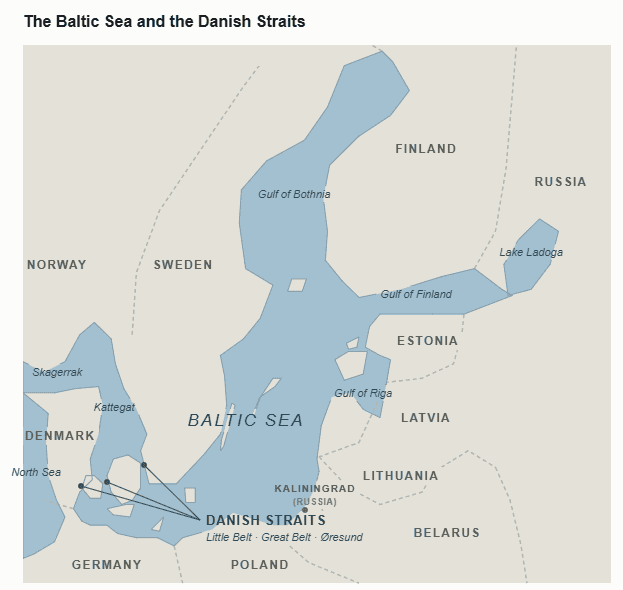
The same ambiguous gray-zone activity occurring on land is also happening at sea, where attribution can be even more difficult.
The Baltic concentrates Russian and NATO military forces, commercial shipping, shadow-fleet tankers and critical infrastructure in a relatively confined body of water. Pipelines, power cables and telecommunications infrastructure cross the seabed, while commercial and military vessels operate alongside one another.
A damaged cable can be an accident or sabotage. GPS interference can disrupt civilian navigation without a shot being fired. And commercial vessels can carry Russian commodities while also operating as part of the shadow fleet.
Against that backdrop, NATO’s military chiefs met in Copenhagen this weekend for their annual conference. Russia’s recent airspace violations, drone incidents and hybrid activity were part of the discussions, with NATO describing Denmark as the “gateway between the Baltic Sea, the North Atlantic and the High North.”
Nearly all maritime traffic between the Baltic and North Sea passes through the Danish Straits. Kpler tracks roughly 1,600 crossings each month, while the straits carry roughly 6% of global seaborne crude oil and petroleum product trade. That makes the Danish Straits a major commercial chokepoint in an increasingly contested Baltic security environment.
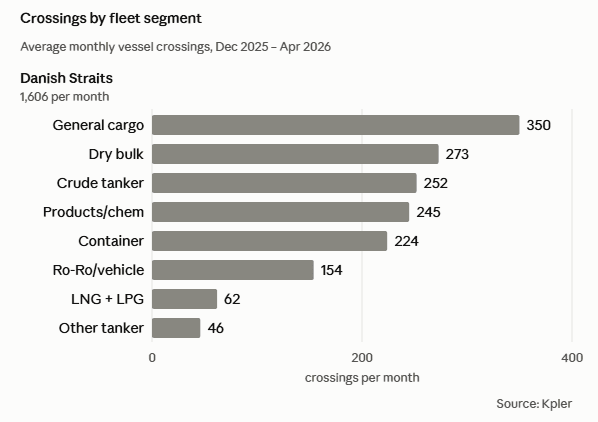
There is a parallel with the Turkish Straits, where we have spent much of this year tracking the expanding risk to commercial shipping. Russian commodities leaving both the Black Sea and the Baltic must pass through narrow maritime gateways controlled by NATO members.
But the similarities largely end there. The Black Sea is already an active war zone, with attacks increasingly reaching commercial shipping. The Seafarers' Union of Turkey estimates that 35 ships were attacked in July alone, killing 23 seafarers. The Baltic remains below the threshold of conventional war, but Russian pressure is increasingly visible through GPS interference, suspected sabotage of subsea infrastructure, shadow-fleet activity and more frequent encounters with NATO military assets.
Europe now faces rising Russian maritime risk on both its northern and southern flanks. In the Black Sea, that risk has escalated into conventional war. In the Baltic, it remains largely in the gray zone.
Europe’s Energy Security Crisis
During Macron’s three-hour security meeting, energy security was also a priority. Alongside the rising Russian threat, French officials were briefed on the energy consequences of the Middle East war, with Macron identifying diesel, jet fuel and gas as the most sensitive supplies.
Europe has already had to reorganize where its fuel comes from. Lost Middle Eastern jet fuel has increasingly been replaced by U.S. and Nigerian barrels, while diesel flows have shifted toward the United States as Saudi and Kuwaiti supply has fallen. That growing reliance on U.S. supply comes as high domestic diesel prices have put export controls into the policy conversation in Washington, potentially putting another source of European supply at risk.
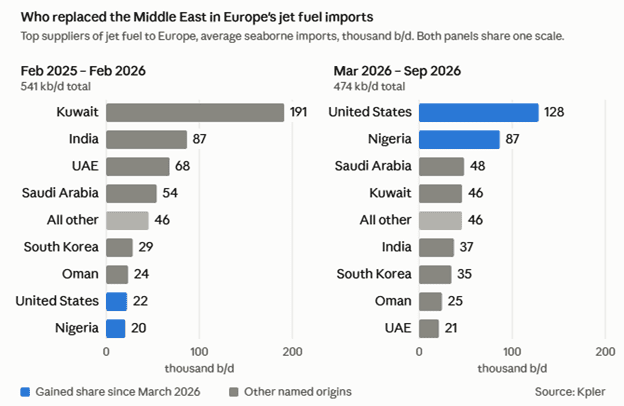
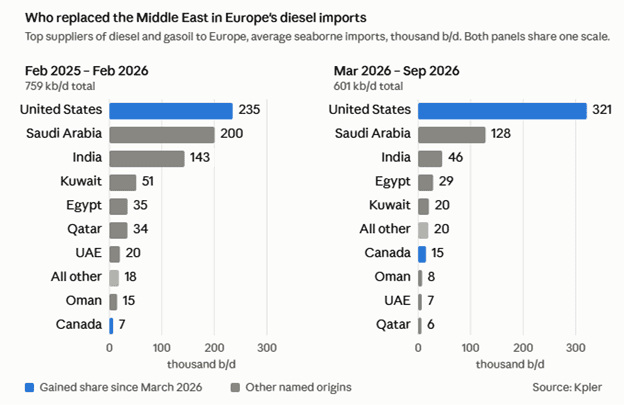
The pressure is still building. Following the attack on Saudi Arabia’s East–West Pipeline, Saudi Aramco reportedly told European customers they will receive no crude allocations in October, forcing refiners to look elsewhere for replacement barrels.
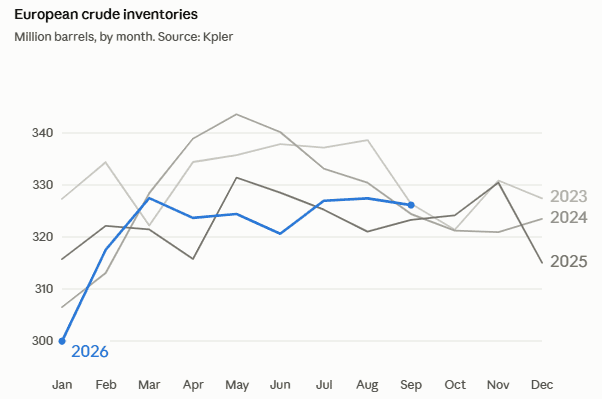
Europe is strengthening its defenses while simultaneously scrambling to replace energy supplies disrupted by another war.
Freedom of the Seas
Earlier this month, 18 major maritime nations, including Denmark, warned that the rules governing global shipping are beginning to break down. Hormuz, geopolitical conflict and the growth of the shadow fleet, they argued, point to a structural change in the environment in which global trade operates.
For decades, markets largely treated freedom of navigation as a given. The security required to keep the world’s major waterways open sat in the background, much of it underwritten by U.S. military power.
The model began to crack in 2023, when the Houthis started attacking commercial ships in the Red Sea. Bab el-Mandeb required naval protection and widespread rerouting around the Cape of Good Hope. Today, commercial traffic through Hormuz depends on U.S. military protection concentrated into designated transit windows. That protection is expensive: operating an advanced U.S. military aircraft is estimated to cost $25,000–$75,000 an hour. The Black Sea has become an active maritime theater, while the Baltic increasingly combines Russian military activity, shadow fleets, sabotage risk and vulnerable infrastructure.
Who ultimately pays for maritime security—governments, insurers, shipowners or eventually some form of security fee—is becoming part of the new economics of contested waterways.
As security becomes more regional, the cost of keeping waterways open moves closer to the countries that depend on them. Surveillance, sanctions enforcement, infrastructure protection and naval patrols all have a price.
Closure is only the most extreme form of chokepoint risk. A waterway can remain open while becoming more expensive, more regulated and more militarized.
The harder problem for Europe is deciding where the gray zone ends. Russia can continue testing the boundary with drones, sabotage, interference with critical infrastructure and increasingly aggressive activity at sea. Each incident forces the same calculation: does Europe absorb it, respond below the threshold of war, or eventually decide that an attack is an attack?
That calculation is becoming increasingly important in the Baltic—and puts the Danish Straits firmly on the European security map.

See why the most successful traders and shipping experts use Kpler