How will LPG and naphtha reshuffle around the Bab el-Mandeb blockade?
The Houthis blockade has materially impacted LPG and naphtha transits through the Bab el-Mandeb (BeM) strait since 20 July. Asian buyers now need to pay even higher premiums to attract additional spot barrels from the West, while trade reshuffling also adds to freight costs. Infrastructure damage, including at the Jizan refinery, will also constrain Saudi’s west coast exports further in August.
Key Takeaways:
- The rerouting of Saudi Arabia's west coast exports through the Suez Canal, and potentially into the Med, is likely to cap Western light ends cracks, leading to a wider E/W spread for naphtha.
- Russia's naphtha exports through the BeM should face limited constraints, although recent exports have been low due to stronger seasonal gasoline blending demand and lower refinery runs.
- For LPG, tighter balances are likely to be concentrated in Eastern butane markets from mid-August, leading to a wider East-West C4 spread.
- An expected uptick in product tanker and VLGC freight rates will also raise overall light ends landed costs, especially into Asia, this quarter.
It has been almost two weeks since Houthis declared a maritime blockade on Saudi vessels on 20 July. On 30 July, Saudi Arabia announced that it is forming military coalition to protect shipping in the Red Sea, with 14 countries already affirming their support for the coalition. Saudi Arabia has also prepared an offensive against the Houthis, potentially by both land and sea, signalling a further escalation in tensions (or on the other side, a successful operation could help break the Houthis' chokehold on Saudi exports through the southern Red Sea.)
That said, overall transits through the BeM have not stopped over the past two weeks but have instead slowed markedly, with traffic roughly halved. Commodity transits fell to a low of 16 vessels on 26 July before partially recovering to 28 vessels on 30 July 2026, including 19 vessels entering the Red Sea.
For LPG and Naphtha, outflows through the BeM have clearly declined since 20 July, although we note that VLGC NY LORD has ballasted this week.
LPG and Naphtha production at the West Coast of Saudi Arabia
Yanbu: Aramco operates a 585 kbd fractionator at Yanbu, which typically receives NGL feed from the East via the Abqaiq–Yanbu NGL pipeline, running parallel to the 1201 km East-West Crude Oil Pipeline. Several downstream petchem plants, including the 930 kt/year YANPET cracker, the 1.3 Mt/year Yansab cracker, and National Petrochemical's 400 kt/year PDH unit, consume naphtha and LPG, while surplus volumes are exported. Yanbu typically exports ~1.7 Mt/year of LPG and ~1.1 Mt/year of naphtha.
Rabigh: The 400 kbd Rabigh refinery typically produces naphtha for gasoline blending and to feed the 1.35 Mt/year paraxylene (PX) unit. Naphtha exports here were ~670 kt/year in 2025.
Jizan: The 400 kbd Jizan refinery produces naphtha primarily for gasoline blending, with surplus volumes exported intermittently when maintenance occurs at the reformer or C5+ iso unit. Naphtha exports totalled ~350 kt in 2025 and reached 205 kt in June of mostly heavy naphtha amid reformer maintenance. We now expect the refinery to be offline at least until mid-August following Houthis attack on 27 July.
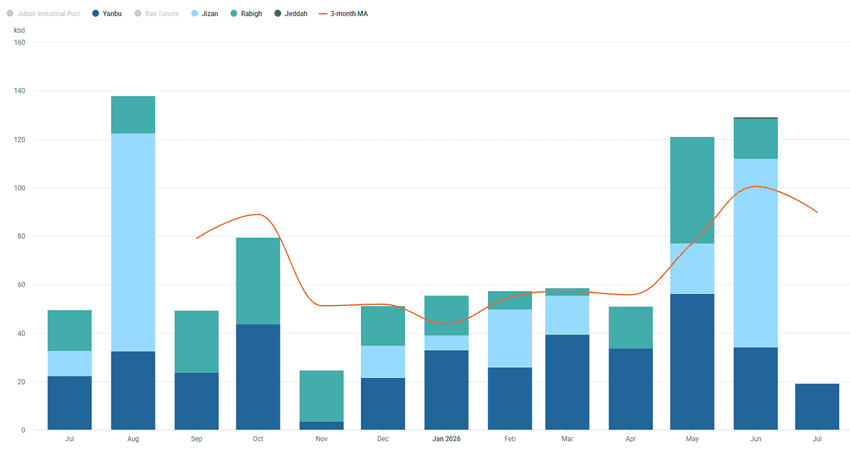
Saudi Arabia has exported ~100 kbd of LPG via Yanbu since the start of the Strait of Hormuz (SoH) crisis. Meanwhile, naphtha exports from its west coast ports of Yanbu, Rabigh, Jizan and Jeddah averaged ~120 kbd in May and June. Theoretically, these represent the maximum disruption to the country's west coast exports, although outflows here are likely to continue through vessel rerouting.
Saudi Arabia’s west coast naphtha exports, kbd
Vessels to reshuffle from the Bab el-Mandeb
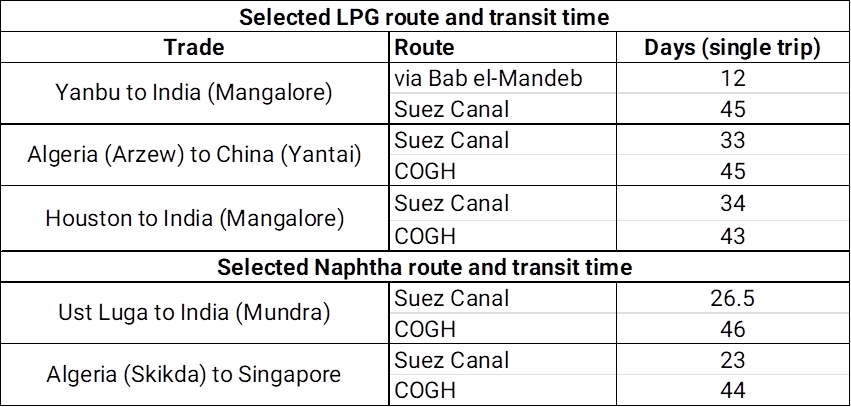
Given the elevated risks in the BEM, several vessels have already rerouted via the Suez Canal. Torm Innovation loaded ~60kt of naphtha at Yanbu on 23 July with Japan initially indicated as its destination but has since transited the Suez Canal and is now en route to Spain. VLGC Gas King, which loaded at Yanbu on 19 July, likewise transited the Suez Canal.
The Suez Canal is also a key route for vessels transporting cargoes from the West (the Med and the US) to Asia. Routing via the Cape of Good Hope (COGH) typically adds around one month to voyage times for a round trip. In some cases, round trips could take up to two months longer, such as between Yanbu and India. This reshuffling would materially increase tonnage requirements and freight rates and put upward pressure on landed costs in Asia.
Select vessel route and transit time
Which trade routes will be affected?
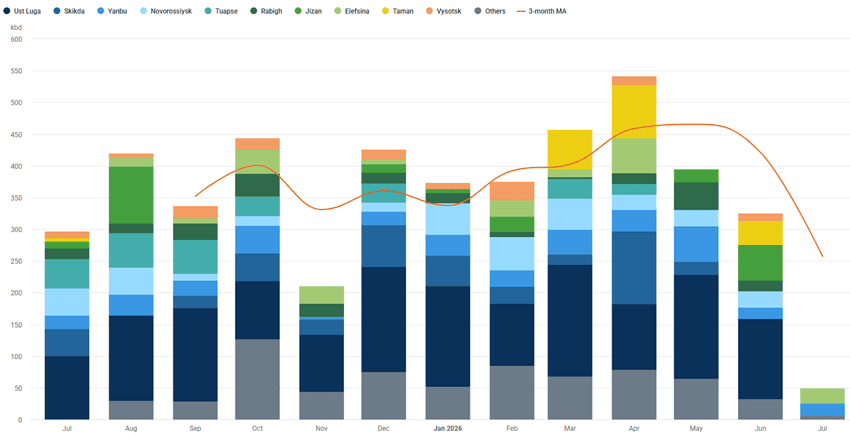
- For Naphtha, the BeM is a trade route for sending cargoes from the West to the East. In Q2 2026, such flows averaged 426 kbd, representing 17% of seaborne trade. Most volumes originated from Russia's Ust-Luga and Taman ports, as well as Algeria's Skikda refinery. These cargoes transited the Suez Canal to reach Asian markets, including India, South Korea, and Singapore.
- Almost half of Russia's naphtha exports transited the Suez Canal to Asia, averaging ~215 kbd in 2026. Over the past week, several vessels linked to China, Russia, and Pakistan (all countries viewed as friendly to Iran) have reportedly transited the waterway safely. This suggests the risk to Russian outflows through the corridor were still manageable.
- However, Russian naphtha exports have fallen sharply since late June due to a combination of increasing refinery outages, Black Sea attacks, and seasonally stronger domestic blending demand.
Monthly Naphtha exports via BeM by origin port, kbd
- For LPG, the main impact will be on Yanbu exports (~100 kbd), with cargoes likely to be rerouted through the Suez Canal. Some Saudi-linked vessels might "gone dark" by switching off their AIS transponders to transit the BeM, but this does not guarantee safety from Houthis attacks. Some LPG exports from Yanbu could be redirected to Egypt and Jordan too if the disruption persists.
- Algerian LPG exports also typically transit the Suez Canal and the BeM to reach Asia, although volumes are relatively small.
- The US also uses the Suez Canal to export LPG, mainly to Egypt and occasionally Jordan, averaging 50 kbd in April and May 2026. This route is less exposed to disruption, as it does not transit the BeM.
Overall, the rerouting of Saudi Arabia's west coast exports through the Suez Canal, and potentially into the Mediterranean, is likely to cap Western light ends cracks. Asian buyers will need to pay even higher premiums to attract additional spot barrels from the West through August and H1 September. We therefore expect a stronger E/W spread for Naphtha, although differentials are unlikely to revisit the highs seen in March.
For LPG, tighter market balances are likely to be concentrated in the Eastern butane market from mid-August, leading to a wider East-West butane spread. An expected uptick in product tankers and VLGC freight rates will also increase overall landed costs especially into Asia this quarter.

See why the most successful traders and shipping experts use Kpler