


The Turkish straits: Where Europe's war meets the Middle East
As military risk expands south through the Black Sea and north through the Eastern Mediterranean, the Bosphorus is at risk of becoming the next critical junction where two major conflicts intersect. The convergence of these conflicts could fundamentally reshape commercial risk, energy trade, and the strategic importance of Europe's most vital maritime corridor.
The Bosphorus: Where Europe's War Meets the Middle East
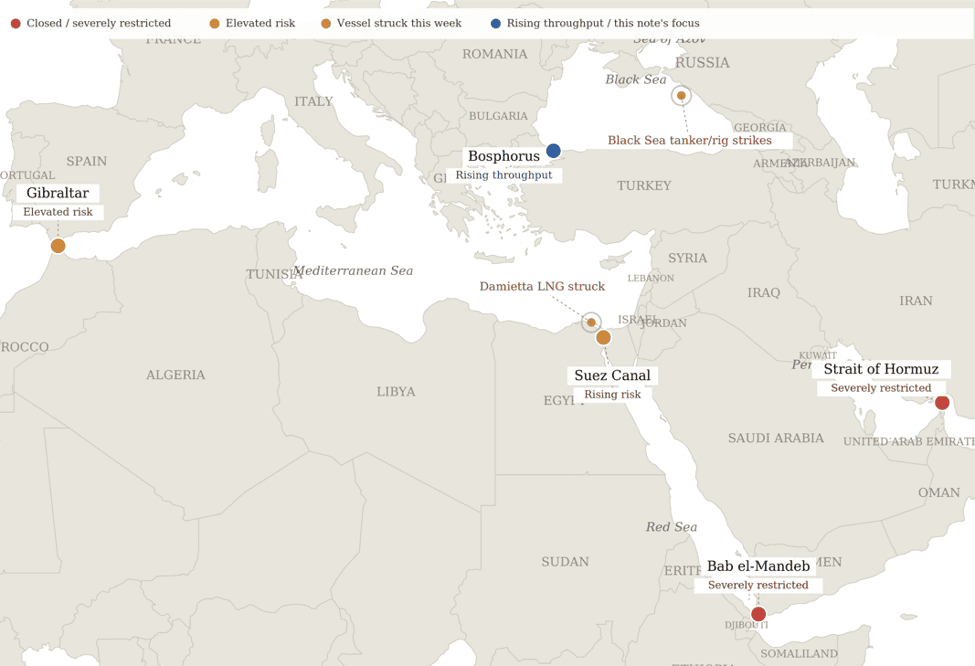
Two weeks ago, I argued that the Houthis' entry into the conflict marked the beginning of a broader geographic expansion of military risk. What had been largely a contest centered on the Strait of Hormuz was becoming a broader maritime conflict, extending into the Bab el-Mandeb and the Red Sea. Today's attack on LNG infrastructure near Egypt marks the next stage in that expansion, bringing military risk into the Eastern Mediterranean.
At nearly the same time, Ukraine announced it had struck a Russian vessel allegedly transporting military cargo linked to Iran, while Reuters reported that Tehran is expected to receive hundreds of Chinese-made air-defense systems. These developments span thousands of miles and involve different actors, yet they are occurring along the same interconnected maritime network.
The Turkish Straits now occupy the narrow space between two expanding conflicts. As military risk advances through the Black Sea from the north and the Eastern Mediterranean from the south, the Bosphorus Strait could become the next major commercial corridor where expanding military risk begins to influence market behavior.
The Bridge Between Two Strategic Theaters
The Turkish Straits occupy the narrow bridge between two expanding conflicts. The Dardanelles form the southern gateway from the Eastern Mediterranean, while the Bosphorus provides the northern entrance to the Black Sea.
For decades, the Turkish Straits have connected the Black Sea with the Mediterranean, serving as the gateway through which Russian and Kazakh crude, Ukrainian grain, and other Black Sea exports reach global markets. Today, that commercial gateway lies between the Black Sea conflict in the north and the expanding Middle East conflict in the south. The geography of the Russia-Ukraine war is moving south through the Black Sea, while the geography of the Middle East conflict is moving north from the Strait of Hormuz through the Red Sea and into the Eastern Mediterranean.
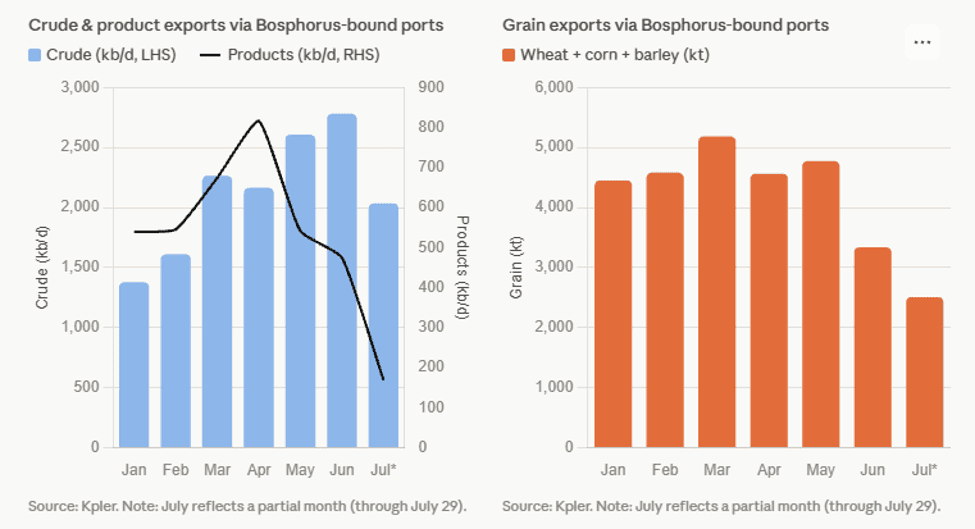
Every month, millions of barrels of crude oil, refined products, grain, LNG, and other cargoes move through the interconnected Bosphorus-Suez corridor. Together, these waterways form one of the world's most important commercial routes, linking Black Sea exports with Europe and global energy markets.
As military activity expands across both ends of that corridor, the strategic significance of the Bosphorus increasingly extends beyond the Black Sea itself.
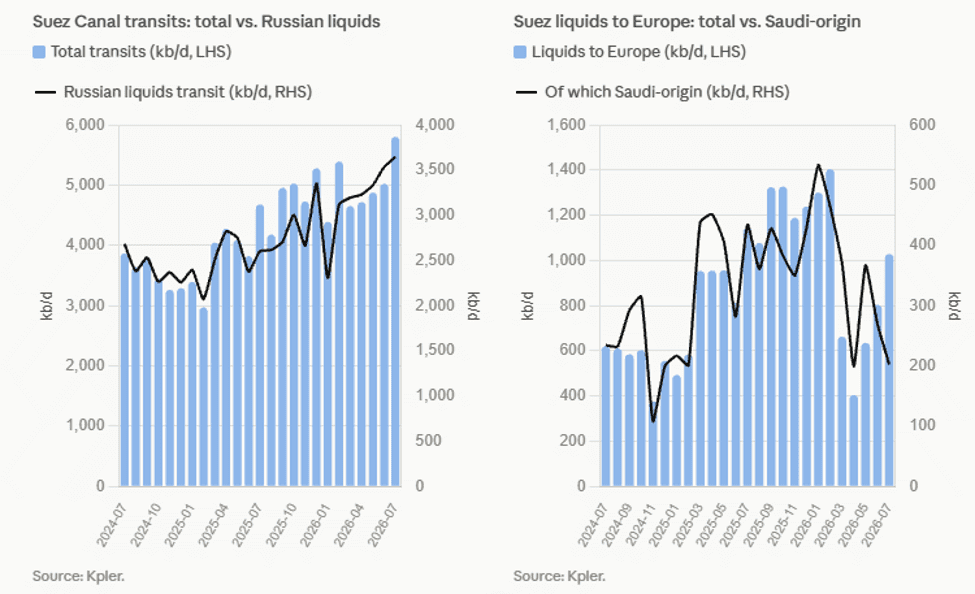
The attacks near Egypt demonstrate that maritime risk is no longer confined to the Strait of Hormuz or the Red Sea. Commercial energy infrastructure in the Eastern Mediterranean has now been drawn into the conflict. At the same time, Ukraine is increasingly targeting the maritime logistics supporting Russia's broader military relationships. Together, these developments extend military risk across a corridor that carries Russian and Black Sea exports south while moving Middle Eastern energy north toward Europe.
Unlike the Strait of Hormuz, the Turkish Straits operate under a long-established legal framework. The Montreux Convention has provided nearly a century of predictable commercial access while giving Turkey broad authority over the transit of warships during periods of conflict. That legal stability has helped make the Bosphorus one of the world's most important commercial waterways.
The strategic environment surrounding the Turkish Straits is changing. The Bosphorus has long been valued for its predictability and operational reliability. As military risk moves closer to the corridor, commercial markets will increasingly need to consider not only the efficiency of transiting the Straits, but the security environment surrounding them.
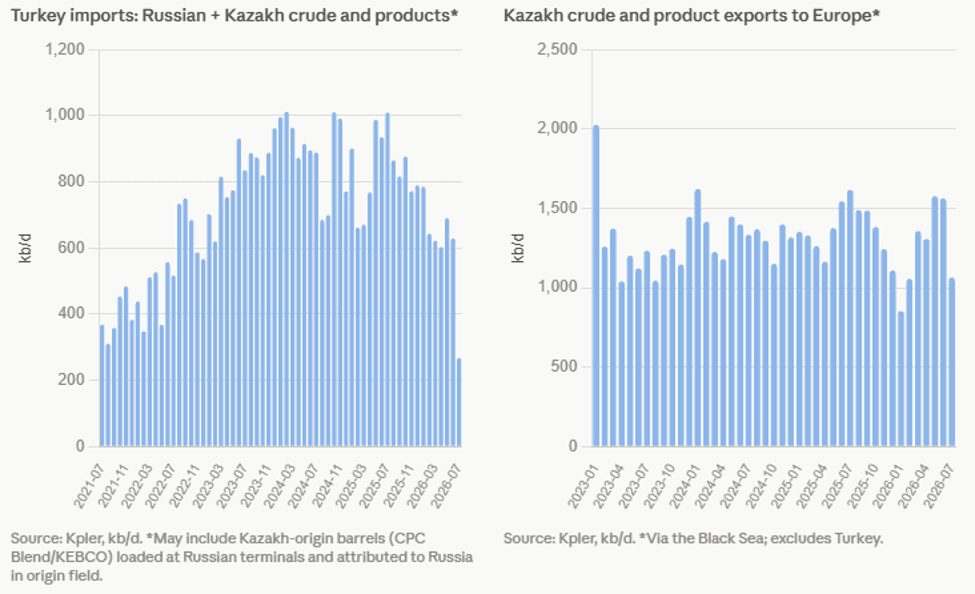
Turkey therefore occupies a unique position in the global energy system. It is simultaneously the gatekeeper to Black Sea exports, a major importer of Russian crude, and the NATO ally responsible for administering one of the world's most important maritime corridors. Few countries occupy a more consequential position within today's evolving maritime security architecture.
Conclusion
For decades, commercial operators viewed the Bosphorus differently from the Strait of Hormuz or the Bab el-Mandeb. The Turkish Straits were regarded as a stable, well-governed commercial corridor linking the Black Sea with the Mediterranean rather than an active geopolitical flashpoint. The geography of conflict is forcing a reassessment of that view.
Maritime markets rarely wait for a waterway to close before reassessing risk. Insurance costs, freight rates, routing decisions, and commercial behavior begin adjusting as the security environment changes, long before shipping is disrupted. As the geography of conflict converges on the Turkish Straits, commercial markets will increasingly need to determine whether a corridor long associated with operational reliability should also carry a geopolitical risk premium.
The Eastern Mediterranean is unlikely to represent the final stage in the geographic expansion of maritime risk. If the current trajectory continues, the Turkish Straits become the next major commercial corridor where the security consequences of Europe's war and the Middle East conflict begin to converge. Whether that convergence ultimately extends beyond the Bosphorus toward the remaining maritime gateways of the Mediterranean will depend on how these conflicts evolve.

See why the most successful traders and shipping experts use Kpler






