
South Asia LNG demand forecast: Tracking India, Bangladesh & Pakistan LNG imports in 2026
As summer heat builds across South Asia, India, Bangladesh, and Pakistan — some of Asia's largest and fastest-growing LNG markets — are navigating a complex and rapidly shifting supply and demand landscape. These economies hold massive populations, are undergoing rapid industrialisation, and urgently need to meet their growing energy demand.
From weather-driven changes in power sector consumption to evolving import dynamics and domestic production trends, the factors actively shaping these markets are interconnected and fast-moving. In environments like this, having precise, country-level balance data is what separates reactive decision-making from informed positioning. Kpler's newly released LNG & Natural Gas S&D product gives market professionals exactly that: granular natural gas balances across the world's key gas economies, delivering the clarity needed to stay ahead in volatile markets.
India LNG imports: Weather-driven demand and Hormuz recovery
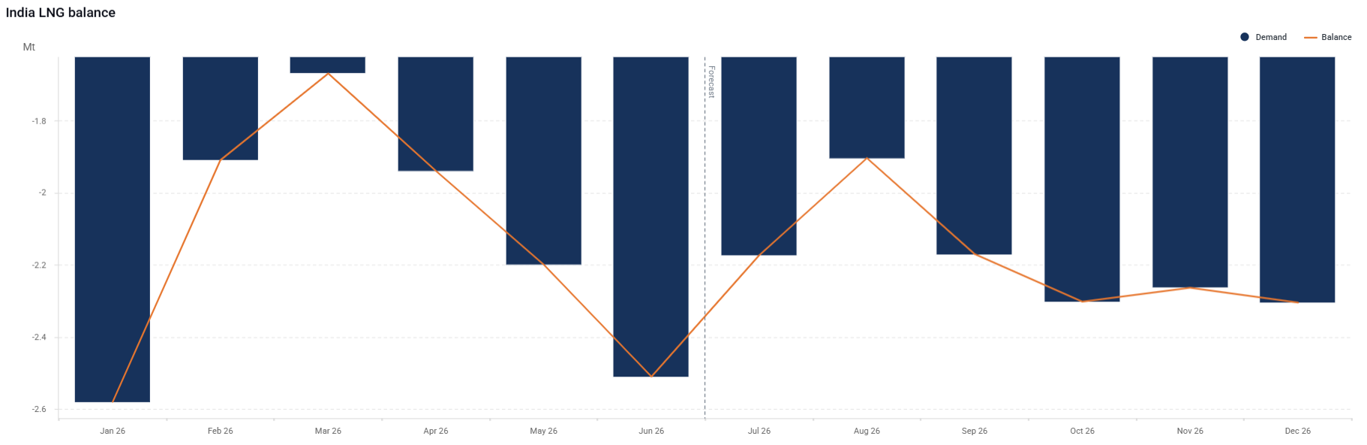
India's July weather outlook has turned decidedly hotter and drier, and Kpler's LNG & Natural Gas S&D product is well-positioned to help users understand what this means for LNG demand. The India Meteorological Department (IMD) is forecasting below-normal rainfall alongside above-normal temperatures across most of the country, conditions that drive significantly stronger gas-fired power generation as cooling demand peaks.
Kpler's S&D dataset captures exactly this dynamic. With a full India natural gas balance covering domestic production, sectoral gas consumption, and LNG import forecasts, users can track how weather-driven increases in power sector demand feed through to LNG procurement requirements — and with LNG demand forecasts updated at country level, users can quantify the incremental cargo requirements that a hotter-than-expected summer implies. Combined with Kpler's proprietary price forecasts, users can assess not just how much additional LNG India is likely to need, but what that means for Asian spot LNG prices through the peak summer procurement season.
Reflecting the weather-driven demand uplift, Kpler Insight has raised its July 2026 India LNG demand forecast, and with monthly updated balance figures and forecasts, users can see how actual demand moves, alongside the market’s expectations for the coming months, through Kpler’s S&D dataset.
With resilient spot demand and contracted LNG supply still-constrained by Middle Eastern outflows, India is expected to remain active in the spot LNG market through the summer, keeping upward pressure on Asian LNG prices through the peak procurement season. For market professionals tracking these dynamics, Kpler's LNG & Natural Gas S&D product provides the precise balance detail needed to stay ahead: from installation-level LNG supply forecasts and India's full sectoral gas consumption breakdown, to proprietary price forecasts that translate demand signals directly into price implications — all updated monthly and delivered via Excel or API.
Bangladesh LNG demand: A story that keeps surprising
Bangladesh is another market where Kpler's data has been telling an important story. Petrobangla's April Monthly Information System (MIS) data showed total gas demand easing marginally to 2.34 bcm, down 0.04 bcm year-on-year, but remaining above Kpler Insight's expectations. Despite tighter LNG supply conditions and reduced gas availability, April consumption came in ahead of forecast, suggesting underlying demand is more resilient than supply conditions might imply.
Kpler's LNG & Natural Gas S&D product gives users the sectoral breakdown needed to understand exactly where that resilience is coming from. For Bangladesh, this means tracking gas consumption split across the power sector and non-power demand — giving users the granularity to identify which parts of the economy are driving consumption trends and where demand is holding up, despite constrained supply. This sectoral visibility is available across all of Kpler's bottom-up models, making it possible to identify when demand in a specific segment is outperforming expectations before that signal shows up in prices or LNG cargo flows.
Looking ahead, the Bangladesh Meteorological Department (BMD) is forecasting above-normal maximum and minimum temperatures for July through September, with three to five isolated heatwaves expected during the period. Users can track how these translate into changes in power-sector gas demand and LNG procurement requirements, with supply and demand forecasting that Kpler makes visible in one solution.
Reflecting both the stronger April demand data and the updated weather outlook, Kpler Insight has raised its full-year 2026 Bangladesh LNG demand forecast, with July, August, and September each having increases to their monthly demand forecasts, respectively. Higher cooling demand is expected to lift power-sector gas consumption during Q3, increasing LNG procurement requirements accordingly.


Pakistan LNG: Nuclear shortfalls drive opportunistic buying
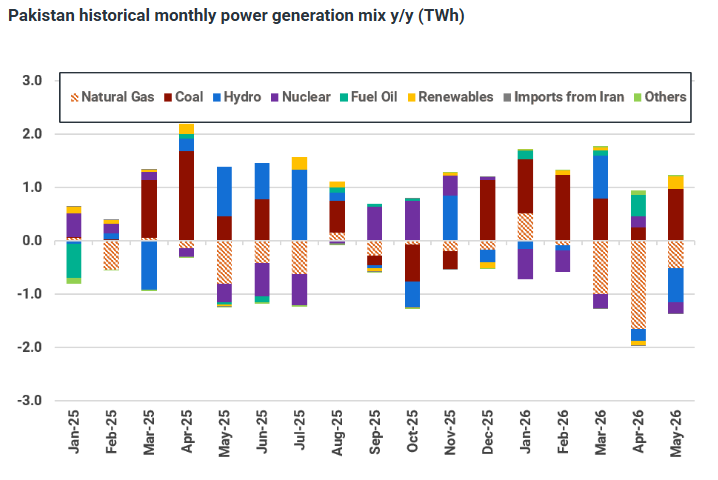
Pakistan's power generation mix is telling a nuanced story this summer, one where Kpler's LNG & Natural Gas S&D product helps users cut through the complexity. National Electric Power Regulatory Authority (NEPRA) data showed total power generation at 12.6 TWh in May 2026, down year-on-year and slightly below expectations for summer electricity demand. The key driver of the demand revision is not heat alone, but a shortfall in nuclear availability, which fell to 1.8 TWh in May, increasing the call on alternative generation to fill the gap through Q3.
Kpler's S&D product gives users the sectoral visibility to track exactly this kind of generation mix dynamic. With Pakistan's full natural gas balance, covering domestic production, sectoral gas consumption, and LNG demand, users can monitor how shifts in nuclear availability, etc. flow through to regasified LNG requirements. While weaker nuclear output is raising the call on gas-fired power, it is worth noting that stronger coal generation and seasonal hydro recovery are expected to absorb much of the additional thermal load, limiting the net increase in LNG demand. Rather than tracking these variables across multiple sources, Kpler's S&D balance data brings the full picture together in one place, with 18 months of forward-looking visibility across production, sectoral consumption, and LNG demand.
Reflecting higher summer balancing requirements, Kpler Insight has raised its 2026 Pakistan LNG demand forecast and, importantly, this revision reflects seasonal balancing needs rather than any structural recovery in Pakistan's gas demand - a distinction that matters for how market participants should interpret Pakistan's presence in the spot market. With monthly updated LNG demand forecasts at country level, Kpler's S&D dataset allows users to track these revisions as they happen and understand the drivers behind them, rather than reacting after the fact.
For market professionals assessing Pakistan's contribution to Asian spot LNG balances, Kpler's proprietary price forecasts, combined with country-level LNG demand figures across 30+ regions, provide the broader market context needed to assess how Pakistan's incremental buying, alongside India and Bangladesh, is shaping the regional supply and demand picture through the summer.
Asian LNG prices and the global LNG demand outlook by Kpler
For these gas economies, Kpler's data points in a consistent direction: Asian LNG balances are tightening, and spot prices are likely to remain supported through Q3. With Middle East supply still running below pre-conflict levels and South Asian summer demand now tracking above earlier forecasts, the combination of firmer demand and constrained supply is visible in Kpler's LNG & Natural Gas S&D data.
Whether it's tracking weather-driven demand revisions across South Asia's power sectors, monitoring how nuclear shortfalls flow through to LNG procurement requirements, or understanding how individual country balances are shaping the regional supply and demand picture, Kpler's S&D product gives market participants the precise, forward-looking balance data needed to stay ahead of these shifts — not react to them. In a market where incremental demand revisions can move prices, having monthly updated country-level balances, sectoral consumption breakdowns, and proprietary price forecasts is what sets informed participants apart.
Interested in seeing the data for yourself? Reach out to us and request a demo here.

See why the most successful traders and shipping experts use Kpler