US copper imports on course for record as stocks thin elsewhere
The United States imported a record volume of copper cathode on open-hatch vessels in July, well above the level required to balance domestic supply and demand. Meanwhile, the concentrate market remains extraordinarily tight, Chinese exchange stocks hold under a week of consumption, and a tighter sulphuric acid market threatens hydrometallurgical output in the DRC. With the prospect of a tariff on refined copper still unresolved, the stateside stockpile is unlikely to return to the wider market.
Record imports
The United States imported over 185kt of copper cathodes on open-hatch vessels in July, a record in Kpler’s trades. Open-hatch is the dominant route for cathode, but not the only one: in a typical month, containers and other modalities add a further 30 to 50kt, putting total deliveries for July at 215–235kt. That would test the record of 221kt, set in July 2025 during the first round of tariff speculation.
US copper cathode imports
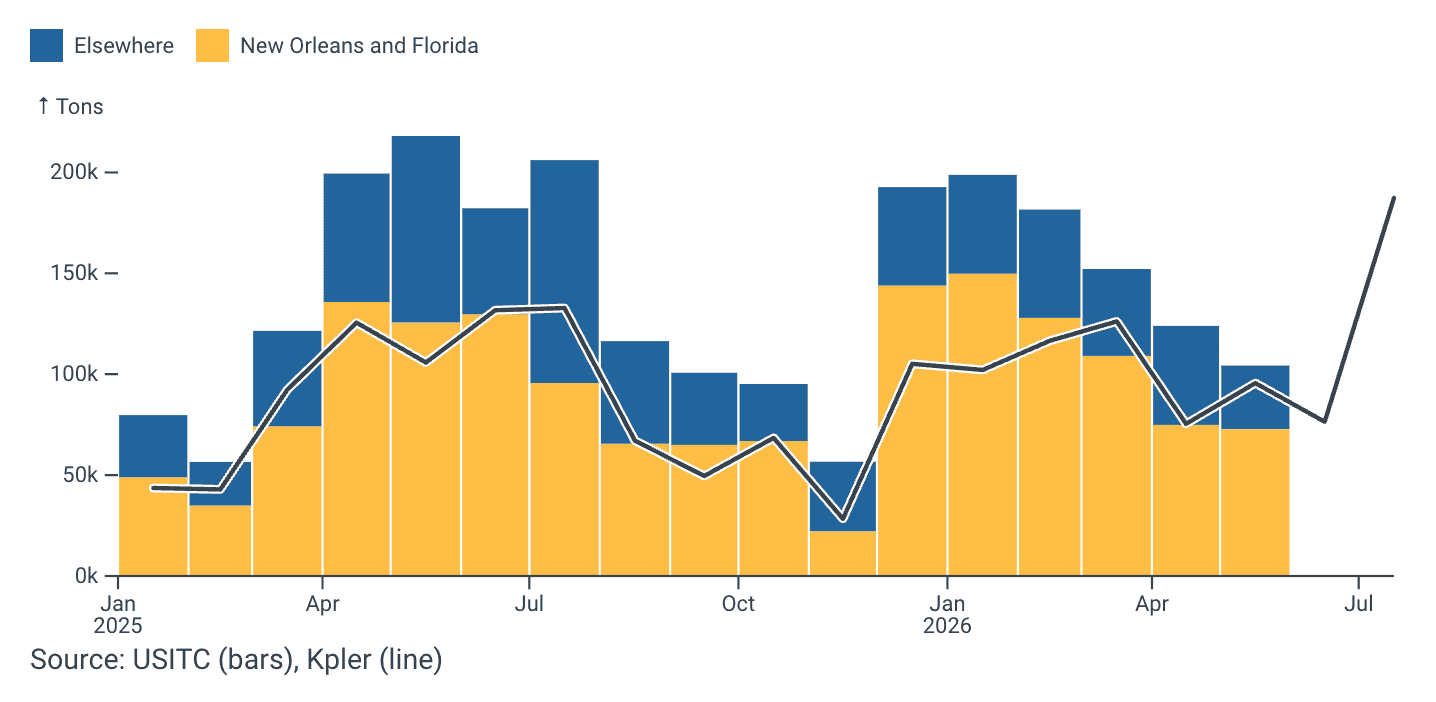
While the United States is dependent on copper imports, current flows clearly exceed the 70kt required on a monthly basis to balance domestic supply and demand. These flows reflect the continued arbitrage between CME and LME copper prices that first emerged with the possibility of a tariff on refined copper in February 2025.
Refined metal was exempted when tariffs on semi-finished and copper-intensive products took effect the following August, and the arbitrage narrowed accordingly. What remained was the option to phase in a duty on refined copper from January 2027. The deadline for a determination passed at the end of June without one, and that expectation is still priced into the forward curve, where the differential supports continued imports.
Limited cover outside the US
As copper stocks in the United States have reached unprecedented levels, those elsewhere have declined through Q2 and into Q3. SHFE stocks fell to a low of 69kt in the week ending 24 July before rebuilding to 110kt at month end, while LME ex-United States stood at 152kt at the same date. Both sit against more than 800kt of visible inventory in the United States.
Exchange registered copper inventories
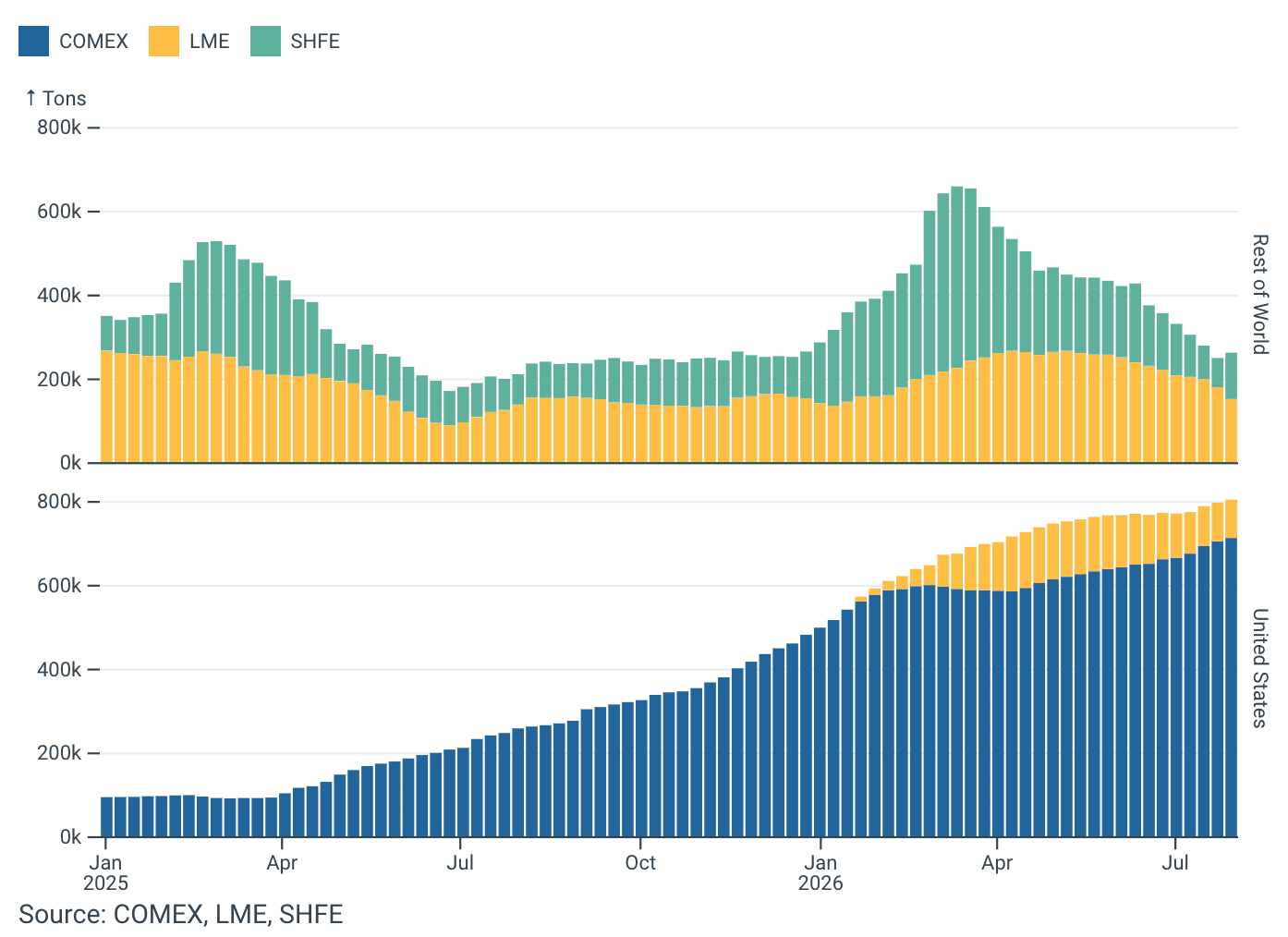
The US inventory covers close to five months of domestic consumption on USGS figures for 2025. China's SHFE, even after the rebuild, holds under a week of exchange-deliverable copper, and the recovery is only a week old. Bonded stock adds to the Chinese total, but only marginally. Availability has been further restricted by tighter VAT enforcement on scrap transactions, which has disrupted circulation and pushed end-users towards refined metal. The Yangshan import premium reached a 14-month high of $100/t in July, drawing in the imports behind the rebuild.
The Chinese demand pull competes directly with US imports. The DRC remains the largest supplier of seaborne cathode into China, but Congolese producers have redirected an increasing share to the US since the arbitrage emerged. Kpler’s trades for July recorded 57kt of cathode delivered from producers including Tenke Fungurume, Sicomines and Metalkol.
Prospects for a supply response
Meanwhile, the copper concentrate market remains extraordinarily tight and negative TC/RCs prevail. The 2026 benchmark settled at $0 per ton against $21.25 for 2025, and the system itself now appears at risk, with Antofagasta seeking spot-indexed term sales and deeply negative tenders being offered for 2027. Seaborne concentrate volumes were down in the first half, with China, Japan, South Korea, Spain and Germany all receiving less than a year earlier.
Mine supply is recovering in places, but declining elsewhere. Increased volumes from Grasberg are flowing to PT Smelting and the first deliveries have been made to Manyar. Glencore reported copper production up 15% in H1, and at Cobre Panamá processing of stockpiled ore has begun, targeting 30-40kt of contained copper this year, though a full restart remains subject to negotiation. Against that, Codelco, the world's largest copper producer, has withdrawn its target of returning to 1.7Mt and guided 2026 to no more than 1.357Mt, signalling a shift of priority from volume to cost.
Copper production has also been exposed to the sulphur shortage following the closure of the Strait of Hormuz, through which 50% of seaborne sulphur is exported. With copper averaging above $13k in the year to date producers have been able to absorb the cost, but the physical shortage has still played out. Chile's imports of total sulphuric acid equivalent, including acid and elemental sulphur, are 5.5% below the equivalent period of 2025 year to date, while those countries in sub-Saharan Africa through which the DRC's sulphur is routed received 26% less, returning to 2024 levels. Congolese production is largely hydrometallurgical and so constrained by acid rather than smelting capacity, which makes the volumes now moving to the US among the more exposed in the market.
Sulphur and sulphuric acid imports into Chile and sub-Saharan Africa
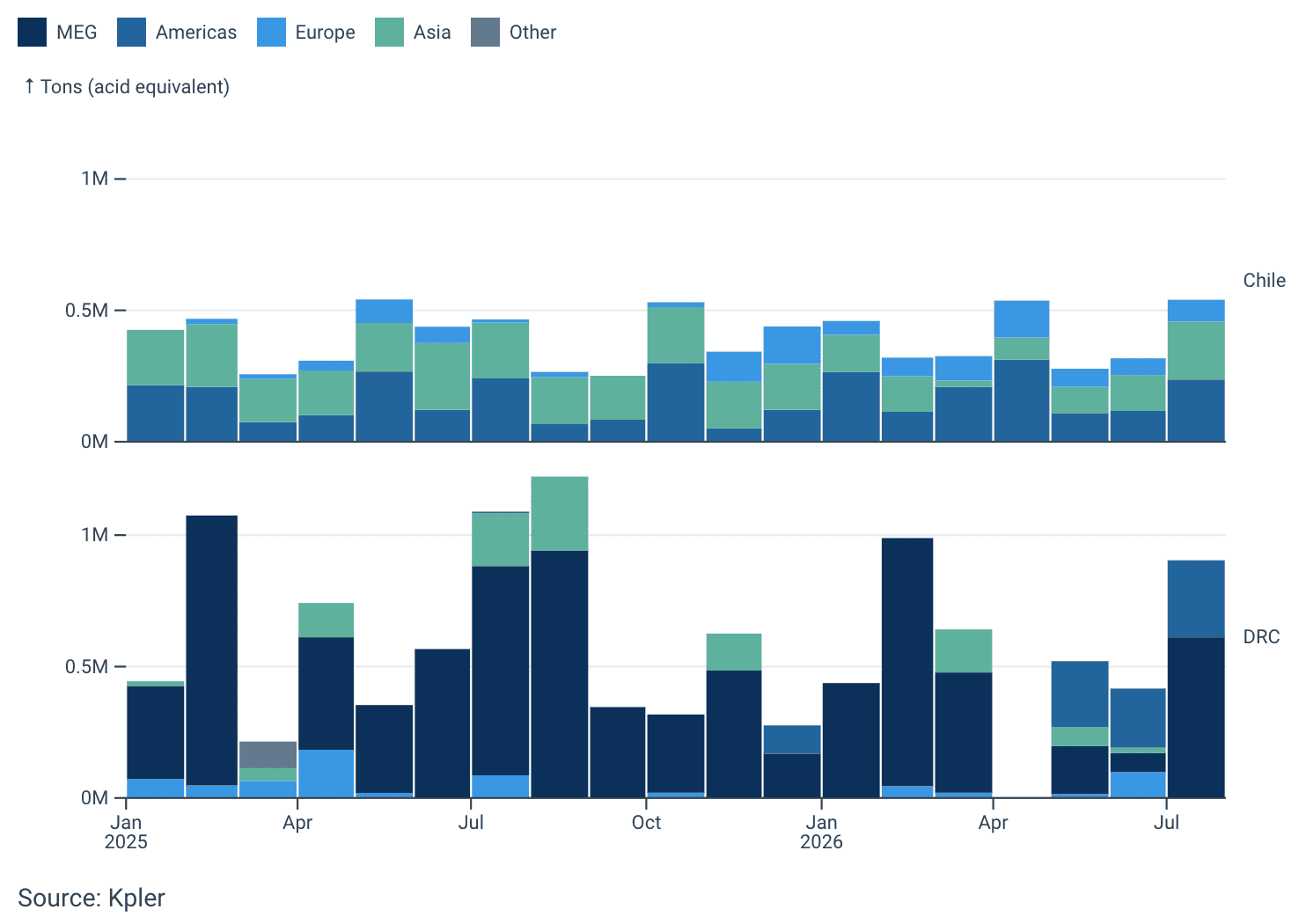
Given traffic through the Strait has not yet normalised, we may see further tightness in the sulphur market in the months to come. The more significant variable however is the tariff determination. A phased duty would widen the arbitrage and draw further volumes in. A rejection would be the first plausible route by which US inventory returns to the global market, though that looks unlikely, and would in any case require the rest of the world to bid above the CME price rather than merely close the gap to it.
Market insights you can trust
Kpler delivers unbiased, expert-driven intelligence that helps you stay ahead of supply, demand, and market shifts.
Trade smarter. Request access to Kpler today.

See why the most successful traders and shipping experts use Kpler