AIS suggests a breach of the US blockade. Satellite evidence says otherwise.
Between 19 and 22 November, reports of an Iranian tanker convoy shifted from preparations to an apparent breakout on tracking maps. Kpler's satellite-backed analysis shows no verified breakout. About 44 million barrels (mb) of Iranian crude and condensate remain aboard 37 tankers in the Middle East Gulf and the Gulf of Oman, and imagery from 10 to 18 November showed no laden crude tanker heading for the blockade line. The vessel at the centre of those claims has no verifiable identity, and its track implies a speed no laden VLCC can sustain. For traders, insurers and compliance teams, distinguishing an AIS signal from a verified voyage is essential to assessing the blockade, escalation risk and Iranian supply.
Market and trading calls
• Iranian crude is still stranded, not sailing. About 44 mb sits on 37 tankers in the Gulf and the Gulf of Oman, most of it at anchor off Kharg Island and Qeshm. Kpler has recorded no Iranian crude or condensate export loadings since 24 August, against 2.23 mbd of exports in February, and no tanker has been imaged at Kharg's crude jetties since 29 August
• The tanker said to have broken the blockade is an AIS signal, not a verified ship. KHAT SHEKAN broadcasts an Iranian MMSI with no IMO number and a call sign that belongs to a Liberian chemical tanker in the Mediterranean, and its track jumps 351 nm in 17.5 hours, an implied 20 knots.
• Ship-to-ship transfers are taking place, and Washington has expanded its blockade guidance to cover receiving vessels. Five STS transfers moved about 1.9 mb of Iranian crude and fuel oil between 12 and 18 November. A US Navy addendum to an 18 November maritime advisory says such vessels may be considered to be evading the blockade under specified conditions..
A convoy narrative gains traction before the evidence catches up
Last week a commentary carried by a news agency close to the IRGC, called for a convoy of Iranian tankers to sail for China and break the US blockade, warning that energy infrastructure in neighboring states would be hit if the convoy were obstructed. IRGC spokesman Hossein Mohebi said on 20 November that Iran would hit back harder if its vessels were attacked, and according to public reporting more than a dozen tankers were crewed and ready to sail from Kharg Island. As posts about tankers gathering near Kharg spread publicly, the appearance on 22 November of a tanker called KHAT SHEKAN, Persian for "line breaker", looked to some observers like proof that the blockade had been challenged.
The vessel's identity fails basic checks. Its AIS broadcasts the Iranian MMSI 422215750 and a draught of 22.5 m, consistent with a fully laden VLCC, but no IMO number, so the signal cannot be tied to a registered hull. Its call sign, A8XZ9, belongs to STOLT BOBCAT (IMO 9511167), a Liberia-flagged chemical tanker whose own AIS placed it off northeast Spain on 24 November.
Its track does not hold up either. Kpler received the first ping at 21:59 UTC on 21 November in the Strait of Hormuz, south of Qeshm Island, at 12.5 knots, with the destination set to "OIL TERMINAL". The pings stopped at 05:24 UTC on 22 November and resumed 17.5 hours later in the Arabian Sea, 351 nm away, with Zhoushan in China as the new destination. That implies an average speed of 20 knots, against signalled speeds of 6 to 12 knots and well above the service speed of a laden VLCC. The last ping arrived at 00:32 UTC on 23 November, just outside the blockade line announced by US Central Command.
AIS messages are self-reported broadcasts, and fabricated messages can put a convincing-looking vessel on a tracking map. That does not identify the sender or prove a voyage.
TANIA STAR (IMO 9134165) shows why a real ship's track also needs checking. The 1996-built LPG carrier, which Kpler records carrying Iranian butane, sat at anchor off Shinas in Oman until early afternoon on 22 November. Its AIS then showed it running 75 nm south-east at exactly 15 knots on a straight course, turning between 19:00 and 20:00 UTC and running back along almost the same line at the same speed, while its destination changed from Kandla to Kochi in India. By 01:00 UTC on 23 November it was stationary off Sohar again. A track that regular is suspicious AIS behaviour, not proof that US forces turned the vessel back.
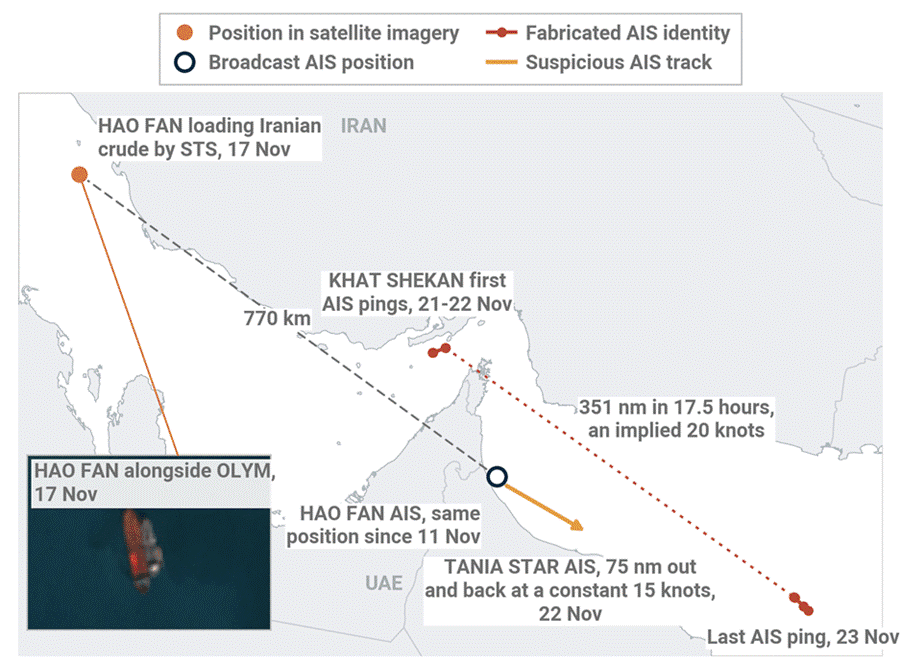
Figure 1. Broadcast AIS positions against physical evidence for HAO FAN, KHAT SHEKAN and TANIA STAR, 11 to 24 November 2026, with satellite imagery of HAO FAN alongside OLYM on 17 November. The transfer site is approximate. Kpler AIS and Kpler Oil team satellite analysis; contains modified Copernicus Sentinel data 2026
Satellite imagery shows a stalled export fleet, not a departing convoy
Kpler Insights team found about 44 mb aboard 37 tankers inside the Middle East Gulf and the Gulf of Oman in its 20 November assessment, made up of 16 VLCCs, 12 Suezmaxes, 6 Aframaxes and 3 MRs. The largest group, 11 tankers holding 15 mb, sits at anchor around Kharg Island. Nine more, with 10 mb, wait off Bandar Abbas, Qeshm and Larak, eight with another 10 mb lie between Sirik and Jask, and two holding 1.5 mb have been at Chabahar since at least mid-October. Twenty of the 37 have sent no AIS messages for a week or more, but 31 were imaged laden on their latest satellite pass, with 38.5 mb aboard.
Kharg Island itself is idle. Its two crude jetties had four tankers alongside on 20 February, eight days before the war began, but none has been imaged there since 29 August. Kpler satellite readings put the island's tanks at 22.2 mb on 17 November, 72% of their 31 mb capacity, and within a 19.5-22.6 mb range since August. With no loadings and stable crude inventory levels, Kpler expects Iran's crude and condensate output to have fallen to about 2.1 mbd, roughly half the pre-war level.
Kpler flows show how the blockade, in place since 13 April apart from a pause from 18 June to 13 July according to public reporting, has emptied the export line. Excluding cargoes delivered within Iran, crude and condensate exports reached 2.23 mbd in February, fell to 0.26 mbd in May and recovered to 0.89 mbd in July. There has been no export loading since 24 August.
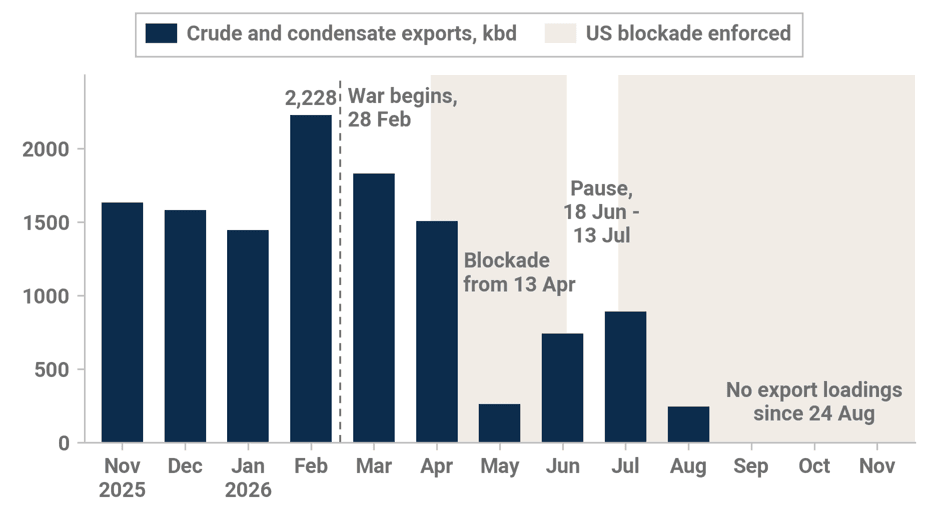
Figure 2. Iranian crude and condensate exports per month by departure date, excluding intra-country flows, November 2025 to 24 November 2026, kbd. Blockade periods from public reporting. Kpler flows data
This matters for the oil market. Talk of a breakout does not release stranded barrels or show that Washington's blockade has failed.
Real STS transfers are taking place where AIS shows little activity
What has changed is a run of STS transfers inside the Gulf. Kpler recorded five between 12 and 18 November, moving 1.9 mb of Iranian crude and fuel oil in all. Three of them, off Bandar Abbas, gathered fuel oil onto HASNA, a 2003-built VLCC of the National Iranian Tanker Company, and onto EDOR.
DateFromToCargoVolumeLocation12 NovARTAVILFAXONCrude0.25 mbOff Bushehr13 NovFORESTHASNAFuel oil0.20 mbOff Bandar Abbas17 NovOLYMHAO FANCrude0.33 mbAbout 45 km south of Kharg Island18 NovARGO IEDORFuel oil0.48 mbOff Bandar Abbas18 NovARK IIIHASNAFuel oil0.60 mbOff Bandar Abbas
Table 1. STS transfers of Iranian oil inside the Gulf, 12 to 18 November 2026. Kpler Oil team
One transfer stands out. HAO FAN, a 2003-built MR on EU and UK sanctions lists but not designated by the US, was imaged empty off Shinas on 8 November. On 17 November imagery placed it alongside OLYM, a Suezmax that loaded at Kharg in late August, about 45 km south of the island, taking 326,856 barrels of crude. Yet its AIS has broadcast exactly the same coordinates off Sohar, 770 km (415 nm) away, since 11 November, with a 7 m draught that signals an empty ship. Kpler had logged 1,178 identical pings by 23 November, including 63 on the day of the transfer, and the signal was still there on 24 November. Sentinel-2 passes on 13, 15, 18 and 23 November showed no vessel at that position.
EDOR, a 2003-built Panamax under US sanctions, came in empty from Shinas in the same way. Its AIS went silent on 14 November as it headed north, and on 18 November it was imaged off Bandar Abbas taking 0.48 mb of fuel oil from ARGO I.
These are not isolated cases. Of the 282 tankers and gas carriers that carried Iranian cargo from the Gulf on trades active since 20 August, 76 were caught spoofing their positions by satellite imagery or Kpler compliance screening. Their AIS most often claimed Iraqi ports and anchorages (31 vessels), anchorages off the UAE and Oman (23) or waters as far away as West Africa (16). Between 13 and 18 November, 10 tankers imaged inside the Gulf were broadcasting positions outside it, including TRONE, a VLCC with 2 mb of Iranian crude whose AIS had placed it off Khor Fakkan for a month.
Washington tightens blockade enforcement guidance for STS cargoes
A Joint Maritime Information Center advisory on 18 November, carrying a US Navy addendum, said a ship that takes Iranian-loaded cargo by STS may be treated as running the blockade even if it never entered Iranian waters, and may be stopped, boarded, diverted or captured. The US established Task Force Iron Gate on 7 November to target prohibited material and illicit revenue flows across Iran’s land borders and the Caspian Sea.
That puts HAO FAN and EDOR at the centre of the next test. As Kpler noted on 20 November, a 23-year-old MR carrying a sixth of a VLCC cargo is a cheap way to probe the blockade. If US forces stop it, Iran loses little. If one is struck, the IRGC gains the pretext it has threatened to use against regional energy infrastructure, at a time when Kpler counted 16 attacks on shipping in Hormuz in November up to 20 November, after 24 attacks on commercial tankers in October.
The practical test is physical evidence, not viral momentum
For governments, an unverified crossing cannot establish whether deterrence has succeeded or failed. For traders and insurers, verified cargo movements, vessel identities and satellite-confirmed positions determine supply and exposure, and the Iranian barrels that count are still in the Gulf. For compliance teams, the three cases illustrate distinct warning signs, an identity that cannot be verified, an implausibly regular track, and AIS positions contradicted by satellite imagery. The first ships to watch are HAO FAN and EDOR, the smallest and most expendable of the laden tankers. A documented departure across the blockade line, followed by verified delivery, would change that judgement. An AIS dot alone will not.

See why the most successful traders and shipping experts use Kpler