
Policy toolbox: Bringing down freight rates
With soaring freight rates pushing delivered crude prices higher and squeezing refinery margins, transportation costs have become a major obstacle to bringing oil prices down. This note explores three unconventional policy levers—relaxing marine-fuel rules, easing tanker sanctions, and repurposing seized Iranian tankers—that could provide relief, although each risks creating new problems elsewhere in the oil market.
Policy Toolbox: Bringing Down Freight Rates
The oil market is incredibly complex. Between crude, refined products, refinery runs and freight rates, it seems that every time we solve one problem, we create another one or two.
Diesel is certainly near the top of today's problems, with the market in deficit and prices approaching $200/bbl. But if it isn't diesel, it will be jet fuel or gasoline.
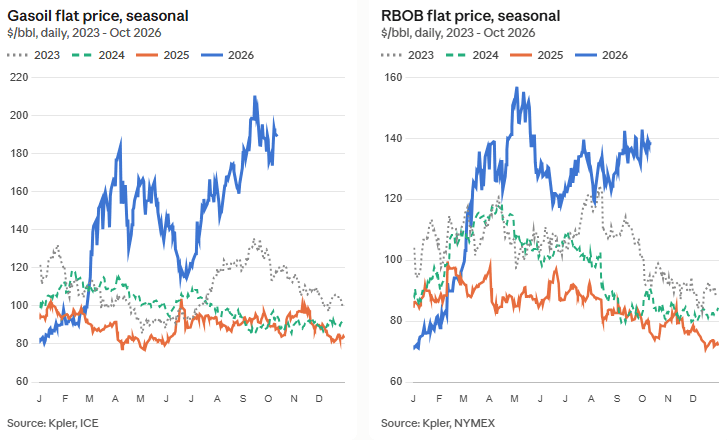
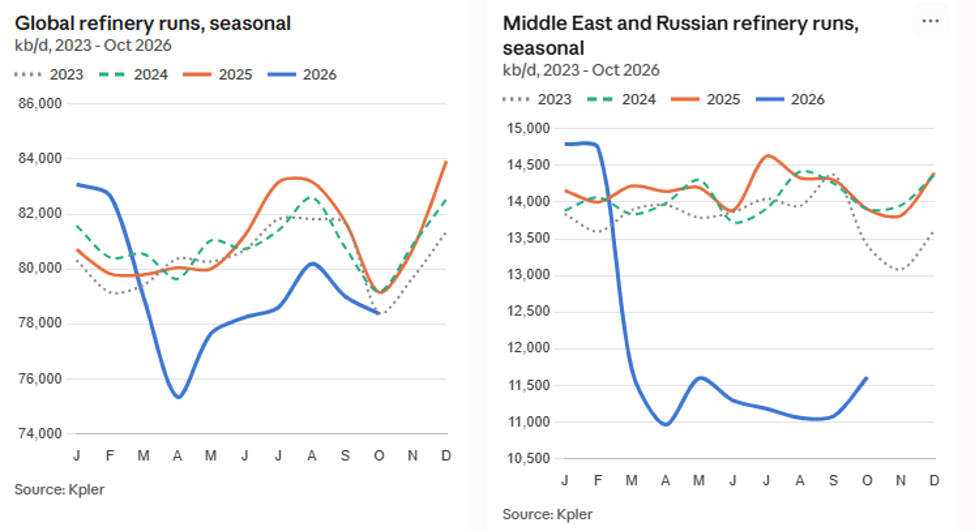
The underlying issue is that global refining capacity has fallen by around 5 million b/d since January, leaving the market short of the products it needs.
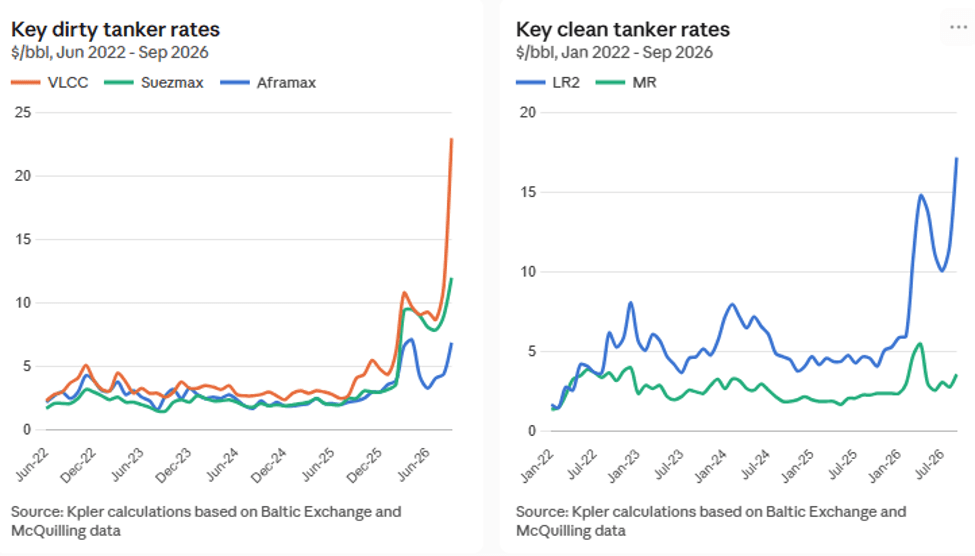
At the same time, freight rates are pushing delivered crude prices higher and compressing refinery margins.
Additional diesel supply from European strategic reserves, and potentially Russia if its refiners can get back up and running, could bring product prices lower. But if freight costs remain elevated, refiners will be paying more for crude while receiving less for their products, further squeezing margins and potentially forcing additional run cuts.
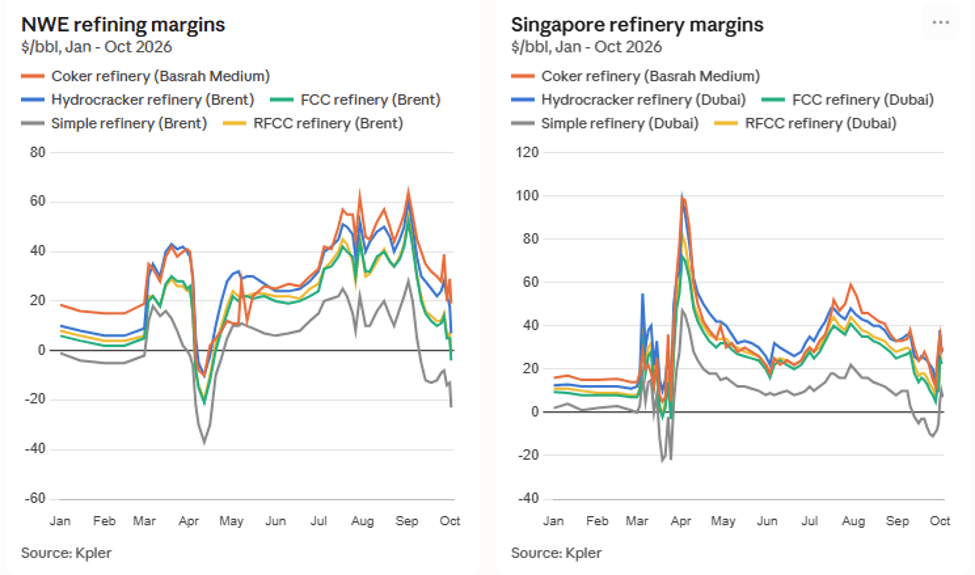
The extraordinary strength in product cracks has helped refiners absorb some of these higher crude acquisition costs, particularly in diesel, where gasoil cracks remain around $80–90/bbl. But that cushion could shrink quickly if additional diesel supply brings cracks lower while freight rates remain elevated.
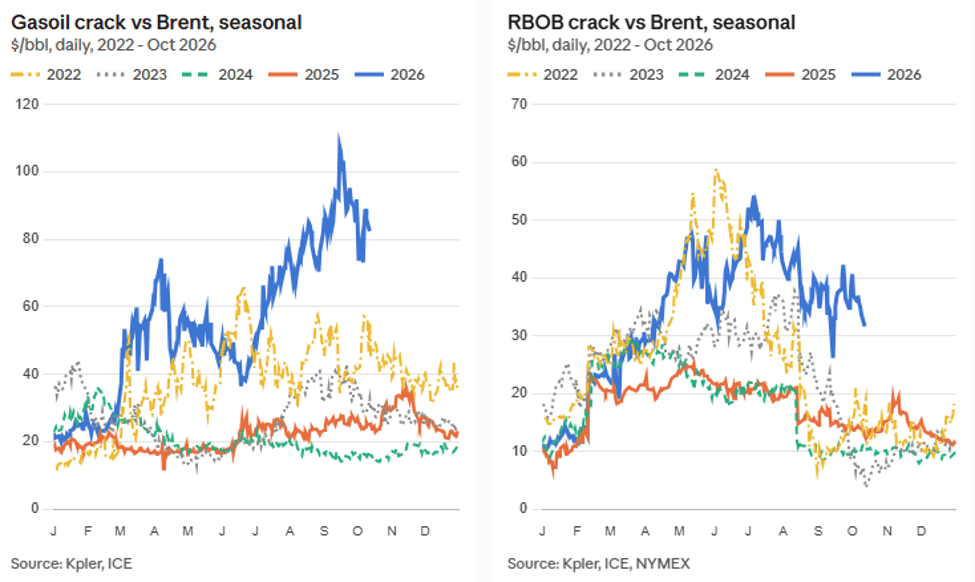
In other words, partially solving the diesel shortage could actually make the refining problem worse.
Making freight the linchpin to bringing oil prices lower. For now, anyway. Reducing transportation costs would give refiners some breathing room, allowing product prices to decline without putting as much pressure on margins. It won't replace lost refining capacity, but it could help prevent further run cuts.
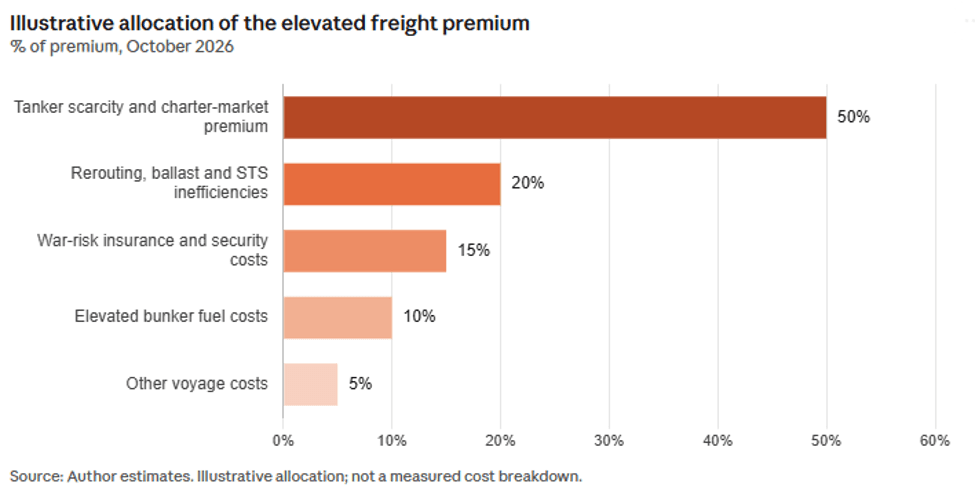
Freight rates are exceptionally high for several reasons: a shortage of available tankers, soaring war-risk insurance premiums, elevated bunker fuel costs, inefficient trade flows as ships avoid high-risk areas, and the additional expense of ship-to-ship (STS) transfers being used to move crude out of the Middle East.
While it's difficult to isolate exactly how much each factor contributes to freight rates, my estimate is that tanker scarcity accounts for roughly half of the current premium, with inefficient shipping routes and STS transfers contributing another 20%. Insurance, bunker fuel and other voyage costs account for the remainder. These are illustrative estimates, but they highlight where the greatest potential relief may lie.
There are several levers the administration could pull to bring freight costs down. Let's focus on three. None is straightforward, and as with almost everything in the oil market right now, each risks creating another problem somewhere else.
#1. Relax Marine-Fuel Rules to Free Up Diesel and Reduce Bunker Costs (10% of freight)
I mentioned this option in my earlier note, Before the Ban. While temporarily relaxing the IMO's marine sulfur rules would be complicated, it could lower bunker costs and free up diesel for the on-road transportation sector.
Under IMO 2020, ships must burn fuel with a sulfur content below 0.50%, unless equipped with scrubbers. Relaxing this requirement outside coastal Emission Control Areas would allow compatible vessels to switch back to high-sulfur fuel oil (HSFO), reducing demand for marine gasoil and the distillate components used to blend very-low-sulfur fuel oil (VLSFO). As estimated in my earlier note, this could free up 600 kbd to 1 million b/d of distillate and distillate-range material.
The economics are increasingly compelling. The European gasoil–fuel oil spread has widened from around $30/bbl at the beginning of the year to roughly $90–100/bbl in early October, making the incentive to switch back to HSFO particularly strong. Lower bunker costs could eventually translate into some freight relief, although they would do little to address the shortage of tankers or elevated insurance premiums.
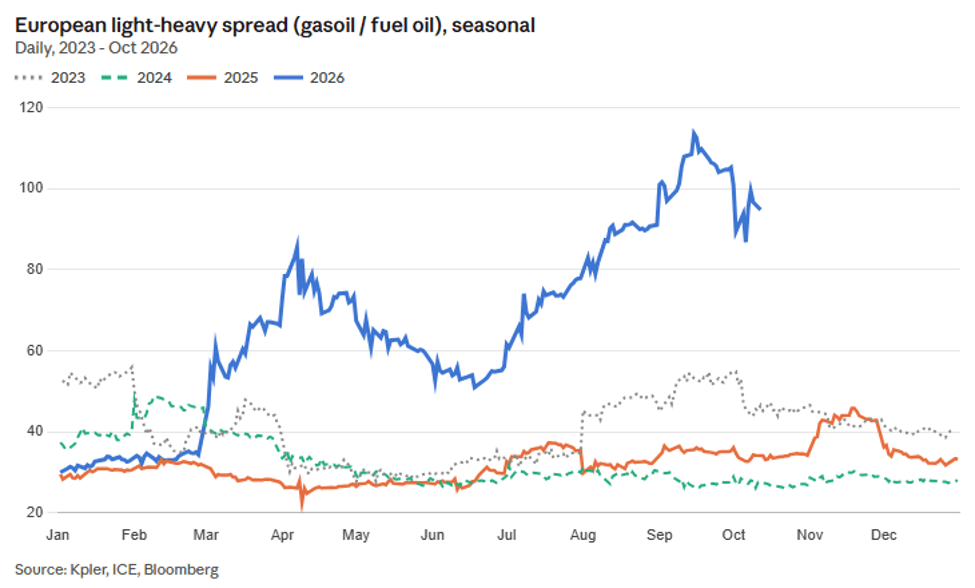
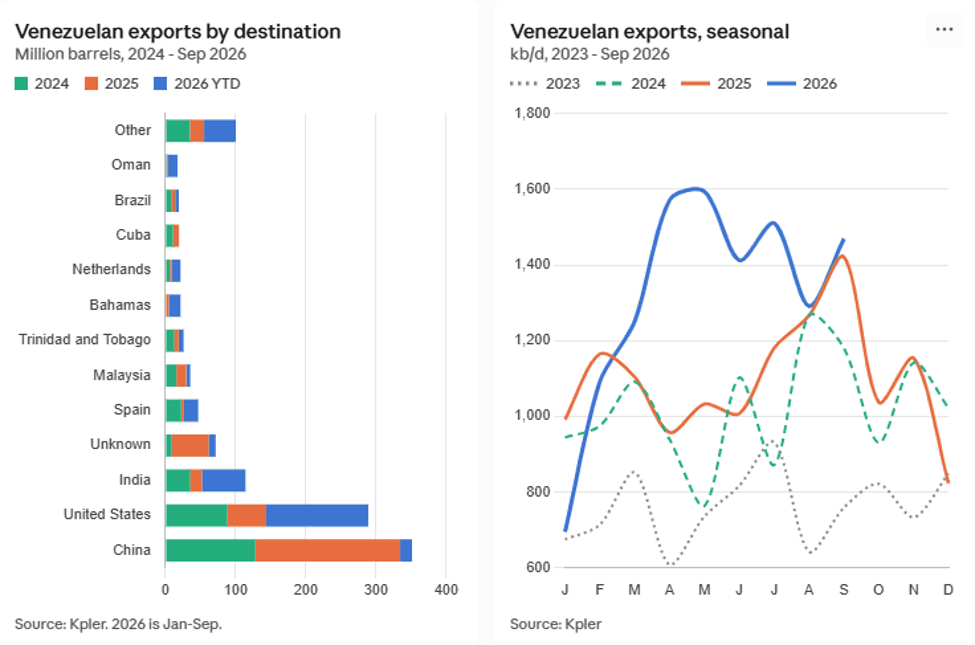
The risk, of course, is that additional HSFO demand pushes fuel oil prices higher, offsetting some of the benefit. Increased Venezuelan crude availability could help by providing more heavy feedstock for fuel oil production, although the impact would depend on refinery operations. And there is an environmental trade-off, as burning more HSFO would increase sulfur emissions.
This wouldn't be a quick fix, but it could help ease diesel shortages and shipping costs simultaneously, even if some of the pressure simply shifts to another part of the barrel.
#2. Remove sanctions so tankers can return to commercial service
Another option would be to temporarily ease sanctions on Iranian and Russian tankers, bringing additional vessels back into the mainstream freight market.
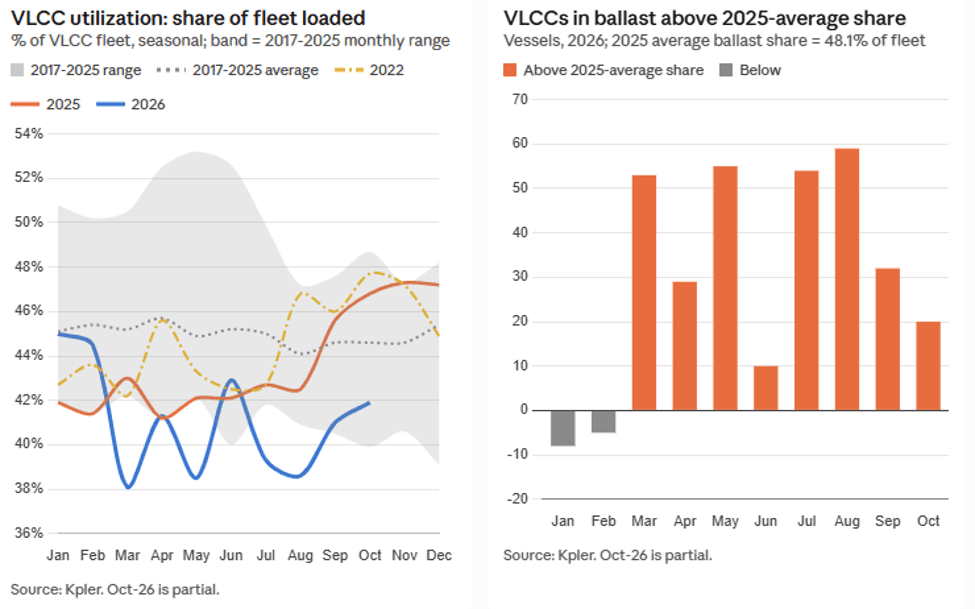
Of the global fleet of 923 VLCCs, approximately 120 Iranian vessels are effectively unavailable to conventional charterers. Excluding these vessels leaves around 803 VLCCs, of which 766 are currently employed, equivalent to roughly 95% of the remaining fleet. And that doesn't account for other sanctioned or operationally unavailable vessels, suggesting the market could be even tighter.
But the shortage isn't simply about the number of ships. Kpler data shows that the share of VLCCs carrying cargo is well below historical levels, at around 42% compared with a historical average of roughly 45%. At the same time, the number of vessels sailing in ballast is unusually high, with around 20 more VLCCs in ballast than would be expected based on the 2025 average. Longer voyages, disrupted trade routes and ship-to-ship transfers are reducing the efficiency of the fleet, requiring more vessels to move the same volume of crude.
The administration could consider temporarily easing restrictions on Iran's National Iranian Tanker Company (NITC), Russia's Sovcomflot and qualifying individually sanctioned vessels. Not all would become available immediately, and some are already transporting crude. But even a partial return to conventional trading could help ease the shortage of available tonnage and put downward pressure on freight rates.
The trade-off is geopolitical, but with freight costs now accounting for such a significant portion of delivered crude prices, expanding the pool of available tankers could provide some much-needed relief.
#3. Seize and redeploy otherwise unavailable vessels for specific shuttle operations
The third option is certainly the most unconventional, and likely the most controversial. But with freight rates at extraordinary levels, perhaps it is worth asking the question.
What if the U.S. seized some of the empty, sanctioned Iranian tankers and redeployed them on the short-haul shuttle runs currently being used to move crude out of the Middle East?
The idea would be to use these vessels for the higher-risk portion of the journey, freeing up conventional tankers for longer-haul voyages. With ship-to-ship transfers tying up vessels for days at a time, even a relatively small number of additional ships could improve fleet availability.
There is also an interesting geopolitical twist. If Iran were to target one of these vessels, it would potentially be attacking a tanker that was previously part of its own fleet. Would that change the calculation? Perhaps, although once seized and operating under U.S. control, there is no guarantee Iran would view the vessel any differently.
Of course, there are enormous legal, diplomatic and operational hurdles. The U.S. would need a lawful basis to seize the ships, and operating them would raise questions about ownership, crewing, insurance and security. There is also the possibility that using seized Iranian vessels could escalate tensions rather than reduce them.
This is hardly a conventional solution, and it may not be a realistic one. But it raises an interesting question: could vessels currently sitting outside the commercial market be repurposed to free up tanker capacity where it is needed most?
The Circle
There is also another problem potentially brewing. Exceptionally high dirty tanker rates are encouraging clean tankers to switch into crude and fuel oil service. That helps ease the shortage of dirty tonnage today, but what happens if diesel and other product exports recover? The market could find itself short of clean tankers just as more refined products become available to ship.
And that brings us back to where we started. Every solution seems to create another problem somewhere else. Lower freight rates won't replace lost refining capacity, but they could help keep the refineries that are operating from cutting runs further.

See why the most successful traders and shipping experts use Kpler