


Aramco goes full circle: why rising Saudi exports are bearish diffs but not bearish risk
Three weeks after the attack on the East-West Petroline, Saudi oil exports have surged to their highest level since the COVID-19 pandemic. This is bearish for crude differentials and should trigger a sell-off, but Iran's potential reaction makes bearish positioning risky nonetheless.
Market & Trading Calls
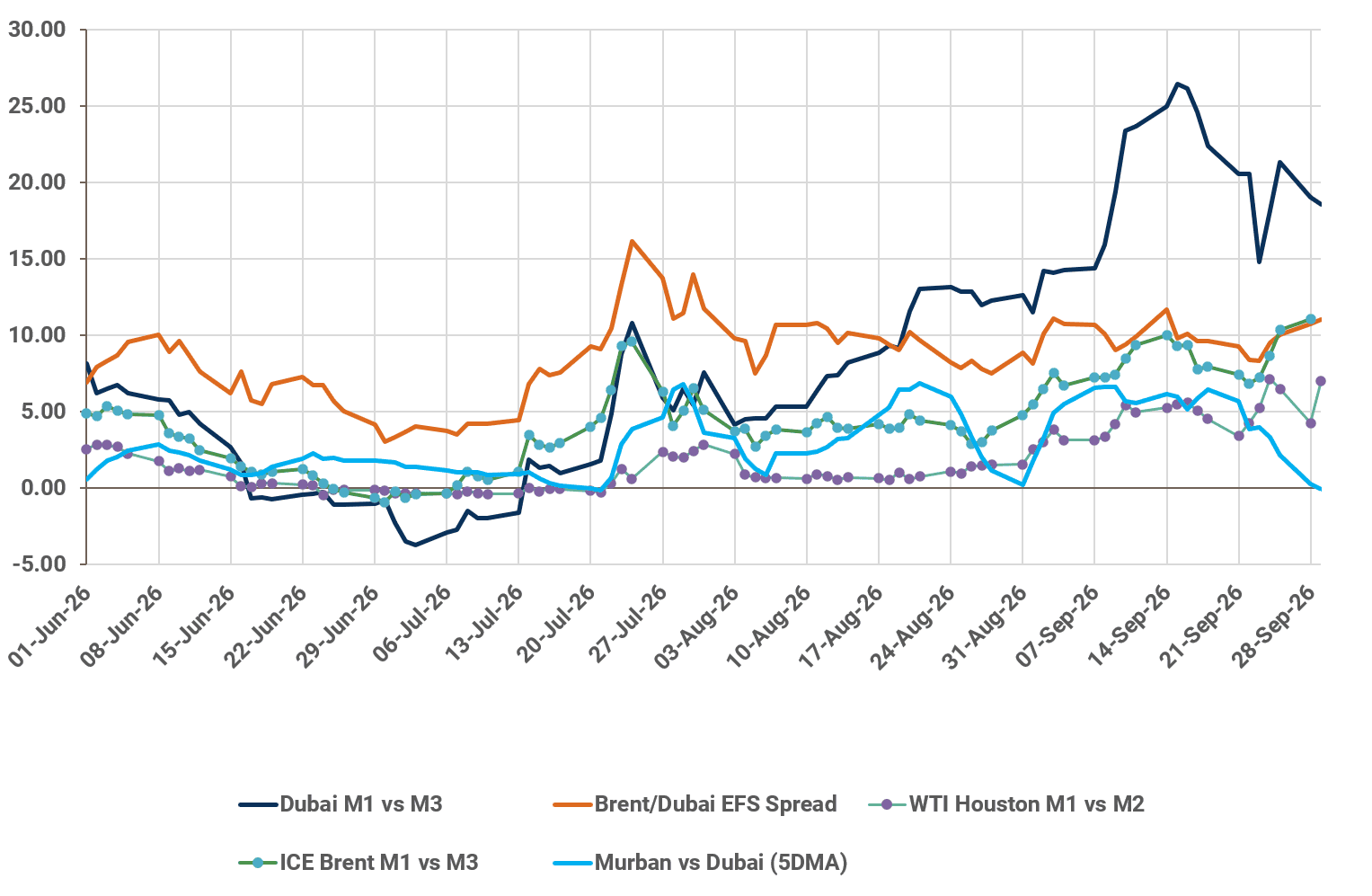
- Bearish Dubai/Oman and Murban time spreads. With Saudi loadings at a six-year high, the physical market is looser than the paper structure suggests. Front-month backwardation should compress over the next few weeks.
- Bearish Dubai-linked differentials as higher Middle Eastern exports keep VLCC freight rates high, requiring diffs to soften to remain competitive.
- Bullish Brent-Dubai EFS considering geopolitical risk will remain high as Iran's incentive to disrupt regional oil infrastructure increases. Hormuz-related shocks this year have consistently widened the EFS rather than narrowed it. A confirmed hit on Abqaiq or an UAE-directed strike would spark a violent move.
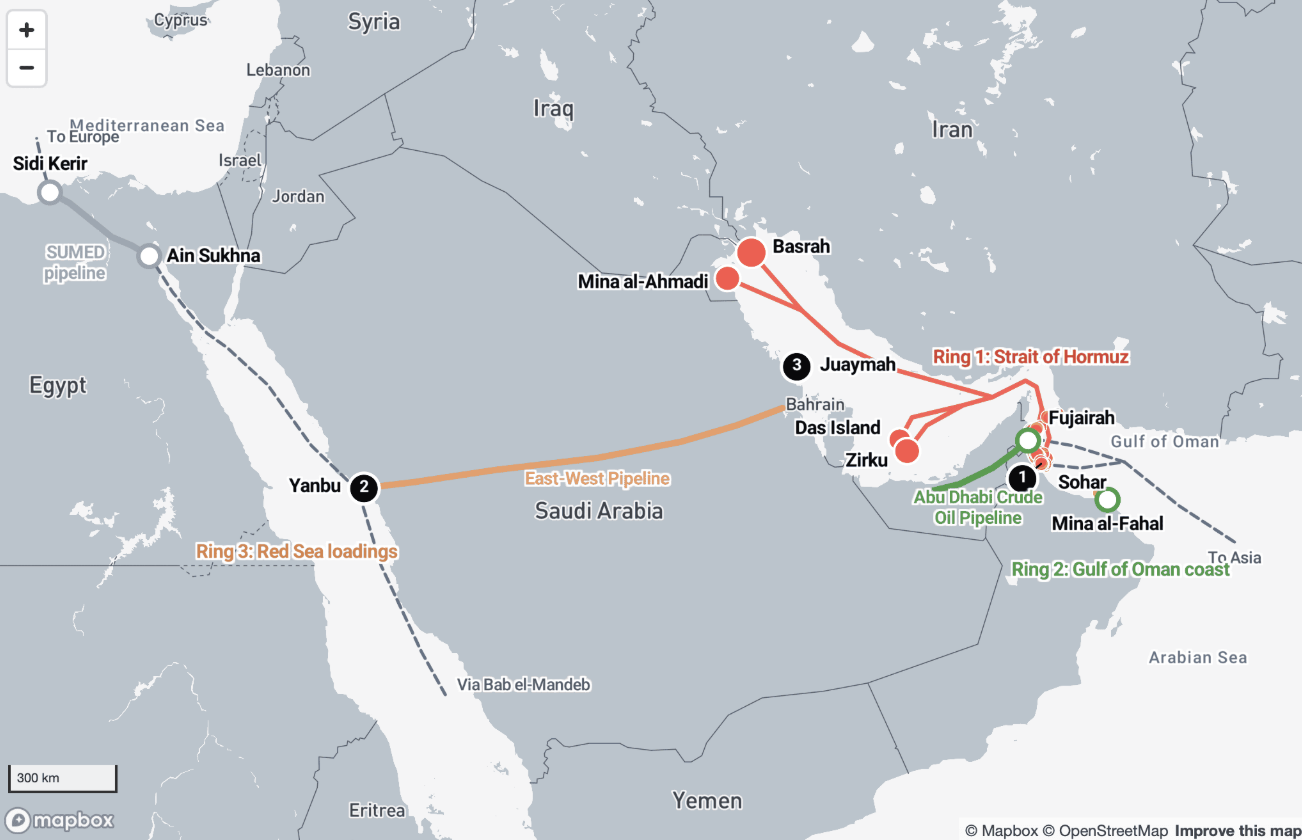
Crude leaving the Persian Gulf region is back at pre-war levels outside Iran, at least 16.5 mb/d between 1 and 28 September. The routes have changed: only 60% crossed Hormuz, mostly via shuttle tankers transferring off Fujairah and Sohar, while 23% loaded on the Gulf of Oman coast and 17% via the Red Sea.
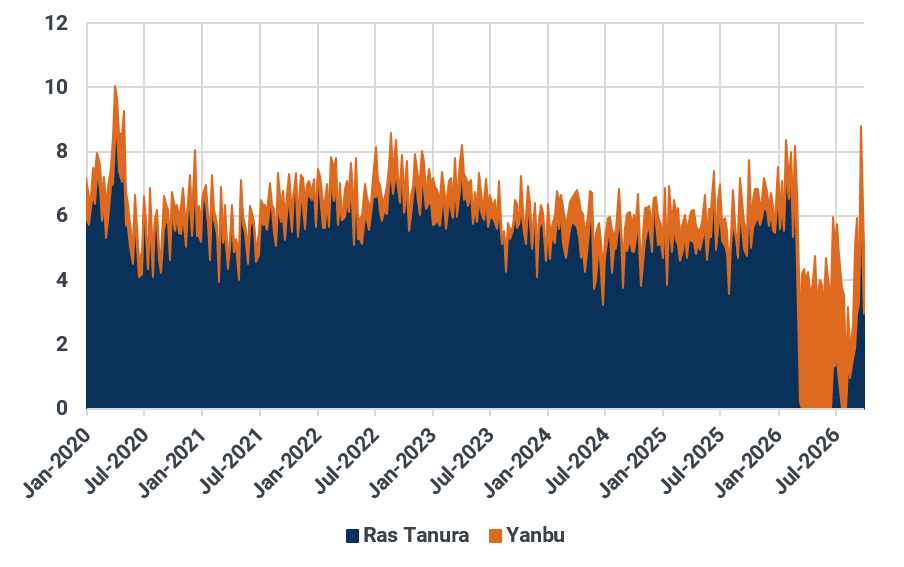
The trend has paradoxically accelerated since the 10 September strike. Saudi crude loadings averaged about 8.8 mb/d in the week to 27 September, the highest weekly level since April 2020, at the peak of the last price war. After the attack halted Yanbu, Aramco pushed volumes east: all six Juaymah moorings were occupied by 20 September, and our confirmed Saudi crude crossing Hormuz rose from 0.7 mb/d in August to 2.9 mb/d in September (6.7 mbd in the w/co 21st Sep), likely higher given unknown-origin STS volumes that may have loaded at Ras Tanura. Yanbu then recovered, with all seven berths full by the 27th and loadings averaging roughly 3.3 mb/d over 26-30 September.
Weekly Saudi oil loadings by origin port (mbd)
Source: Kpler
Upstream is being pushed just as hard. We hear Saudi production reached 11.5 mb/d yesterday and may test 12 mb/d in the coming days, a level last seen in April 2020. Aramco has placed a combined 90 mbbls through two rounds of private offers between 10 and 23 September, then inviting Chinese refiners on 28 September to bid for late-October cargoes on an STS basis near Sohar. Neutral Zone grades are returning too: Aramco has reportedly sold 10 mbbls of Khafji, its first offer of that grade on an STS basis, though we have seen no loadings yet.
Key market structures ($/bbl)
Source: Kpler
Ships are not a major constraint for Aramco
Fleet ownership is the deeper advantage in this market. Iraq's SOMO has widened FOB discounts for Basrah Medium and Basrah Heavy to more than $30/bl below the destination benchmark, a direct consequence of lacking tonnage. Saudi Arabia does not have that problem: most cargoes sail direct on a national fleet of 50 VLCCs. On our estimates, Bahri’s own vessels alone would support sustained loadings of roughly 7.4-8.3 mb/d from both Ras Tanura and Yanbu, against 6.3 mb/d of exports in 2025, before counting chartered tonnage.
Producers with ships can defend volume; those without must pay for it in differentials. The Gulf price war has effectively begun and will most likely broaden once the conflict ends and every producer tries to maximise output at once, with differentials the first casualty. Beyond Aramco, Adnoc has also been boosting its shipments, particularly from Fujairah: crude exports reached a new record of 2.53 mbd in September, way above the ADCOP pipeline maximum capacity of 1.8 mbd. This suggests extensive of Fujairah oil inventories, including from underground caverns which hold a 42 mbbls capacity. Murban’s higher availability has contributed a narrowing of its spread against Dubai.
Iran’s threat is increasingly explicit
Reports today suggest Houthis struck Abqaiq, the world's largest crude stabilisation plant, which processes Ghawar crude and feeds Ras Tanura and Juaymah. Details and confirmation are still awaited; satellite imagery is so far contradictory.
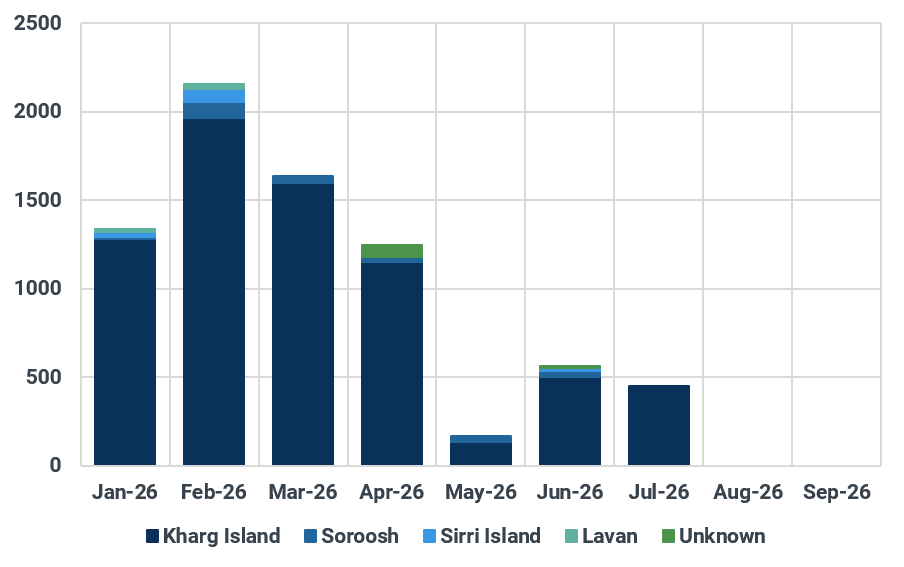
The intent is clearer by the day. Iranian parliament speaker Qalibaf said on 29 September that in a region where Iran does not sell oil, nobody will sell oil, and that if Iran's security is not ensured, no infrastructure will be safe. With Iranian crossings at zero under the US blockade against 1.7 mb/d of pre-war exports, Tehran has diminishing reason to spare those who can still sell. The UAE is also squarely in frame: Supreme National Security Council head Mohsen Rezaei warned Abu Dhabi yesterday that hosting Netanyahu would not bring it security.
Iranian oil transit through the Strait of Hormuz by origin port, mbd
Source: Kpler

See why the most successful traders and shipping experts use Kpler

.jpg)






